Back to the on-screen lesson ·
Convert compatible units and use the results in geometric and fraction-data problems.
Paper packet. Every task here also exists on screen, where it is checked automatically; answers written on paper are not assessed by Nydus. When you are back at a device, enter your answers there.
Explain within-system measurement conversions, build equivalent-value tables and combine mixed measurements. Use common units when calculating rectangle area, perimeter and summaries of fractional measurement data.
You can multiply equal groups, divide to recover a group count and combine like fractional units. Measurement conversion uses those relationships to describe the same quantity with another unit. Before calculating, identify what is measured: length, mass, capacity or time. Then use an equivalence between units of that same kind. A meter can be renamed in centimeters, but a length cannot be renamed as a mass merely by multiplying its number.
| Term | What it means |
|---|---|
| Unit | A standard-sized quantity used to measure. |
| Conversion | Expressing the same measured quantity using a different unit. |
| Conversion factor | The number of smaller units making one larger unit in the stated relationship. |
| Mixed measurement | A quantity written using more than one compatible unit, such as hours and minutes. |
| Capacity | The amount a container can hold under the stated conditions. |
| Equivalent measurements | Different number-and-unit combinations describing the same quantity. |
One meter equals one hundred centimeters. A three-meter strip therefore contains three groups of one hundred centimeters, or three hundred centimeters. The strip has not grown. The unit became smaller, so more units were needed to describe the same length. In the reverse direction, grouping three hundred centimeters into hundreds gives three meters.
Use the specific equivalence for the units involved. One hour contains sixty minutes, one foot contains twelve inches and one pound contains sixteen ounces. Not every conversion uses ten or one hundred. State the relationship, decide whether you are counting smaller units or grouping them into larger units, and check that the numerical direction matches the unit-size change.
Another way: steps
Name the measured quantity, write a valid unit equivalence, multiply or group using that factor, retain unit labels, and verify that the physical amount has not changed.
For length, one kilometer equals one thousand meters, one meter equals one hundred centimeters, and one foot equals twelve inches. For mass in the metric system, one kilogram equals one thousand grams. For customary weight measures, one pound equals sixteen ounces. For capacity, one liter equals one thousand milliliters. For time, one hour equals sixty minutes and one minute equals sixty seconds.
These relationships connect compatible units within a system or within time measurement. They are not statements that a kilogram equals a liter or that an ounce of weight is the same as a fluid ounce of volume. The same familiar word can occur in different measurement settings, so read the full unit name. The tasks here state the intended quantity and use exact within-system relationships; they do not require approximate conversions between metric and customary systems.
Make a table with feet in one column and inches in the other. The pairs 1 and 12, 2 and 24, 3 and 36, 4 and 48 describe equal lengths in different units. Each additional foot adds twelve inches. Multiplying the foot count by twelve produces the corresponding inch count.
The table can be read in either direction. Forty-eight inches corresponds to four feet because forty-eight contains four groups of twelve. Do not add twelve to the foot count; that would produce thirteen inches for one foot, which fails the basic equivalence. A useful table labels both columns and places equivalent quantities on the same row. Without column units, the pattern may be numerically visible but its measurement meaning is missing.
To rename four kilograms in grams, use one thousand grams per kilogram. Four equal groups contain 4 × 1,000 = 4,000 grams. To rename five feet in inches, use twelve inches per foot, giving 5 × 12 = 60 inches. The multiplication structure is the same even though the factors differ.
Check the direction: grams are smaller than kilograms, and inches are smaller than feet, so the count increases for a positive fixed quantity. A result such as four kilograms equals four grams would ignore the unit relationship. A result of four thousand kilograms would retain the wrong output unit even if the arithmetic were correct. Both the number and its unit are part of the answer, so carry unit labels through the reasoning.
To express 4,000 grams in kilograms, group the grams into sets of one thousand. There are four such groups, so the quantity is four kilograms. To express eighty-four inches in feet, group the inches into twelves: 84 divided by 12 = 7 feet. The larger unit needs a smaller numerical count for the same positive quantity.
Some counts do not make a whole number of larger units. Ninety inches contains seven full feet and six inches left over. A mixed measurement, seven feet six inches, keeps the leftover unit explicit. When the task requests only exact whole larger units, the supplied counts divide evenly. When it permits a mixed result, verify that the leftover is smaller than one complete larger unit; otherwise another group can be formed.
Two hours and fifteen minutes contains two groups of sixty minutes plus fifteen more. The total is 120 + 15 = 135 minutes. Do not multiply the fifteen minutes by sixty: that part is already expressed in the target unit. Likewise, three meters forty centimeters becomes 300 + 40 = 340 centimeters.
A mixed measurement is an addition of compatible quantities, not a decimal automatically formed by putting the smaller-unit count after a point. Two hours fifteen minutes is not 2.15 hours, because an hour has sixty minutes rather than one hundred. For meters and centimeters, 3.40 meters does match three meters forty centimeters because the relationship is one hundred, but that is a specific base-ten equivalence, not a rule for every pair of units.
One fourth of a meter is twenty-five centimeters because one hundred centimeters split into four equal groups gives twenty-five per group. Three fourths of a meter is seventy-five centimeters. One half of a liter is five hundred milliliters because one thousand milliliters split into two equal shares gives five hundred.
These conversions connect unit size with fraction meaning. The fraction's denominator tells how the larger unit is partitioned, and its numerator counts those parts. A quarter hour is fifteen minutes, not twenty-five, because the reference hour contains sixty minutes. Identify the full unit before applying the fraction. Equal fractions of different units may have different numerical counts in their corresponding smaller units.
A board is one meter thirty centimeters long, and another is eighty centimeters long. Rename the first as 130 centimeters, then add eighty to obtain 210 centimeters, or two meters ten centimeters. Adding one, thirty and eighty as though they all counted the same unit would lose the meter's one-hundred-centimeter contribution.
The same preparation is needed for comparison and subtraction. A 150-centimeter board is longer than a one-meter-twenty-centimeter board because the second is 120 centimeters. Their difference is thirty centimeters. The original numbers alone may be misleading when units differ. Convert compatible quantities to one common unit, perform the requested operation, then report the result in a useful unit with any regrouping explained.
A rectangular model is two meters long and fifty centimeters wide. Convert the length to two hundred centimeters before calculating in centimeter units. Its perimeter is 2 × (200 + 50) = 500 centimeters. Its area is 200 × 50 = 10,000 square centimeters. These results measure boundary length and surface coverage respectively.
Do not label the area as ten thousand centimeters without the word square. Also do not convert square units using only the length factor. A one-meter square has one hundred centimeters along each edge, so it contains 100 × 100 = 10,000 square centimeters. The two-dimensional conversion follows from converting both dimensions. This example uses the rectangle model to explain the result rather than extending a one-dimensional shortcut to a different kind of measure.
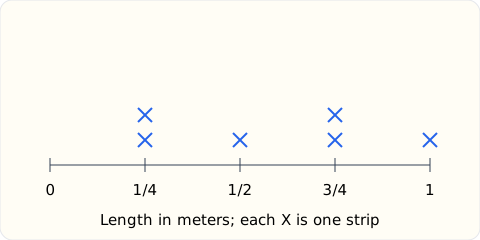
The six strip lengths are one fourth, one fourth, one half, three fourths, three fourths and one meter. Rename them in centimeters as 25, 25, 50, 75, 75 and 100. The total is 350 centimeters, agreeing with three and one half meters. The largest-minus-smallest difference is 100 - 25 = 75 centimeters, agreeing with three fourths of a meter.
The conversion changes the axis labels' unit but not the number of observations or their order. Two X marks at one fourth still mean two strips, each twenty-five centimeters long. The frequency does not become twenty-five. Keep the count of observations separate from each observation's measured value. This lets you compare fraction-based and whole-centimeter calculations as two exact descriptions of the same data.
An angle of sixty degrees remains sixty degrees if both drawn rays are extended or if the entire diagram is enlarged without changing its shape. A longer arm does not require more degrees, because degrees measure turn rather than distance along the arm. Converting a ray's length from meters to centimeters does not convert its angle.
If an angle is divided into adjacent parts, its degree measures can be added because they use the same angular unit and cover a known whole turn. For example, twenty-five degrees plus sixty-five degrees makes a right angle of ninety degrees. That relationship differs from converting feet to inches. In both situations units matter, but one combines parts of a turn while the other renames a fixed length. State which operation your model represents.
A learner reports that three feet equals thirty-six inches. Dividing thirty-six by twelve recovers three feet, verifying the exact relationship. Another reports that two hours fifteen minutes equals 215 minutes. Grouping 215 minutes into sixties gives three hours thirty-five minutes, which does not reconstruct the original duration. The reverse check reveals the error.
A quick size check also helps. Two hours fifteen minutes must lie between two and three hours, or between 120 and 180 minutes. A result of 215 is outside that interval. The boundary check rejects the answer without locating every arithmetic step; the inverse check identifies the mismatch more precisely. Use both appropriately, and remember that a result inside the interval may still require an exact verification.
A rectangular model measures two meters along one side and fifty centimeters along the adjacent side. To order border material in centimeters, rename two meters as two hundred centimeters. The complete perimeter is five hundred centimeters. If a roll contains six hundred centimeters and no extra overlap is required, one hundred centimeters remains after bordering the model. The calculation assumes all four sides need border. If one side is left open, the material requirement changes even though the rectangle's geometric perimeter does not. Identify the requested feature and its conditions before calculating. Conversion makes the side units compatible; it does not decide which sides should be included in a practical construction.
The line plot's six strips have combined length fourteen fourths of a meter, or three and one half meters. Converting each observation to centimeters and adding gives 350 centimeters, the same total. The agreement supplies an exact check across representations. The longest strip exceeds the shortest by seventy-five centimeters, but that range is not the total material available. If a project requires a single continuous 350-centimeter strip, six separate pieces do not automatically meet that condition. The data support a total-length claim and a count of pieces; they do not erase the pieces' separation. A careful summary names the unit, retains the six-observation count and states the relevant construction limitation.
A smaller unit requires more units for the same positive amount. Use the actual factor, not always one hundred. Convert only compatible measurement kinds and do not treat mixed hours and minutes as decimal hundredths. Area conversion requires considering both dimensions.
Identify the measurement kind.
Length: 5 feet
Both requested units measure length.
Write the exact relationship.
1 foot = 12 inches
Each foot contains twelve smaller units.
Count all smaller units.
5 × 12 = 60
There are five equal groups.
Attach the target unit.
60 inches
The physical length has not changed.
Check the inverse conversion.
60 divided by 12 = 5 feet
The original quantity is recovered.
Separate the two contributions.
2 hours and 15 minutes
The parts use different but compatible units.
Rename the hours.
2 × 60 = 120 minutes
Sixty minutes make each hour.
Keep the existing minute part.
15 minutes
This part already uses the target unit.
Combine the matching units.
120 + 15 = 135 minutes
The sum describes the complete duration.
Check bounds and reconstruction.
120 < 135 < 180; 135 = 2 × 60 + 15
The duration is between two and three hours.
Read the two adjacent sides.
2 meters and 50 centimeters
The units must be made compatible.
Rename the longer side.
2 meters = 200 centimeters
One meter contains one hundred centimeters.
Calculate the boundary length.
2 × (200 + 50) = 500 centimeters
The rectangle has two of each side.
Calculate the surface measure.
200 × 50 = 10,000 square centimeters
The product counts unit squares.
Check the unit distinction.
Perimeter in centimeters; area in square centimeters
Length and surface coverage are different quantities.
Verify the model's dimensions.
200 cm by 50 cm is the original 2 m by 50 cm rectangle
Conversion preserves the geometry rather than enlarging it.
Read one observation's fraction unit.
3/4 meter
The whole is one meter.
State the whole in smaller units.
1 meter = 100 centimeters
This supplies the conversion relationship.
Find one fourth of the whole.
100 divided by 4 = 25 centimeters
Four equal shares make the meter.
Count three such shares.
Check the equivalent measurement.
Using 1 minute = 60 seconds, convert 5 minutes to seconds.
Answer:
Convert 5 meters and 35 centimeters into centimeters.
Rename the whole meters.
5 meters = 500 centimeters.
Each meter contains one hundred centimeters.
Add the remaining centimeters.
The complete length is c centimeters.
The second part already uses the target unit.
Check the fixed physical quantity.
Regroup hundreds of centimeters back into meters.
The original mixed measurement must be recovered.
A 4-meter strip is renamed in centimeters. Which explanation is correct?
Using 1 minute = 60 seconds, convert 360 seconds to minutes.
Answer:
Using 1 minute = 60 seconds, convert 7 minutes to seconds.
Answer:
A workshop session lasts 1 hours and 40 minutes, including its breaks. How many minutes is that?
Answer:
Audit a new workshop record. A rectangular mat is 2 meters by 75 centimeters. A strip-length line plot in meters records X X at 1/4, X at 1/2 and X X at 3/4; each X is one separate strip. The maker wants border for all four sides, with no overlap allowance. Select all supported passages, including the limitation on the material claim.
This task has no paper form; do it on a device.
Audio transcript: None
Lesson test: one question per skill, one attempt each, no hints. Your answers are checked when you submit.
Using 1 hour = 60 minutes, convert 10 hours to minutes.
Answer:
Convert two hours fifteen minutes to minutes and explain why it is not 215 minutes. Then state why a two-meter by fifty-centimeter rectangle needs compatible side units before its area is calculated.
22. Rename fractional strip data in centimeters, step 4
3 × 25 = 75 centimeters
The numerator counts the selected fourths.
22. Rename fractional strip data in centimeters, step 5
75/100 meter = 3/4 meter
The length is unchanged.