Back to the on-screen lesson ·
Find the area of parallelograms, triangles, trapezoids and composite shapes by cutting and rearranging them.
Paper packet. Every task here also exists on screen, where it is checked automatically; answers written on paper are not assessed by Nydus. When you are back at a device, enter your answers there.
In this lesson you find the area of any parallelogram, triangle and trapezoid by cutting and rearranging it into a rectangle or half of one. You pick out the height at a right angle to the base, and you find the area of composite shapes, such as the end wall of a shed, by breaking them into pieces and adding, or by subtracting a missing piece from a surrounding rectangle.
You know that area measures the space a flat shape covers, counted in square units such as square inches or square feet. You can find the area of a rectangle by multiplying its length by its width, and you know that a square foot is a square 1 foot on each side. Earlier in this course you found the areas of right triangles and L-shapes drawn on the coordinate plane. This lesson finds the area of any parallelogram, any triangle and any trapezoid, and of shapes built from them, by one idea: cut the shape up and move the pieces until you have a rectangle.
| Term | What it means |
|---|---|
| Parallelogram | A four-sided shape whose opposite sides are parallel, like a rectangle pushed over. |
| Trapezoid | A four-sided shape with at least one pair of parallel sides. |
| Base | The side a shape is measured from. Any side can be the base. |
| Height | The distance straight across from the base to the opposite side or corner, measured at a right angle to the base. |
| Composite shape | A shape made of simpler shapes, such as a rectangle with a triangle on top. |
| Decompose | To cut a shape into pieces whose areas are easy to find. |
| Square unit | A square 1 unit on each side, the unit area is measured in: square feet, square centimeters. |
You already know the area of a rectangle: base times height. Every other shape in this lesson gets its area by being turned into a rectangle, or into half of one.
A parallelogram is a rectangle pushed over. Cut the triangle off one slanted end and slide it to the other end. The pieces make a rectangle with the same base and the same height, and moving a piece does not change the area. So
$$\text{area of a parallelogram} = b \times h.$$
A triangle is half of a parallelogram. Take a copy of any triangle, turn it upside down and fit it against the original: the two make a parallelogram with the same base and height. So
$$\text{area of a triangle} = \tfrac{1}{2} \times b \times h.$$
A trapezoid is half of a bigger parallelogram. Two copies, one turned over, make a parallelogram whose base is the two parallel sides added together. So the area of a trapezoid is half of $(a + b) \times h$, where $a$ and $b$ are the parallel sides. That is the same as the average of the parallel sides times the height.
In every formula, $h$ is the height: the straight-up distance, at a right angle to the base, not the length of a slanted side.
Another way: hands on
Draw a parallelogram on grid paper with a base of 6 squares and a height of 4 squares. Cut it out, then cut along a line straight down from one top corner. Slide the triangle you cut off to the other end. You now hold a 6-by-4 rectangle: 24 squares, exactly what $6 \times 4$ predicts.
Another way: picture
Picture a sheet of paper folded along its diagonal. The fold splits the rectangle into two matching right triangles, each half the sheet. Any triangle works the same way once it is paired with a copy of itself.
The height is the most common source of mistakes, so look for it carefully. It is always measured at a right angle to the base. On a drawing it is often a dashed line with a small square where it meets the base.
In a parallelogram with a base of 9 inches, slanted sides of 5 inches and a height of 4 inches, the slanted side is not the height. The area is $9 \times 4 = 36$ square inches, not $9 \times 5 = 45$. The slanted side is always longer than the height, because it leans.
In a triangle, the height goes from the base to the opposite corner. In a right triangle, one leg is the height when the other leg is the base. In a triangle with a wide, blunt corner, the height can fall outside the triangle: extend the base with a dotted line, and measure straight down from the top corner to it. The formula $\tfrac{1}{2} b h$ still works.
Any side can be the base, as long as you use the height that goes with it. A triangle with base 10 and height 6 has area 30; measured from another side of length 12, its height must be 5, because $\tfrac{1}{2} \times 12 \times 5$ is also 30.
Most real shapes are not a single rectangle or triangle. Floor plans, gardens, walls and signs are composite shapes. There are two ways to find their area.
Add the pieces. Cut the shape into rectangles, triangles and trapezoids that do not overlap, find each area, and add. A shape like a house front is a rectangle with a triangle on top.
Subtract a missing piece. Draw the rectangle that surrounds the shape, find its area, and subtract the pieces that are not part of the shape. A picture frame is a big rectangle minus the opening.
Choose whichever needs fewer, easier pieces. Both must give the same answer, which makes a good check. Before calculating, label every piece with the lengths it needs; sometimes a length is not written on the drawing and must be found by adding or subtracting other lengths.
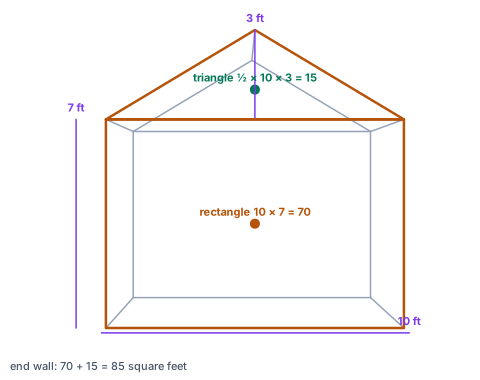
The figure shows a garden shed 10 feet wide, with side walls 7 feet tall and a roof whose peak is 3 feet higher. Look at the front end wall. It has five sides, so no single formula fits it. Now look at the two outlines drawn on it: a line across at the top of the side walls splits it into a rectangle below and a triangle above. The rectangle is 10 feet by 7 feet, 70 square feet. The triangle has the same 10-foot base, and its height is the 3 feet from that line up to the peak, so its area is $\tfrac{1}{2} \times 10 \times 3 = 15$ square feet. Notice that the triangle's height is measured straight up the middle, not along the sloping roof edge. The whole wall is $70 + 15 = 85$ square feet. Turn the live figure and you will see the back wall is the same shape, so the two end walls together are 170 square feet.
Take a trapezoid with parallel sides of 6 and 14 centimeters and a height of 5 centimeters. Place a second copy upside down beside it: the 6 of one copy lines up with the 14 of the other, so the two make a parallelogram with base $6 + 14 = 20$ and height 5. Its area is $20 \times 5 = 100$, and the trapezoid is half: 50 square centimeters.
That is the formula $\tfrac{1}{2}(a + b)h$. Reading it another way, $\tfrac{a + b}{2}$ is the average of the parallel sides, 10, and $10 \times 5 = 50$. The trapezoid has the same area as a rectangle whose width is halfway between its two parallel sides. You can also check by decomposing: a 6-by-5 rectangle in the middle (30) plus two triangles whose bases add to $14 - 6 = 8$ (together $\tfrac{1}{2} \times 8 \times 5 = 20$) gives 50 again.
To find the area of a polygon:
To check:
The shed in the figure has two end walls, each a 10-by-7-foot rectangle with a triangle of base 10 feet and height 3 feet on top. Each wall is $70 + 15 = 85$ square feet, so the two ends are 170 square feet. The long side walls are plain rectangles, 8 feet by 7 feet, or 56 square feet each, 112 for both. The whole outside is $170 + 112 = 282$ square feet, less the door. If the door is 3 feet by 6 feet, 18 square feet, the paint must cover $282 - 18 = 264$ square feet. Many paint cans say that a gallon covers about 350 square feet for one coat, so one gallon is enough for one coat, but two coats need $2 \times 264 = 528$ square feet, which is two gallons. A painter who forgot the triangles would be 30 square feet short on every coat.
Lots next to a curving road are often cut as trapezoids. Suppose a community garden plot has a street side of 40 feet, a parallel back side of 60 feet, and 30 feet between them. Its area is $\tfrac{1}{2}(40 + 60) \times 30 = 50 \times 30 = 1{,}500$ square feet. Garden planners often give each family a 10-by-10-foot bed, 100 square feet, and keep about a third of the land for paths. Two thirds of 1,500 is 1,000 square feet of beds, which is room for 10 families. Getting the trapezoid's area wrong by forgetting to halve would promise 20 families a bed that does not exist.
Using the slanted side as the height. The height is measured at a right angle to the base. A leaning side is always longer than the height.
Forgetting the half for a triangle. Base times height is the parallelogram; the triangle is half of it.
Adding the trapezoid's sides without halving. $(a + b) \times h$ is two trapezoids. Halve it.
Counting a piece twice. When you decompose, the pieces must not overlap. Draw the cutting lines before you calculate.
Writing a length unit. An area is in square units: 36 square inches, not 36 inches.
A parallelogram has a base of 9 inches, slanted sides of 5 inches and a height of 4 inches. Name the base and the height.
$b = 9 \text{ in}, \qquad h = 4 \text{ in}$
The height meets the base at a right angle; the 5-inch side leans, so it is not the height.
Cut the triangle off one slanted end and move it to the other end.
$\text{parallelogram} \to \text{rectangle } 9 \text{ in by } 4 \text{ in}$
Moving a piece does not change how much area there is.
Multiply the base by the height.
$9 \times 4 = 36$
The rectangle's area is its base times its height.
Write the area with its unit.
$36 \text{ square inches}$
Inches times inches gives square inches.
Check against the wrong length.
$9 \times 5 = 45 > 36$
Using the slanted side would count area that is not there, because the shape leans.
A triangular sail has a base of 10 feet and a height of 7 feet. Name the base and the height.
$b = 10 \text{ ft}, \qquad h = 7 \text{ ft}$
The height runs from the base straight up to the top corner.
Picture a copy of the sail turned upside down and placed against it.
$\text{two triangles} = \text{one parallelogram}$
Two copies of any triangle always fit together into a parallelogram.
Find the parallelogram's area.
$10 \times 7 = 70 \text{ square feet}$
The parallelogram has the same base and height as the triangle.
Take half for the triangle.
$70 \div 2 = 35 \text{ square feet}$
The sail is one of the two equal halves.
Write the same work as one formula.
$\tfrac{1}{2} \times 10 \times 7 = 35$
The formula is the picture written in symbols.
Check with a surrounding rectangle.
$35 < 10 \times 7 = 70$
The sail fits inside a 10-by-7 rectangle and fills exactly half of it.
A trapezoid has parallel sides of 6 cm and 14 cm and a height of 5 cm. Cut it into a rectangle and two triangles.
$\text{rectangle } 6 \text{ by } 5, \text{ plus two triangles}$
Lines straight down from the ends of the short side leave a rectangle in the middle.
Find the rectangle's area.
$6 \times 5 = 30$
The middle piece is as wide as the short side and as tall as the trapezoid.
Find the total base of the two triangles.
$14 - 6 = 8$
The long side is the short side plus the two triangle bases.
Find the two triangles' area together.
$\tfrac{1}{2} \times 8 \times 5 = 20$
Both triangles have height 5, so together they act like one triangle with base 8.
Add the pieces.
$30 + 20 = 50 \text{ cm}^2$
The pieces cover the trapezoid once each.
Check with the trapezoid formula.
$\tfrac{1}{2}(6 + 14) \times 5 = 10 \times 5 = 50$
The average of the parallel sides times the height gives the same area.
Check that the size makes sense.
$6 \times 5 = 30 < 50 < 14 \times 5 = 70$
The trapezoid is bigger than a rectangle on its short side and smaller than one on its long side.
Name the base and the height.
$b = 12, \qquad h = 3.5$
The height meets the base at a right angle.
Multiply the base by the height.
$12 \times 3.5 = 42$
Twelve threes are 36 and twelve halves are 6.
Write the area with its unit.
Each shape has height 7 inches. Match each shape with its area in square inches.
| 126 square inches | 63 square inches | 77 square inches | |
|---|---|---|---|
| a parallelogram with base 18 in | |||
| a triangle with base 18 in | |||
| a trapezoid with parallel sides 4 in and 18 in |
The end wall of a garage is 8 feet wide. The walls are 7 feet tall, and the roof's peak is 3 feet above the top of the walls. Complete the worked solution to find the area of the end wall.
Split the wall along the top of the side walls.
$\text{wall} = \text{rectangle} + \text{triangle}$
A line across at the roof line cuts the five-sided wall into two shapes whose areas you know.
Find the rectangle's area.
$8 \times 7 =$ a square feet
The rectangle is as wide as the wall and as tall as the side walls.
Find the triangle's area.
$\tfrac{1}{2} \times 8 \times 3 =$ t square feet
The triangle's base is the wall's width and its height is how far the peak rises.
Add the two areas.
$\text{rectangle} + \text{triangle} =$ s square feet
The two pieces cover the wall once each, with no overlap.
Check that the wall is less than the rectangle around it.
$\text{wall} < 8 \times (7 + 3)$
The triangle fills only half of the box above the roof line, so the wall must be smaller than the full rectangle.
A triangle has base 12 feet and height 8 feet. Find the area of the parallelogram made from two copies of it, and the area of the triangle.
The parallelogram is par square feet, so the triangle is tri square feet.
A parallelogram has base 7 cm and height 9 cm. What is its area? Give the number and choose the unit.
Answer: unit: m2 / cm2 / km2
A trapezoid has parallel sides 18 cm and 16 cm, and the height between them is 6 cm. Find the sum of the parallel sides, their average, and the area.
The sum is s cm, the average is m cm, and the area is a square centimeters.
A rug is a 9 ft by 10 ft rectangle with a 3 ft by 4 ft corner cut out so it fits around a fireplace. Find the area of the whole rectangle, of the cut-out, and of the rug.
The whole rectangle is w square feet, the cut-out corner is k, so the rug is z square feet.
A triangular flower bed has a base of 4 feet and a height of 15 feet. One bag of compost covers 10 square feet. How many bags cover the bed exactly?
Answer:
Lesson test: one question per skill, one attempt each, no hints. Your answers are checked when you submit.
A backyard is shaped like a trapezoid. Its two parallel sides are 8 yards and 28 yards long, and they are 7 yards apart. Sod costs 7 dollars per square yard. Find the area of the yard and the cost to cover it with sod.
The yard is area square yards, and the sod costs cost dollars.
You can find the area of triangles, parallelograms, trapezoids and composite shapes. Without looking: why is a triangle's area half of base times height, and why is a slanted side not the height?
16. Your turn: a parallelogram with base 12 m and height 3.5 m, step 3
$42 \text{ square meters}$
Meters times meters gives square meters.