Back to the on-screen lesson ·
Which quantity you choose and which one follows, in a table, a graph and an equation.
Paper packet. Every task here also exists on screen, where it is checked automatically; answers written on paper are not assessed by Nydus. When you are back at a device, enter your answers there.
In this lesson you relate two quantities with an equation and say which is which: the independent variable is the one you choose, and the dependent variable is the one that follows from it. You write the rule with the dependent variable alone on the left, fill in a table from it, find a rule from a table, and run a rule backward. Getting the two the right way round also decides which one goes on which axis of a graph.
You can write and evaluate expressions such as $4n + 10$, and you know that a letter can stand for a number that changes. You have made ratio tables and plotted points on the coordinate plane, with the first number of a pair read across and the second read up. This lesson joins those skills. Many real situations have two amounts that change together, like hours worked and money earned. You will learn to say which amount controls the other, and to show the link as an equation, a table and a graph.
| Term | What it means |
|---|---|
| Variable | A letter that stands for an amount that can change, such as $h$ for a number of hours. |
| Independent variable | The amount you choose or that changes on its own, such as the number of hours you work. |
| Dependent variable | The amount that is worked out from the independent one, such as the pay for those hours. |
| Equation in two variables | A rule such as $p = 12h$ that tells you how to get the dependent variable from the independent one. |
| Input and output | Other names for the independent variable (what goes in) and the dependent variable (what comes out). |
| Constant | A number in the rule that stays the same in every case, such as the 12 in $p = 12h$. |
Jordan mows lawns and earns 15 dollars for each lawn. The number of lawns and the money earned both change from week to week, so each one is a variable. But they are not equal partners. Jordan decides how many lawns to mow. The money is then settled: it is worked out from the lawns.
The amount that is chosen, or that changes on its own, is the independent variable. The amount that is worked out from it is the dependent variable, because it depends on the first one. With $n$ for the number of lawns and $m$ for the money, the rule is
$$m = 15n.$$
The dependent variable stands alone on the left. The right side says how to get it from the independent variable. The 15 is a constant: it is the same every week, so it is not a variable at all.
A quick test tells the two variables apart. Say the sentence '___ depends on ___' both ways. 'The money depends on the number of lawns' makes sense. 'The number of lawns depends on the money' does not, because Jordan does not mow more lawns just because some money appears. The amount after 'depends on' is the independent variable.
Another way: picture
Think of a machine with a slot at the top and a tray at the bottom. You drop the independent variable into the slot. The machine follows the rule, times 15, and drops the dependent variable into the tray. Put in 4 lawns and 60 dollars comes out. You control the slot. You never control the tray directly; you only get what the machine gives you. That is why one is called the input and the other the output.
Another way: story
A science class heats a pot of water and reads a thermometer every minute. The minutes tick by whatever the class does, so time is the independent variable. The temperature is what they measure at each minute, so it is the dependent variable. In an experiment, the thing you set up or wait for is independent, and the thing you measure is dependent.
A link between two variables can be shown in three ways, and each one puts the independent variable in a set place.
Equation. The dependent variable is alone on the left: $m = 15n$.
Table. The independent variable goes in the first column, or the top row, and the dependent variable goes next to it. You choose the inputs and fill in the outputs.
| Lawns $n$ | 1 | 2 | 3 | 4 |
|---|---|---|---|---|
| Money $m$ (dollars) | 15 | 30 | 45 | 60 |
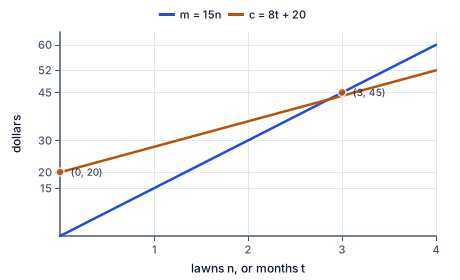
Graph. The independent variable goes on the horizontal axis, the $x$-axis, and the dependent variable goes on the vertical axis, the $y$-axis. Each column of the table becomes a point, such as $(3, 45)$. For Jordan's lawns the points lie on a straight line through $(0, 0)$, since zero lawns earn zero dollars.
The three views always agree, so you can use one to check another. If a point on your graph is not in your table, one of them has a mistake.
Not every rule is just a number times the input. Suppose a streaming service charges a one-time 20-dollar sign-up fee and then 8 dollars a month. The cost after $t$ months is
$$c = 8t + 20.$$
The 8 is multiplied by $t$ because it happens once for every month. The 20 is added once, because the sign-up fee is paid only at the start. At $t = 0$ the cost is already 20 dollars, so the graph starts at $(0, 20)$, not at the origin, and then rises 8 dollars for every month.
This is how you read a table that has a starting amount. Look at how much the output changes when the input goes up by 1: that is the number that multiplies the variable. Then find the output when the input is 0: that is the number added on. For the streaming table the outputs go 28, 36, 44, 52 for months 1 to 4. Each jump is 8, and stepping back from 28 by 8 gives 20 for month 0.
The chart draws both rules with the independent variable across: the lawn money starts at (0, 0), and the streaming cost starts at (0, 20).
Some dependent variables get smaller as the independent variable grows. A phone battery starts at 100 percent and loses 8 percent every hour of video, so the charge left after $h$ hours is
$$b = 100 - 8h.$$
The hours are still the independent variable, because they pass whatever the battery does. The charge still depends on the hours. The only difference is the minus sign: each hour takes 8 away instead of adding 8. On a graph the points go down from left to right.
You can also run a rule backward. When does the battery reach 36 percent? The battery has lost $100 - 36 = 64$ percent, and at 8 percent an hour that takes $64 \div 8 = 8$ hours. Put 8 back in to check: $100 - 8 \times 8 = 36$. Even when you are told the output and asked for the input, the variables keep their names. The hours are still independent; you are just working the machine in reverse.
A graph lets you answer questions without any arithmetic. Picture the points for $c = 8t + 20$, the streaming cost, with months across and dollars up. To find the cost after 5 months, start at 5 on the horizontal axis, go straight up to the line of points, then go straight across to the vertical axis and read 60 dollars. That is the input-to-output direction: across first, then up.
To run the rule backward, go the other way. To find when the cost reaches 84 dollars, start at 84 on the vertical axis, go across to the points, then go down to the horizontal axis and read 8 months. Check with the equation: $8 \times 8 + 20 = 84$.
The steepness of the points shows the number that multiplies the variable. A plan that costs 12 dollars a month climbs faster than one that costs 8, so where two plans are drawn on the same axes you can see which one grows more quickly and where the two lines cross.
To set up a rule from a story:
To use the rule: substitute the value of the independent variable and follow the order of operations, multiplying before adding or subtracting.
To check:
In New York City, a yellow taxi ride starts with a base fare of 3 dollars, and then the meter adds 70 cents for every fifth of a mile. That is 5 fifths in each mile, so a mile costs $5 \times 0.70 = 3.50$ dollars. For a ride of $d$ miles, the meter part of the fare is
$$f = 3.50d + 3.$$
The distance is the independent variable: the rider picks where to go. The fare is the dependent variable: the meter works it out. A 4-mile ride costs $3.50 \times 4 + 3 = 17$ dollars before tolls, surcharges and the tip. A 6-mile ride costs 24 dollars. Each extra mile adds the same 3.50 dollars, so a graph of this fare is a straight line that starts at 3 dollars, not at 0, because the meter shows 3 dollars the moment you sit down.
A garden hose at ordinary household water pressure delivers roughly 9 gallons of water a minute; the exact amount depends on the hose and the pressure. If you water for $m$ minutes, you use about
$$g = 9m$$
gallons. The minutes are independent, because you decide when to turn the tap off. The gallons depend on the minutes. A 20-minute watering uses about 180 gallons. Many towns ask people to water less in dry summers, so this rule can be run backward too. If your family wants to use no more than 135 gallons, divide: $135 \div 9 = 15$ minutes. The rule turns a goal about water into a time you can set on a kitchen timer.
Swapping the variables. 'Hours depend on pay' sounds wrong when you say it aloud. Always use the sentence test before you write the rule.
Calling the constant a variable. In $m = 15n$ the 15 never changes. Only letters that stand for changing amounts are variables.
Putting the axes the wrong way round. The independent variable goes across on the $x$-axis and the dependent variable goes up the $y$-axis.
Adding a one-time fee every time. A sign-up fee of 20 dollars is added once: $8t + 20$, not $(8 + 20)t$.
Thinking a backward question swaps the names. When you are given the output and asked for the input, the independent variable is still the input.
A car wash charges 9 dollars for each car. Find the two amounts that change.
$\text{number of cars}, \quad \text{money taken in}$
The 9 dollars is the same for every car, so it is a constant, not a variable.
Use the sentence test to decide which depends on which.
$\text{money depends on cars}$
More cars bring in more money; money does not make cars arrive.
Choose a letter for each variable.
$k = \text{cars (independent)}, \quad d = \text{dollars (dependent)}$
First letters make the rule easy to read back.
Write the rule with the dependent variable alone on the left.
$d = 9k$
Each car adds 9 dollars, so $k$ cars bring in 9 times $k$.
Test the rule with 3 cars.
$d = 9 \times 3 = 27$
Three cars at 9 dollars each is 27 dollars, which matches the story.
A table shows tickets $t$ and cost $c$: 1 ticket costs 11, 2 cost 18, 3 cost 25, 4 cost 32. Name the variables.
$t \text{ (independent)}, \quad c \text{ (dependent)}$
You choose how many tickets to buy; the cost follows.
Find the change in cost from 1 ticket to 2.
$18 - 11 = 7$
Neighboring rows are one ticket apart, so the change is the price of one ticket.
Check that every step is the same.
$25 - 18 = 7, \qquad 32 - 25 = 7$
A steady jump means the rule is a number times $t$, plus a fixed amount.
Step back one ticket to find the cost of 0 tickets.
$11 - 7 = 4$
The 4 dollars is paid even before any ticket is bought, so it is a fixed fee.
Write the rule.
$c = 7t + 4$
Each ticket adds 7, and the fee of 4 is added once.
Check the rule on the last row.
$7 \times 4 + 4 = 32$
The rule gives the same cost as the table for 4 tickets.
A water cooler holds 240 cups and 12 cups are poured every hour, so $w = 240 - 12h$. Name the variables.
$h \text{ (hours, independent)}, \quad w \text{ (cups left, dependent)}$
The cups left depend on how many hours have passed.
Say what the question gives and what it asks: when are 84 cups left?
$w = 84, \quad h = ?$
This time you know the output and must find the input.
Find how many cups have been poured.
$240 - 84 = 156$
What is gone is the full cooler minus what is left.
Divide by the cups poured in one hour.
$156 \div 12 = 13$
Each hour takes 12 cups, so the hours are the number of 12s in 156.
Put 13 back into the rule to check.
$240 - 12 \times 13 = 240 - 156$
Working forward is the surest check of a backward answer.
Finish the check.
$240 - 156 = 84$
The rule gives 84 cups, exactly what the question said.
State the answer in words.
$\text{After } 13 \text{ hours, } 84 \text{ cups are left.}$
An answer names its units, so the reader knows 13 counts hours, not cups.
Name the variables.
$m \text{ (months, independent)}, \quad c \text{ (cost, dependent)}$
The cost depends on how many months you stay.
Write the rule.
$c = 30m + 25$
Each month adds 30 dollars, and the sign-up fee is paid once.
Put 6 in place of $m$ and multiply.
$30 \times 6 = 180$
Multiplication comes before addition.
Add the sign-up fee.
A snail crawls 7 feet every hour, so $f = 7h$. Which letter is the dependent variable?
A lake rents kayaks. Its price list shows the cost $c$ in dollars for $h$ hours: 1 hour costs 39, 2 hours cost 47, 3 hours cost 55 and 4 hours cost 63. Complete the worked solution to find the rule and the cost of 9 hours.
Subtract the 1-hour cost from the 2-hour cost.
$47 - 39 =$ step dollars for each extra hour
Neighboring rows are one hour apart, so their difference is the price of one hour.
Check that every extra hour adds the same amount.
$55 - 47 \text{ and } 63 - 55 \text{ give the same difference}$
A rule of the form number times $h$ plus a number needs the same jump every time.
Step back one hour from the 1-hour row to find the cost for 0 hours.
$c \text{ at } h = 0:$ start dollars
Taking one hour's price away from the 1-hour cost leaves the fee you pay before you paddle at all.
Write the rule with the dependent variable on the left.
$c = (\text{price per hour}) \times h + (\text{cost at } 0 \text{ hours})$
The cost depends on the hours, so $c$ stands alone and $h$ goes on the right.
Use the rule for 9 hours.
$c =$ pred dollars
Multiply the price per hour by 9 first, then add the fixed fee.
A sunflower is 8 inches tall when it is planted and grows 4 inches each week, so its height $h$ in inches after $w$ weeks is $h = 4w + 8$. Complete the table.
| Weeks w | Height h (inches) |
|---|---|
| 2 | |
| 4 | |
| 8 |
A company rents bounce houses for parties. It charges 38 dollars to deliver one, plus 26 dollars for every hour it stays. Write the cost $c$ in dollars in terms of the number of hours $h$.
Answer:
A class sells candles to raise money. Each candle brings in 7 dollars, and the supplies cost 40 dollars in all, so the profit $p$ in dollars from selling $n$ candles is $p = 7n - 40$. The class sells 18 candles. How much money do the sales bring in, and what is the profit?
The sales bring in sales dollars, and the profit is profit dollars.
Two bike shops rent bikes by the hour. At Shop A the cost in dollars is $c = 24 + 5h$, and at Shop B it is $c = 6h$, where $h$ is the number of hours. Find each shop's cost for 5 hours, and how many dollars the cheaper shop saves.
Shop A costs shopa dollars, Shop B costs shopb dollars, and the cheaper shop saves saving dollars.
A pump empties a backyard pool. The pool starts with 1097 gallons, and the pump takes out 15 gallons each minute, so the water left after $m$ minutes is $W = 1097 - 15m$ gallons. How much water has been pumped out, and after how many minutes, when 872 gallons are left?
The pump has taken out gone gallons, so 872 gallons are left after minutes minutes.
Lesson test: one question per skill, one attempt each, no hints. Your answers are checked when you submit.
Two bike shops rent bikes by the hour. At Shop A the cost in dollars is $c = 26 + 8h$, and at Shop B it is $c = 14h$, where $h$ is the number of hours. Find each shop's cost for 6 hours, and how many dollars the cheaper shop saves.
Shop A costs shopa dollars, Shop B costs shopb dollars, and the cheaper shop saves saving dollars.
You can identify the independent and dependent variables and write an equation relating them. Without looking: if you buy $n$ books at 7 dollars each, which variable is which, what is the rule, and which axis does each variable go on?
16. Your turn: a gym charges a 25-dollar sign-up fee plus 30 dollars a month. Find the cost for 6 months, step 4
$180 + 25 = 205 \text{ dollars}$
The fee is added once, at the end.