Back to the on-screen lesson ·
What a number below zero means, what zero stands for, and how to order numbers on both sides of it.
Paper packet. Every task here also exists on screen, where it is checked automatically; answers written on paper are not assessed by Nydus. When you are back at a device, enter your answers there.
In this lesson you use negative numbers to describe quantities with a direction: temperatures below zero, depths below sea level, yards lost and money taken out. You decide what zero means in each situation, write each amount as a signed number, put numbers on both sides of zero in order, turn an inequality into a sentence about the situation, and count a change that crosses zero.
You have used a number line since the early grades: whole numbers march to the right from 0, fractions and decimals sit between them, and a number further right is greater. You have read a thermometer, which is a number line standing up. You can find how far apart two numbers are by counting steps or subtracting. Earlier in this course you met opposites, absolute value and all four quadrants of the coordinate plane. This lesson steps back to the idea underneath them: what a number below zero means in a real situation, what zero itself stands for, and how to put numbers on both sides of zero in order.
| Term | What it means |
|---|---|
| Positive number | A number greater than zero, such as 7 or $2\tfrac{1}{2}$. |
| Negative number | A number less than zero, written with a minus sign, such as $-7$. |
| Integers | The whole numbers, their opposites and zero: $\ldots, -2, -1, 0, 1, 2, \ldots$ |
| Reference point | What zero stands for in a situation: sea level, the freezing point on a scale, the starting line, a balance of no money. |
| Signed number | A number with a sign that shows its direction from zero: $+8$ for 8 up or gained, $-8$ for 8 down or lost. |
| Inequality | A statement that one number is less than ($<$) or greater than ($>$) another, such as $-5 < -2$. |
Some quantities come in two directions. A temperature can be above zero or below it. A diver can be above sea level on the boat or below it in the water. A football team can gain yards or lose them. A bank balance can go up with a deposit or down with a withdrawal. Negative numbers let one number line hold both directions.
The key is zero, the reference point. Zero is not 'nothing' in these situations; it is the place everything is measured from. Sea level is 0 feet. The line where a play starts is 0 yards. Positive numbers go one way from zero and negative numbers go the other way, the same distance for the same digits. So 30 feet below sea level is $-30$, and 30 feet above is $30$.
On a number line, negative numbers sit to the left of zero, and on a vertical line, such as a thermometer, they sit below zero. The rule for order does not change: further right, or further up, is greater. That gives a result that feels strange at first. $-20$ is less than $-3$, even though 20 is more than 3, because $-20$ is further left. On a thermometer, $-20$ °F is colder than $-3$ °F. For negative numbers, bigger digits mean a smaller number.
Another way: picture
Picture a thermometer. Zero is a mark in the middle. The numbers above it count up: 1, 2, 3. The numbers below it count down the other way: $-1$, $-2$, $-3$. The further down the red line reaches, the colder the day, and the smaller the number. Turn the thermometer on its side, top to the right, and you have the number line.
Another way: story
An elevator in a hotel goes from parking level P3 up to the fifth floor. If the lobby is floor 0, the parking levels are floors $-1$, $-2$ and $-3$. The elevator passes 0, the lobby, on the way up. Floor $-3$ is the lowest, so it is the least; floor 5 is the highest, so it is the greatest.
The first job in any situation with negative numbers is to decide what zero means and which direction is positive. Usually the choice is natural:
| Situation | Zero means | Positive | Negative |
|---|---|---|---|
| Temperature | 0 degrees on the scale | above | below |
| Elevation | sea level | above | below |
| Football | the line where the play began | yards gained | yards lost |
| Bank account | no change | deposit | withdrawal |
| Time | now | after | before |
Words give the direction away. 'Below', 'loss', 'owe', 'withdraw', 'before' and 'behind' point to negative numbers. 'Above', 'gain', 'earn', 'deposit', 'after' and 'ahead' point to positive ones. Once zero and the positive direction are fixed, every amount becomes a signed number: a loss of 4 yards is $-4$, a gain of 4 yards is $4$. The two are opposites: the same distance from zero on opposite sides. Positive numbers can be written with a plus sign, $+4$, but usually the plus is left off.
Three facts put any set of numbers in order:
So to order $4, -6, 0, -1, 3, -10$, first pull out the negatives and order them from furthest to closest to zero: $-10, -6, -1$. Then comes $0$, then the positives in the usual order: $3, 4$. The whole list is $-10 < -6 < -1 < 0 < 3 < 4$.
A quick test for two negatives: the one closer to zero is greater. Of $-15$ and $-51$, $-15$ is closer to zero, so $-15 > -51$. That is also why a temperature of $-15$ °F is warmer than $-51$ °F.
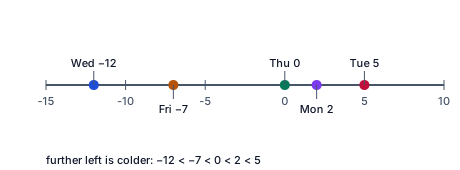
The number line shows the noon temperature on five school days of one winter week in a northern town. Look first at where each dot sits compared with zero. Wednesday's $-12$ and Friday's $-7$ are to the left, below freezing on the Fahrenheit scale by a long way; Thursday sits exactly on 0; Monday's 2 and Tuesday's 5 are to the right. Now read the dots from left to right: that is the order from coldest to warmest, $-12 < -7 < 0 < 2 < 5$, and it needs no rule at all, only the picture. Notice that Wednesday's dot, the one with the biggest digits, is the furthest left: the coldest day. Finally, count the gap between Friday and Tuesday: 7 steps from $-7$ up to 0, and 5 more to 5, so Tuesday was 12 degrees warmer.
An inequality such as $-7 < -3$ is a statement about position: $-7$ is to the left of $-3$. In a situation it becomes a sentence. For temperatures, '$-7$ °C is colder than $-3$ °C'. For elevations, '$-70$ feet is lower than $-30$ feet', which also means deeper. For money, 'a balance of $-25$ dollars is worse than a balance of $-10$ dollars', because more is owed.
Be careful with everyday words that seem to point the other way. A diver at $-70$ feet is deeper than a diver at $-30$ feet, and 'deeper' sounds like 'more', but the number $-70$ is less. The inequality always follows the number line: $-70 < -30$. The sentence can say 'deeper', 'colder' or 'owes more'; the symbol still points to the smaller number.
You can read an inequality either way round. $-3 > -7$ says the same thing as $-7 < -3$: the symbol's point faces the smaller number.
Many questions start at one number and move: a temperature rises, a diver sinks, an elevator climbs. On the number line, rising, gaining or going up moves right (or up); falling, losing or going down moves left (or down).
When a move crosses zero, split it into two parts. A temperature of $-6$ that rises 10 degrees first rises 6 to reach 0, then rises the other 4 to reach 4. A change from $-6$ to $4$ is $6 + 4 = 10$ degrees: the distance below zero plus the distance above. This two-part count is the most reliable way to work across zero until you learn the rules for adding negative numbers in grade 7.
To use negative numbers in a situation:
To check:
The coldest temperature ever officially recorded in the United States was $-80$ °F at Prospect Creek, Alaska, on January 23, 1971. In the lower 48 states the record is $-70$ °F, at Rogers Pass, Montana, on January 20, 1954. Which was colder? On a thermometer, $-80$ is further down than $-70$, so $-80 < -70$ and Alaska's record is colder by $80 - 70 = 10$ degrees. Compare that with the hottest reading ever recorded on Earth, 134 °F in Death Valley, California, in 1913. The distance from the Alaska record up to 0 is 80 degrees, and from 0 up to 134 is 134 more, so the two records are $80 + 134 = 214$ degrees apart. Weather scientists use exactly these comparisons to describe how extreme a place's climate can be, and every one of them depends on putting numbers below zero in the right order.
In American football, every play is measured from the line of scrimmage, which acts as zero. A run that gains 7 yards is recorded as $+7$; a quarterback sacked 9 yards behind the line is recorded as $-9$. Suppose a team runs three plays: $+7$, $-9$ and $+5$. After the first play the ball is 7 yards ahead of where the drive started. The sack moves it back 9: 7 of those yards bring it back to the start, and 2 more put it at $-2$. The third play moves it up 5: 2 yards to reach the start, then 3 more, so the ball ends at $+3$. A team needs 10 yards in four plays for a first down, so after three plays at $+3$ it still needs $10 - 3 = 7$ yards. Coaches and broadcasters track these signed numbers on every drive.
Reading the digits and ignoring the sign. $-20$ is less than $-3$, not more. Among negatives, bigger digits mean a smaller number.
Thinking zero is the smallest number. Every negative number is less than zero. Zero is only the reference point.
Mixing up 'deeper' and 'greater'. A diver at $-70$ feet is deeper than one at $-30$ feet, but $-70 < -30$.
Subtracting across zero. The change from $-6$ to $4$ is not $6 - 4 = 2$. It is 6 up to zero plus 4 more, which is 10.
Forgetting to decide what zero means. 'The temperature is 5' could be 5 above or 5 below until the sign is written.
A scuba diver swims 15 feet below the surface. Write her position as a signed number.
$-15 \text{ ft}$
The surface is zero, and below it is the negative direction.
A running back gains 8 yards. Write the play as a signed number.
$+8 \text{ yards, or } 8$
The line where the play began is zero, and a gain is the positive direction.
Jordan takes 40 dollars out of his account. Write the change in his balance.
$-40 \text{ dollars}$
A withdrawal makes the balance go down, so the change is negative.
A winter night reaches 12 degrees below zero. Write the temperature.
$-12 \text{ °F}$
Temperatures below the zero mark of the scale are negative.
Say what zero means in each of the four situations.
$0 = \text{surface}, \; \text{start of the play}, \; \text{no change}, \; \text{zero on the scale}$
A negative number only has meaning once the reference point is known.
The noon temperatures on five school days were 2, 5, $-12$, 0 and $-7$ °F. Sort them into negative, zero and positive.
$\text{negative: } -12, -7; \quad \text{zero: } 0; \quad \text{positive: } 2, 5$
Negatives come before zero and positives after, so sorting first does most of the work.
Order the negative temperatures.
$-12 < -7$
12 below zero is further left than 7 below, so it is less.
Order the positive temperatures.
$2 < 5$
Positive numbers keep their usual order.
Join the groups with zero in the middle.
$-12 < -7 < 0 < 2 < 5$
Every negative is less than zero and every positive is greater.
Name the coldest and warmest days.
$\text{coldest: } -12 \text{ (Wednesday)}, \quad \text{warmest: } 5 \text{ (Tuesday)}$
The least number is the coldest temperature and the greatest is the warmest.
Find how much warmer the warmest day was than the coldest.
$12 + 5 = 17 \text{ degrees}$
From $-12$ up to 0 is 12 degrees, and from 0 up to 5 is 5 more.
In a hotel the lobby is floor 0 and the parking levels are below it. An elevator starts on parking level 4. Write its floor as a signed number.
$\text{start} = -4$
Four levels below the lobby is four steps below zero.
It goes up 6 floors. Count up to the lobby first.
$-4 \to 0 \text{ uses } 4 \text{ of the } 6 \text{ floors}$
Going up moves toward zero, and $-4$ is 4 floors from it.
Use the rest of the climb above the lobby.
$6 - 4 = 2, \quad \text{so it reaches floor } 2$
Two floors of the climb are left after the lobby.
Then it goes down 3 floors. Count down to the lobby.
$2 \to 0 \text{ uses } 2 \text{ of the } 3 \text{ floors}$
Going down moves toward zero from a positive floor.
Use the rest of the drop below the lobby.
$3 - 2 = 1, \quad \text{so it stops at floor } -1$
One floor of the drop is left after the lobby, and below the lobby is negative.
Compare the stop with the start.
$-1 > -4$
$-1$ is closer to zero, so the elevator ends higher than it began.
Find how many floors higher it ended.
$6 - 3 = 3 \text{ floors higher}$
It went up 6 and down 3; counting from $-4$ up to $-1$ also gives 3 steps.
Place both temperatures below zero.
$-8 \text{ is } 8 \text{ below}, \quad -13 \text{ is } 13 \text{ below}$
Both have a minus sign.
Find the one further from zero.
$13 > 8$
Further below zero means colder.
Write the comparison.
Put these numbers in order from least to greatest: -7, 1, -10, -3.
Number the steps in order (write the number in the box):
At 6 a.m. the temperature in a mountain town is -6 °F. By noon it is 12 °F. How many degrees did it rise, and if it rose the same amount each hour for those 6 hours, how many degrees per hour? Complete the worked solution.
Measure the part of the rise below zero.
$\text{from } -6 \text{ to } 0: 6 \text{ degrees}$
-6 is 6 steps below zero on a thermometer.
Measure the part of the rise above zero.
$\text{from } 0 \text{ to } 12: 12 \text{ degrees}$
A positive temperature is its own distance above zero.
Add the two parts to get the whole rise.
$6 + 12 =$ t degrees
The temperature passed through zero, so the rise is the distance below zero plus the distance above.
Share the rise equally among the 6 hours.
$\text{rise} \div 6 =$ h degrees per hour
From 6 a.m. to noon is 6 hours, and the rise was the same each hour.
Check on the thermometer.
$\text{start} + 6 \times \text{hourly rise} = \text{noon temperature}$
Counting up by the hourly rise six times from the start must land on the noon reading.
The temperature in a freezer is -5 °F, which is 5 degrees below zero. It then rises 14 degrees. How many degrees does it take to reach zero, and what is the new temperature?
It takes zero degrees to reach zero, and the new temperature is answer °F.
Write a signed number for each situation, and the number for the opposite situation. Row 1: a football team loses 8 yards on a play. Row 2: a hiker stands 48 feet below sea level. Row 3: Ana puts 29 dollars into her savings account.
| The situation | The opposite situation | |
|---|---|---|
| Yards on the play | ||
| Height of the hiker | ||
| Savings deposit |
On a January morning it is -4 °F in Duluth, Minnesota, and -13 °F in International Falls, Minnesota. Which temperature is warmer, and by how many degrees?
The warmer temperature is warm °F, and it is gap degrees warmer.
A research submarine is at -300 feet, which means 300 feet below sea level. It rises 90 feet, then dives 180 feet. Where is it after the rise, where does it end, and how many feet deeper than its start is it?
After the rise it is at mid feet, it ends at end feet, and it is deeper feet deeper than its start.
Which of -7 and -14 is greater?
Lesson test: one question per skill, one attempt each, no hints. Your answers are checked when you submit.
A research submarine is at -200 feet, which means 200 feet below sea level. It rises 70 feet, then dives 130 feet. Where is it after the rise, where does it end, and how many feet deeper than its start is it?
After the rise it is at mid feet, it ends at end feet, and it is deeper feet deeper than its start.
You can describe and order negative numbers in real situations. Without looking: why is $-10$ less than $-1$, and how many degrees is it from $-10$ °F to 4 °F?
17. Your turn: which is colder, $-8$ °F or $-13$ °F?, step 3
$-13 < -8, \text{ so } -13 \text{ °F is colder by } 5 \text{ degrees}$
The colder temperature is the smaller number.