Back to the on-screen lesson ·
Unfolding a solid flat, and adding up the faces.
Paper packet. Every task here also exists on screen, where it is checked automatically; answers written on paper are not assessed by Nydus. When you are back at a device, enter your answers there.
In this lesson you unfold a solid into a net and use it to find the surface area. Once the solid is flat, surface area is just adding up rectangles and triangles you already know how to measure. You find the surface areas of cubes, boxes, triangular prisms and square pyramids, and of real objects with a face missing, and you see why surface area and volume are different: one is about the wrapping, the other about the filling.
You can find the area of a rectangle (length times width), a square (side times side) and a triangle (half of base times height). You know that area is measured in square units, such as square inches. You have met solids such as cubes, boxes and pyramids, and you found the volume of a box by filling it with cubes. This lesson is about the outside of a solid instead of the inside: how much material it takes to cover it.
| Term | What it means |
|---|---|
| Face | One flat surface of a solid. A cube has 6 faces. |
| Edge | A line where two faces meet. |
| Net | A flat pattern of shapes that folds up into a solid, with every face appearing once. |
| Prism | A solid with two matching bases joined by rectangles, such as a box or a triangular prism. |
| Pyramid | A solid with one base and triangle faces that meet at a single point on top. |
| Surface area | The total area of all the faces of a solid, in square units. |
| Slant height | The height of a triangle face of a pyramid, measured up the middle of the face. |
Imagine cutting along some edges of a cereal box and pressing it flat. You get a net: a flat pattern of rectangles that folds back into the box. Every face of the box appears in the net exactly once.
The surface area of a solid is the total area of all its faces. A net makes this easy to find, because every face is now a flat shape you already know how to measure. Find the area of each piece and add them up.
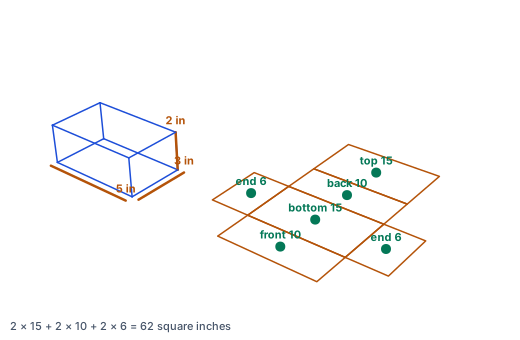
Take a box 5 inches long, 3 inches wide and 2 inches tall. Its net has three pairs of matching rectangles:
The surface area is $30 + 20 + 12 = 62$ square inches.
Surface area and volume measure different things. Volume counts the cubes that fill a solid, in cubic units. Surface area counts the squares that cover it, in square units. The same box has a volume of $5 \times 3 \times 2 = 30$ cubic inches, a different number with a different unit.
Another way: picture
Think of wrapping a present. The paper you need, with no overlap, is the surface area of the box. If you could unwrap it without tearing and lay it flat, the paper would look like the net: a cross of six rectangles. The amount of candy the box holds is a different question, the volume.
Another way: hands on
Take an empty tissue box and cut along enough edges to lay it flat, keeping every face attached to at least one other. Measure each rectangle with a ruler and write its area on it. Adding the six numbers gives the surface area, and folding the net back up shows that nothing was missed or counted twice.
On the left is the box from the start of this lesson, 5 inches long, 3 inches wide and 2 inches tall. On the right is the same box cut along some of its edges and pressed flat. Match each flat face with a face of the box. The long strip down the middle is the back, the bottom, the front and the top, in the order you would meet them if you rolled the box forward. The two small rectangles beside the bottom are the ends; they fold up like flaps. Each face is labeled with its area in square inches: the bottom and the top are 15, the front and the back are 10, and the ends are 6. Notice that the faces come in matching pairs, one pair for each pair of edges of the box, so you only need three multiplications. The total, $2 \times 15 + 2 \times 10 + 2 \times 6 = 62$ square inches, is the surface area. Count the rectangles too: six, one for every face, none twice.
The pieces of a net tell you which solid it folds into. Count the pieces to count the faces.
| Solid | Bases | Side faces | Faces in all |
|---|---|---|---|
| Cube | 2 squares | 4 squares | 6 |
| Rectangular prism | 2 rectangles | 4 rectangles | 6 |
| Triangular prism | 2 triangles | 3 rectangles | 5 |
| Square pyramid | 1 square | 4 triangles | 5 |
| Triangular pyramid | 1 triangle | 3 triangles | 4 |
A prism has two matching bases, one at each end, and a rectangle joining each pair of matching edges. So a prism whose base has 3 edges has 3 rectangles around its side. A pyramid has one base, and a triangle stands on each edge of the base, meeting the others at the top.
One solid can have many different nets, depending on which edges you cut. A cube has 11 different nets. Not every arrangement of six squares works, though: a row of six squares, for example, cannot fold into a cube, because two faces would land on top of each other.
Rectangular prism. A box has three pairs of matching faces. With length $l$, width $w$ and height $h$,
$$SA = 2lw + 2lh + 2wh.$$
For a cube with edge $s$, all six faces are $s \times s$, so the surface area is $6s^2$. A cube with 4-inch edges has $6 \times 16 = 96$ square inches of surface.
Triangular prism. The net has two triangles and three rectangles. The two triangles together are base times height, since two halves make a whole. The three rectangles are all as long as the prism, and their widths are the three sides of the triangle. In the net they sit side by side, forming one long rectangle, so you can add the three widths and multiply by the length once. For a prism 10 inches long with triangle sides 3, 4 and 5 inches, the triangles give $3 \times 4 = 12$ and the rectangles give $(3 + 4 + 5) \times 10 = 120$, so the surface area is 132 square inches.
A square pyramid's net is one square with four matching triangles. The height of each triangle is measured up the middle of the face, from the edge of the base to the top point. It is called the slant height, because it leans. It is longer than the height of the pyramid, which goes straight up through the inside.
For a pyramid with a base 6 inches on a side and a slant height of 5 inches:
The surface area is $36 + 60 = 96$ square inches. Always use the slant height for the triangles: it is the height of the triangle, and the triangle is the shape you are measuring.
Real objects often leave out a face. A fish tank has no lid, a tent may have no canvas floor, and a gift box is covered but not its bottom if it sits on a table. Start from the full net, then cross out the faces that are not there. An open-top box 30 by 12 by 16 inches has a bottom of $30 \times 12 = 360$, two long sides of $2 \times 30 \times 16 = 960$ and two ends of $2 \times 12 \times 16 = 384$, so 1,704 square inches of glass. A sketch of the net with the missing face crossed out keeps you from adding it by habit.
The same care works in reverse. A tent that comes with a sewn-in floor needs the floor rectangle too, and a box with a lid that overlaps its sides needs more cardboard than its net alone. Read the question for which faces are really made of the material, and count only those.
To find a surface area:
To check:
Paint cans in the United States usually say that one gallon covers about 350 to 400 square feet. Suppose a bedroom is 12 feet long, 10 feet wide and 8 feet tall, and you paint the four walls. The walls are the sides of a box without its top and bottom:
$$2 \times 12 \times 8 + 2 \times 10 \times 8 = 192 + 160 = 352 \text{ square feet}.$$
A door and a window take away roughly 20 and 15 square feet, leaving about 317 square feet. One gallon covers that once, but most walls need two coats, so you would buy 2 gallons. Adding the ceiling, $12 \times 10 = 120$ square feet, brings the job to about 437 square feet per coat. Painters estimate every job this way: unfold the room into a net, and add the faces that get paint.
A cereal box might be 8 inches wide, $2\tfrac{1}{2}$ inches deep and 12 inches tall. The cardboard for its net is
$$2(8 \times 12) + 2(2.5 \times 12) + 2(8 \times 2.5) = 192 + 60 + 40 = 292$$
square inches, before the small flaps that are glued. Packaging designers compare shapes this way. A box 6 by 4 by 10 inches holds exactly the same 240 cubic inches as the 8 by 2.5 by 12 box, but it needs $2(24) + 2(60) + 2(40) = 248$ square inches of cardboard. The wide, thin box uses more cardboard for the same cereal, and a company chooses it anyway because the big front face works like a billboard on the store shelf.
Counting only three faces of a box. Each face has a matching partner on the opposite side, so there are six. Double each pair.
Mixing up surface area and volume. Multiplying length, width and height gives volume. Surface area adds the areas of the faces.
Forgetting the half for a triangle. A triangle face is half of base times height.
Using the pyramid's height instead of the slant height. The triangles are measured up their own faces.
Adding a face that is not there. An open box has no top; cross it out on the net first.
A cube has edges of 7 centimeters. Sketch its net.
$6 \text{ squares, each } 7 \text{ cm} \times 7 \text{ cm}$
Every face of a cube is the same square.
Find the area of one face.
$7 \times 7 = 49 \text{ square centimeters}$
A square's area is side times side.
Multiply by the number of faces.
$6 \times 49 = 294 \text{ square centimeters}$
All six faces have the same area, so multiplying is faster than adding six times.
Check the count of faces in the net.
$6 \text{ pieces} = 6 \text{ faces}$
A cube has six faces, and each was counted once.
Compare with the volume to see the difference.
$7 \times 7 \times 7 = 343 \text{ cubic centimeters}$
Volume fills the cube; surface area covers it. They are different numbers with different units.
A shoe box is 13 inches long, 8 inches wide and 5 inches tall. Find the area of the top.
$13 \times 8 = 104$
The top is length by width.
Double it for the top and bottom.
$2 \times 104 = 208$
The bottom matches the top.
Find the front and back together.
$2 \times 13 \times 5 = 130$
The front and back are length by height.
Find the two ends together.
$2 \times 8 \times 5 = 80$
The ends are width by height.
Add the three pairs.
$208 + 130 + 80 = 418 \text{ square inches}$
The six faces together cover the whole box.
Check with the formula.
$2(13)(8) + 2(13)(5) + 2(8)(5) = 208 + 130 + 80 = 418$
The formula is the same three pairs written in one line.
A glass paperweight is a square pyramid with a base 8 centimeters on a side and a slant height of 7 centimeters. Sketch its net.
$1 \text{ square} + 4 \text{ triangles}$
The triangles fold up from the four edges of the base.
Find the area of the base.
$8 \times 8 = 64$
The base is a square.
Write the area of one triangle.
$\tfrac{1}{2} \times 8 \times 7$
Each triangle's base is an edge of the square, and its height is the slant height.
Work it out.
$4 \times 7 = 28$
Half of 8 is 4, so the triangle is 4 times 7.
Multiply by 4 for all the triangles.
$4 \times 28 = 112$
The four triangles are the same size.
Add the base and the triangles.
$64 + 112 = 176 \text{ square centimeters}$
Surface area is every face added together.
Check the count of pieces.
$1 + 4 = 5 \text{ faces}$
A square pyramid has five faces, and all five were added once.
Find the top and bottom together.
$2 \times 10 \times 4 = 80$
Length by width, two of them.
Find the front and back, then the ends.
$2 \times 10 \times 3 = 60, \qquad 2 \times 4 \times 3 = 24$
Length by height, then width by height.
Add the three pairs.
Four nets are cut from cardboard. Match each net to the solid it folds into.
| a cube | a square pyramid | a triangular prism | a rectangular prism | |
|---|---|---|---|---|
| six squares, each 4 inches on a side | ||||
| one square and four matching triangles | ||||
| two triangles and three rectangles, each 8 inches long | ||||
| six rectangles in three matching pairs |
A triangular prism is 7 inches long. Each end is a right triangle whose two shorter sides are 9 inches and 12 inches and whose longest side is 15 inches. Complete the worked solution to find its surface area from its net.
List the pieces of the net.
$2 \text{ right triangles} + 3 \text{ rectangles}$
A triangular prism has two triangle ends and one rectangle for each side of a triangle.
Find the area of the two triangles together.
$2 \times \tfrac{1}{2} \times 9 \times 12 =$ tris square inches
The two shorter sides of a right triangle are its base and height, and two halves make one whole.
Add the widths of the three rectangles.
$9 + 12 + 15 = 36$
Each rectangle is as wide as one side of the triangle, and they all have the same length.
Multiply by the length for the area of all three rectangles.
$36 \times 7 =$ rects square inches
Laid side by side in the net, the three rectangles make one long rectangle.
Add the triangles and the rectangles.
$\text{triangles} + \text{rectangles} =$ total square inches
The surface area is the total area of every piece of the net.
Picture the net of a square pyramid. How many faces does it have, how many of them are rectangles or squares, and how many are triangles?
A square pyramid has faces faces: rects rectangles or squares and tris triangles.
A box is 14 inches long, 7 inches wide and 9 inches tall. Its net has three pairs of matching rectangles. Complete the table with the area of one face and of each pair, in square inches.
| Area of one face | Area of the pair | |
|---|---|---|
| Top and bottom | ||
| Front and back | ||
| The two ends |
A square pyramid has a base 9 centimeters on each side. Each triangle face has a base of 9 centimeters and a height, the slant height, of 18 centimeters. Find the area of the base, the area of one triangle, and the surface area.
The base is base square centimeters, one triangle is tri square centimeters, and the surface area is total square centimeters.
An A-frame tent is a triangular prism lying on one of its rectangles. Each triangle end has a base of 6 feet, a height of 4 feet and two sloping sides of 5 feet. The tent is 8 feet long. The canvas covers the two ends and the two sloping sides, but not the floor. How much canvas do the ends need, how much do the sloping sides need, and how much in all?
The ends need ends square feet, the sloping sides need sides square feet, and the tent needs total square feet of canvas.
A glass fish tank has no lid. It is 23 inches long, 12 inches wide and 18 inches tall. How much glass is in the bottom, how much in the four sides, and how much in all?
The bottom has bottom square inches of glass, the four sides have sides square inches, and the tank has total square inches in all.
Lesson test: one question per skill, one attempt each, no hints. Your answers are checked when you submit.
An A-frame tent is a triangular prism lying on one of its rectangles. Each triangle end has a base of 8 feet, a height of 3 feet and two sloping sides of 5 feet. The tent is 8 feet long. The canvas covers the two ends and the two sloping sides, but not the floor. How much canvas do the ends need, how much do the sloping sides need, and how much in all?
The ends need ends square feet, the sloping sides need sides square feet, and the tent needs total square feet of canvas.
You can find the surface area of a solid from its net. Without looking: how many faces does the net of a rectangular prism have, and why is surface area measured in square units?
17. Your turn: find the surface area of a box 10 inches by 4 inches by 3 inches, step 3
$80 + 60 + 24 = 164 \text{ square inches}$
The six faces cover the box once.