Back to the on-screen lesson ·
Reading side lengths from coordinates, and finding areas without measuring.
Paper packet. Every task here also exists on screen, where it is checked automatically; answers written on paper are not assessed by Nydus. When you are back at a device, enter your answers there.
In this lesson you work with polygons drawn on the coordinate plane. You read the length of a horizontal or vertical side straight from the coordinates, adding distances when the side crosses an axis. Then you use those lengths to find perimeters and areas of rectangles, right triangles and L-shaped polygons, and to find a missing vertex of a rectangle.
You can plot points in all four quadrants of the coordinate plane, such as $(-3, 5)$, which is 3 units left of the origin and 5 units up. You know that the absolute value of a number is its distance from zero, so $|-3| = 3$. You can find the area of a rectangle (length times width) and of a right triangle (half of base times height), and the perimeter of a shape by adding its sides. This lesson uses coordinates to find lengths, perimeters and areas without a ruler.
| Term | What it means |
|---|---|
| Polygon | A flat, closed shape made of straight sides, such as a triangle, a rectangle or an L-shape. |
| Vertex | A corner of a polygon, where two sides meet. The plural is vertices. |
| Horizontal side | A side that runs straight across. Its two endpoints have the same $y$-coordinate. |
| Vertical side | A side that runs straight up and down. Its two endpoints have the same $x$-coordinate. |
| Perimeter | The total distance around the outside of a polygon, in units. |
| Area | The amount of flat space inside a polygon, in square units. |
| Composite shape | A shape that can be cut into simpler shapes, such as rectangles and triangles. |
When a polygon is drawn on the coordinate plane, its vertices are pairs of numbers. For sides that run straight across or straight up and down, you can find the length from those numbers alone.
Take the points $A(2, 4)$ and $B(9, 4)$. Both have $y = 4$, so they are at the same height and the side $AB$ is horizontal. Only the $x$-coordinates change, from 2 to 9, so the length is
$$9 - 2 = 7 \text{ units}.$$
Now take $C(-3, 4)$ and $B(9, 4)$. The side crosses the $y$-axis. $C$ is 3 units left of the axis, since $|-3| = 3$, and $B$ is 9 units right of it, so the length is $3 + 9 = 12$ units. Subtracting gives the same answer: $9 - (-3) = 12$.
The rule is short. Same $y$: use the $x$-coordinates. Same $x$: use the $y$-coordinates. If the two numbers have the same sign, subtract their absolute values. If they have opposite signs, add their absolute values. A length is a distance, so it is never negative.
Once you have the side lengths, the area and perimeter follow from the formulas you already know.
Another way: picture
Think of a city laid out in square blocks. Walking along one street, you only move east or west, so only your east-west position changes. If you start 3 blocks west of Main Street and end 9 blocks east of it, you have walked 3 blocks to reach Main Street and 9 more after it: 12 blocks in all. The coordinates are just street numbers.
Another way: numbers
Put two points on a number line. The distance between $-3$ and 9 is the same as the number of jumps from $-3$ to 9. Three jumps reach 0 and nine more reach 9. A horizontal side is exactly this: a piece of a number line lifted up to the height $y$.
Before finding any length, check which coordinate the two endpoints share.
| Endpoints | Shared | Side | Length |
|---|---|---|---|
| $(1, 6)$ and $(8, 6)$ | $y = 6$ | horizontal | $8 - 1 = 7$ |
| $(-5, 2)$ and $(4, 2)$ | $y = 2$ | horizontal | $5 + 4 = 9$ |
| $(3, -7)$ and $(3, -2)$ | $x = 3$ | vertical | $7 - 2 = 5$ |
| $(-4, -6)$ and $(-4, 3)$ | $x = -4$ | vertical | $6 + 3 = 9$ |
In the third row both $y$-values are negative, so both points are below the $x$-axis on the same side. Their distances from the axis are 7 and 2, and the side is the difference, 5. In the last row the points are on opposite sides of the $x$-axis, so the distances 6 and 3 are added.
If two points share neither coordinate, the side between them is slanted. Its length cannot be found this way yet; that needs the Pythagorean theorem, which you will learn in grade 8. In grade 6 you work with the horizontal and vertical sides, and you use them to find areas even of shapes with slanted sides, such as right triangles.
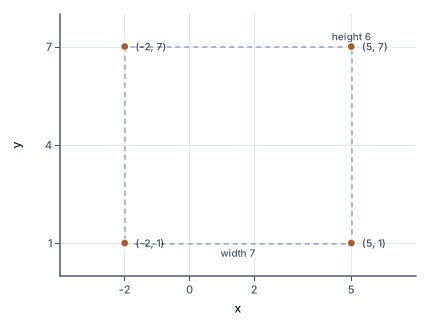
Rectangle. A rectangle drawn along the grid has two horizontal sides and two vertical sides. Read the width from a horizontal side and the height from a vertical side, then multiply. For vertices $(-2, 1)$, $(5, 1)$, $(5, 7)$ and $(-2, 7)$, the width is $2 + 5 = 7$, the height is $7 - 1 = 6$, and the area is $7 \times 6 = 42$ square units.
The chart shows that rectangle, with its width read along y = 1 and its height along x = 5.
Right triangle. If one side of a triangle is horizontal and another is vertical, they meet at a right angle. Those two sides are the base and the height, and the area is half their product. The slanted third side cuts a rectangle exactly in half, which is where the half comes from.
Composite shape. An L-shaped or stepped polygon can be cut into rectangles with a line across or a line up and down. Find each rectangle's area from its own corners and add. Draw the cut before you calculate, and label each piece with its width and height. You can also find the area by subtracting: draw the big rectangle around the whole shape and take away the missing corner.
In a rectangle drawn along the grid, every vertex shares its $x$-coordinate with the vertex above or below it, and its $y$-coordinate with the vertex beside it. That means three vertices are enough to find the fourth.
Suppose a rectangle has vertices $(-4, -1)$, $(3, -1)$ and $(3, 5)$. The first two share $y = -1$, so they form the bottom side. The last two share $x = 3$, so they form the right side. The missing vertex is the top-left corner. It is straight above $(-4, -1)$, so its $x$ is $-4$, and straight across from $(3, 5)$, so its $y$ is 5. The fourth vertex is $(-4, 5)$.
Check by making sure opposite sides match. The bottom and top are both 7 units long, and the left and right sides are both 6 units. A sketch helps: plot the three points, and the missing corner is usually easy to see.
Maps and building plans are drawn to scale. On a town map, one grid unit might stand for 10 feet on the ground. Coordinates still give lengths in grid units, so there is one more step: multiply each length by the scale.
Suppose a rectangular pool on such a map has corners $(-2, 1)$ and $(3, 4)$ at opposite ends. Its sides are $2 + 3 = 5$ units and $4 - 1 = 3$ units long, which is 50 feet by 30 feet on the ground. The real area is $50 \times 30 = 1500$ square feet.
Be careful with area. Multiplying the grid lengths first gives $5 \times 3 = 15$ square units, and each square unit is a square 10 feet by 10 feet, which is 100 square feet, not 10. So change the lengths to real units before you multiply, and the area comes out right on its own.
To find a side length:
To find an area or a perimeter:
To check:
An NBA basketball court is 94 feet long and 50 feet wide. Put the center of the court at the origin of a coordinate plane, with 1 unit for 1 foot. The corners are then $(-47, -25)$, $(47, -25)$, $(47, 25)$ and $(-47, 25)$.
The long side from $(-47, -25)$ to $(47, -25)$ crosses the $y$-axis, so its length is $47 + 47 = 94$ feet. The short side from $(47, -25)$ to $(47, 25)$ is $25 + 25 = 50$ feet. The floor's area is $94 \times 50 = 4700$ square feet, and the boundary line around it is $2 \times (94 + 50) = 288$ feet long. Placing the origin at the center makes the court symmetric: every point on one half has a partner with the opposite $x$-coordinate on the other half, which is how the two free-throw lanes and the two baskets mirror each other.
A family plans an L-shaped garden on graph paper where each square is 1 foot. The corners are $(0, 0)$, $(12, 0)$, $(12, 4)$, $(6, 4)$, $(6, 10)$ and $(0, 10)$. Cutting across at $y = 4$ gives a bottom bed $12 \times 4 = 48$ square feet and a top bed $6 \times 6 = 36$ square feet, 84 square feet in all. A 2-cubic-foot bag of mulch spread 2 inches deep covers 12 square feet, so they need $84 \div 12 = 7$ bags. For a border, they add the six sides: $12 + 4 + 6 + 6 + 6 + 10 = 44$ feet of edging. Reading lengths from coordinates lets them buy supplies before digging.
Subtracting when the points are on opposite sides. From $(-3, 4)$ to $(9, 4)$ is 12 units, not $9 - 3 = 6$. Across an axis, add the distances.
Using the wrong coordinates. For a horizontal side the $y$-values are the same, so the length comes from the $x$-values, not the $y$-values.
Negative lengths. $2 - 9 = -7$ tells you to subtract the other way. A length is always positive.
Forgetting the half for a triangle. Base times height is the rectangle; the triangle is half of it.
Mixing up area and perimeter. Area multiplies and is in square units; perimeter adds and is in plain units.
Find the length of the side from $F(4, -6)$ to $G(4, 3)$. Compare the coordinates.
$x = 4 \text{ for both points}$
The same $x$ means the side is vertical, so only the $y$-values matter.
Find $F$'s distance from the $x$-axis.
$|-6| = 6$
$F$ is 6 units below the axis, and a distance is never negative.
Find $G$'s distance from the $x$-axis.
$|3| = 3$
$G$ is 3 units above the axis.
Add the two distances.
$6 + 3 = 9 \text{ units}$
The points are on opposite sides of the axis, so the side is made of both pieces.
Check by subtracting the $y$-coordinates.
$3 - (-6) = 3 + 6 = 9$
The larger $y$ minus the smaller $y$ gives the same length.
A rectangle has vertices $(-5, -2)$, $(3, -2)$, $(3, 4)$ and $(-5, 4)$. Pick a horizontal side.
$(-5, -2) \text{ to } (3, -2)$
These two vertices share $y = -2$.
Find its length, the width of the rectangle.
$5 + 3 = 8 \text{ units}$
The side crosses the $y$-axis, so add the distances 5 and 3.
Pick a vertical side and find its length, the height.
$(3, -2) \text{ to } (3, 4): \; 2 + 4 = 6 \text{ units}$
This side crosses the $x$-axis, so add the distances 2 and 4.
Multiply for the area.
$8 \times 6 = 48 \text{ square units}$
A rectangle's area is width times height.
Add the four sides for the perimeter.
$8 + 6 + 8 + 6 = 28 \text{ units}$
Opposite sides of a rectangle are equal, so there are two of each length.
Check by counting on a sketch.
$8 \text{ squares across}, \; 6 \text{ squares up}$
Counting grid squares along two sides agrees with the coordinates.
A polygon has vertices $(0, 0)$, $(8, 0)$, $(8, 3)$, $(5, 3)$, $(5, 7)$ and $(0, 7)$. Sketch it and cut it with a line across at $y = 3$.
$\text{bottom rectangle and top rectangle}$
All the corners are right angles, so a line across at the step makes two rectangles.
Find the bottom rectangle's width and height.
$8 - 0 = 8, \qquad 3 - 0 = 3$
It runs from $x = 0$ to $x = 8$ and from $y = 0$ to $y = 3$.
Find the bottom area.
$8 \times 3 = 24$
Width times height.
Find the top rectangle's width and height.
$5 - 0 = 5, \qquad 7 - 3 = 4$
It runs from $x = 0$ to $x = 5$, and from $y = 3$ up to $y = 7$.
Find the top area.
$5 \times 4 = 20$
Width times height again.
Add the two areas.
$24 + 20 = 44 \text{ square units}$
The two rectangles cover the shape once each.
Check by subtracting from the big rectangle.
$8 \times 7 - 3 \times 4 = 56 - 12 = 44$
The 8 by 7 rectangle around the shape, minus the empty 3 by 4 corner, gives the same area.
Find the horizontal side, the base.
$2 + 6 = 8 \text{ units}$
$(-2, -3)$ and $(6, -3)$ share $y = -3$ and are on opposite sides of the $y$-axis.
Find the vertical side, the height.
$3 + 2 = 5 \text{ units}$
$(-2, -3)$ and $(-2, 2)$ share $x = -2$ and are on opposite sides of the $x$-axis.
Take half of base times height.
A side of a polygon runs from $A(-5, 3)$ to $B(8, 3)$. How far is each point from the $y$-axis, and how long is the side?
A is da units from the $y$-axis, B is db units from it, and the side is ab units long.
A triangle has vertices $P(-7, -8)$, $Q(2, -8)$ and $R(-7, 6)$. Complete the worked solution to find its area.
Find the length of $PQ$, which is horizontal.
$|-7| + |2| =$ base units
$P$ and $Q$ share their $y$, and they sit on opposite sides of the $y$-axis, so add their distances from it.
Find the length of $PR$, which is vertical.
$|-8| + |6| =$ height units
$P$ and $R$ share their $x$, and they sit on opposite sides of the $x$-axis.
Notice the right angle at $P$.
$PQ \text{ horizontal}, \; PR \text{ vertical} \;\Rightarrow\; PQ \perp PR$
A horizontal and a vertical side always meet at a right angle, so they are the base and the height.
Multiply the base by the height.
$PQ \times PR =$ rect square units
This is the area of the rectangle with the two legs as its sides.
Take half.
$\text{rectangle} \div 2 =$ area square units
The side $QR$ cuts that rectangle into two equal triangles, and ours is one of them.
Three corners of rectangle $ABCD$ are $A(-8, -6)$, $B(6, -6)$ and $C(6, 7)$. What are the coordinates of the fourth corner, $D$?
$D$ is at $x =$ dx and $y =$ dy.
A rectangle has vertices $(-2, 7)$, $(5, 7)$, $(5, -4)$ and $(-2, -4)$. Find its width, its height and its area.
The width is w units, the height is h units, and the area is area square units.
A community garden plan is drawn on a grid where each unit is 1 yard. A rectangular vegetable plot has corners at $(-3, -3)$, $(1, -3)$, $(1, 2)$ and $(-3, 2)$. How long and how wide is the plot, and how many yards of fence go around it?
The plot is len yards long and wid yards wide, and it needs fence yards of fence.
A school draws its new playground on a grid where each unit is 1 yard. The playground's corners, in order, are $(-3, 0)$, $(4, 0)$, $(4, 4)$, $(1, 4)$, $(1, 8)$ and $(-3, 8)$. Cut it with a line across at $y = 4$. Find the area of each part and of the whole playground.
The bottom part is bottom square yards, the top part is top square yards, and the playground is total square yards.
On a town map, each grid unit stands for 10 feet. A rectangular parking lot has opposite corners at $(-3, -5)$ and $(0, -1)$. What are the lot's real length and width in feet, and what is its real area in square feet?
The lot is len feet long and wid feet wide, with an area of area square feet.
Lesson test: one question per skill, one attempt each, no hints. Your answers are checked when you submit.
A school draws its new playground on a grid where each unit is 1 yard. The playground's corners, in order, are $(-6, 0)$, $(4, 0)$, $(4, 4)$, $(3, 4)$, $(3, 9)$ and $(-6, 9)$. Cut it with a line across at $y = 4$. Find the area of each part and of the whole playground.
The bottom part is bottom square yards, the top part is top square yards, and the playground is total square yards.
You can find side lengths and areas of a polygon from its coordinates. Without looking: how long is the side between $(-2, 3)$ and $(-2, 9)$, and how long is the side between $(-4, 1)$ and $(5, 1)$?
16. Your turn: find the area of the triangle with vertices $(-2, -3)$, $(6, -3)$ and $(-2, 2)$, step 3
$\tfrac{1}{2} \times 8 \times 5 = 20 \text{ square units}$
A right triangle is half of the rectangle its legs make.