Back to the on-screen lesson ·
Filling a box with unit cubes when the edges are not whole numbers.
Paper packet. Every task here also exists on screen, where it is checked automatically; answers written on paper are not assessed by Nydus. When you are back at a device, enter your answers there.
In this lesson you find the volume of a box whose edges are fractions. You fill the box with smaller cubes, such as cubes with edges of one half unit, count them, and see that the count gives the same volume as multiplying length, width and height. Then you use $V = l \times w \times h$ and $V = B \times h$ directly with fractions and mixed numbers, and run them backward to find a missing edge.
In grade 5 you found the volume of a box with whole-number edges by packing it with unit cubes: a box 4 units long, 3 wide and 2 high holds $4 \times 3 \times 2 = 24$ unit cubes, so its volume is 24 cubic units. You also know the formulas $V = l \times w \times h$ and $V = B \times h$, where $B$ is the area of the base. And you can multiply fractions: $\tfrac{1}{2} \times \tfrac{1}{2} = \tfrac{1}{4}$. This lesson puts these together for boxes whose edges are not whole numbers.
| Term | What it means |
|---|---|
| Volume | The amount of space inside a solid, measured by how many unit cubes fill it. |
| Unit cube | A cube whose edges are 1 unit long. Its volume is 1 cubic unit. |
| Cubic unit | The unit of volume, such as a cubic inch or a cubic foot: the space a unit cube takes up. |
| Rectangular prism | A box shape with six rectangle faces. Its edges are its length, width and height. |
| Base | The face the prism stands on. Its area, written $B$, is length times width. |
| Mixed number | A whole number and a fraction together, such as $2\tfrac{1}{2}$, which equals $\tfrac{5}{2}$. |
Volume counts how many unit cubes fill a solid. That is easy when every edge is a whole number. But what about a box that is $1\tfrac{1}{2}$ units long? A whole unit cube does not fit neatly into the last half unit.
The fix is to use smaller cubes. Cubes with edges of $\tfrac{1}{2}$ unit fit exactly: 2 of them along every unit. Look at how many fill one unit cube. Two fit along the length, two across the width, and there are two layers, so
$$2 \times 2 \times 2 = 8$$
half-cubes make one unit cube. Each half-cube is therefore $\tfrac{1}{8}$ of a cubic unit, and $\tfrac{1}{2} \times \tfrac{1}{2} \times \tfrac{1}{2} = \tfrac{1}{8}$ says the same thing.
Now take a box $1\tfrac{1}{2}$ by 2 by $2\tfrac{1}{2}$ units. Along the edges fit 3, 4 and 5 half-cubes, so $3 \times 4 \times 5 = 60$ half-cubes fill it. Sixty eighths is $60 \div 8 = 7\tfrac{1}{2}$ cubic units. Multiplying the edges gives the same answer: $\tfrac{3}{2} \times 2 \times \tfrac{5}{2} = \tfrac{30}{4} = 7\tfrac{1}{2}$. So the formula $V = l \times w \times h$ still works when the edges are fractions. Counting small cubes shows why.
Another way: picture
Picture a box of sugar cubes. Each sugar cube is about half an inch on a side. Line 2 of them up and you have covered one inch. A layer 2 by 2 covers one square inch, and two such layers stacked fill one cubic inch: 8 sugar cubes. A box of sugar cubes that is 3 inches by 2 inches by 1 inch holds $6 \times 4 \times 2 = 48$ of them, which is $48 \div 8 = 6$ cubic inches, the same as $3 \times 2 \times 1$.
Another way: numbers
Think of the formula one layer at a time. A base of $\tfrac{5}{2}$ by 2 units has an area of 5 square units, so one layer 1 unit thick holds 5 cubic units. If the box is only $\tfrac{1}{2}$ unit tall, it holds half a layer: $5 \times \tfrac{1}{2} = 2\tfrac{1}{2}$ cubic units. Multiplying by a fractional height just takes that fraction of a full layer.
The number of small cubes in one unit cube depends on how small they are. If a small cube's edge is $\tfrac{1}{k}$ unit, then $k$ of them fit along each edge of the unit cube, and they fill it in $k$ layers of $k$ rows of $k$.
| Small edge | Along one edge | In one unit cube | Volume of one small cube |
|---|---|---|---|
| $\tfrac{1}{2}$ | 2 | $2 \times 2 \times 2 = 8$ | $\tfrac{1}{8}$ |
| $\tfrac{1}{3}$ | 3 | $3 \times 3 \times 3 = 27$ | $\tfrac{1}{27}$ |
| $\tfrac{1}{4}$ | 4 | $4 \times 4 \times 4 = 64$ | $\tfrac{1}{64}$ |
Notice how quickly the count grows. Halving the edge does not make 2 small cubes per unit cube; it makes 8, because the cubes shrink in all three directions at once. This is the most common surprise in this lesson. To go from a count of small cubes to cubic units, divide by the number that fill one unit cube: 8 for halves, 27 for thirds, 64 for quarters.
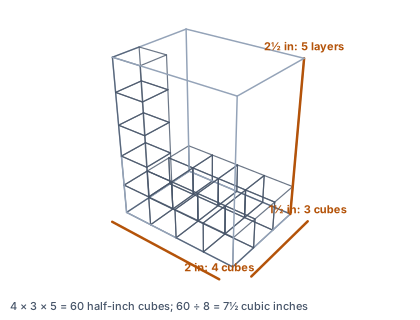
The picture is the box from the start of this lesson, measured in inches: 2 inches long, $1\tfrac{1}{2}$ inches wide and $2\tfrac{1}{2}$ inches tall. Look first at the floor. It is covered by one layer of half-inch cubes, 4 along the 2-inch edge and 3 along the $1\tfrac{1}{2}$-inch edge, so one layer holds $4 \times 3 = 12$ cubes. Now look at the column of cubes standing in one corner. It shows how many layers fit up the $2\tfrac{1}{2}$-inch height: 5. Every layer is the same as the floor, so the whole box holds $12 \times 5 = 60$ half-inch cubes. The last step is the one people forget. A half-inch cube is not half a cubic inch; 8 of them make one cubic inch, so the volume is $60 \div 8 = 7\tfrac{1}{2}$ cubic inches. Turn the box in the live figure and count the layer again from another side: the count, and the volume, stay the same.
Counting cubes explains the formula, but multiplying is faster. To use $V = l \times w \times h$ with fractions:
For a box $\tfrac{3}{4}$ foot by 6 feet by 2 feet, the volume is $\tfrac{3}{4} \times 6 \times 2 = \tfrac{36}{4} = 9$ cubic feet. Dividing out early keeps numbers small: $\tfrac{3}{4} \times 12$ is $3 \times (12 \div 4) = 3 \times 3 = 9$.
You can also use $V = B \times h$. Find the area of the base first, then multiply by the height. It does not matter which face you call the base, since multiplication can be done in any order. Pick the face whose area is easiest to find.
Sometimes you know the volume and two edges and need the third. Because $V = B \times h$, the missing height is the volume divided by the area of the base:
$$h = V \div B.$$
Suppose a tank holds 30 cubic feet and its base is $2\tfrac{1}{2}$ feet by 4 feet. The base has an area of $\tfrac{5}{2} \times 4 = 10$ square feet, so the height is $30 \div 10 = 3$ feet. Check by multiplying: $10 \times 3 = 30$. Always check a backward answer by working forward.
If the division leaves a fraction, that is fine. A volume of 15 cubic feet over the same 10-square-foot base gives a height of $1\tfrac{1}{2}$ feet.
A cubic unit is always a cube whose edge is one of the length units. A cubic inch is a cube 1 inch on each side, about the size of a large sugar cube. A cubic foot is a cube 1 foot on each side, and a cubic yard is a cube 1 yard on each side.
The same idea as the small cubes tells you how these units compare. A foot is 12 inches, so a cubic foot holds 12 cubic inches along its length, 12 across its width and 12 layers up: $12 \times 12 \times 12 = 1728$ cubic inches. A yard is 3 feet, so a cubic yard holds $3 \times 3 \times 3 = 27$ cubic feet. The numbers grow three times over, once for each direction.
Keep all three edges in the same unit before you multiply. A box 2 feet long, 18 inches wide and 1 foot tall should first become 2 feet by $1\tfrac{1}{2}$ feet by 1 foot, which is 3 cubic feet. Multiplying $2 \times 18 \times 1$ would give 36, a number with no sensible unit at all, since it mixes feet with inches.
To find the volume of a box with fractional edges:
To count small cubes instead: divide each edge by the small edge to count cubes along it, multiply the three counts, then divide by the number of small cubes in one unit cube.
To check your answer:
The US Postal Service sells a Priority Mail Medium Flat Rate Box whose inside measures 11 inches by $8\tfrac{1}{2}$ inches by $5\tfrac{1}{2}$ inches. How much can it hold? Change the mixed numbers to fractions and multiply:
$$11 \times \frac{17}{2} \times \frac{11}{2} = \frac{2057}{4} = 514\tfrac{1}{4} \text{ cubic inches}.$$
A flat rate box costs the same to mail whatever is inside, as long as it fits and stays under the weight limit. So a seller with a stack of books 10 inches by 8 inches by 5 inches, which is 400 cubic inches, can tell that it fits, with room left over for padding. Shipping companies measure boxes this way every day, because space in a truck is limited and every cubic inch has a cost.
A family builds a raised garden bed 6 feet long, $3\tfrac{1}{2}$ feet wide and $1\tfrac{1}{2}$ feet deep. The soil it needs is its volume:
$$6 \times \frac{7}{2} \times \frac{3}{2} = \frac{126}{4} = 31\tfrac{1}{2} \text{ cubic feet}.$$
Garden soil is often sold in bags of $1\tfrac{1}{2}$ cubic feet. Dividing, $31\tfrac{1}{2} \div 1\tfrac{1}{2} = \tfrac{63}{2} \times \tfrac{2}{3} = 21$ bags fill the bed. If the family fills it only 1 foot deep, the volume drops to $6 \times 3\tfrac{1}{2} \times 1 = 21$ cubic feet, which is 14 bags. Getting the fractions right means buying the right number of bags instead of making a second trip to the store.
Thinking half-size cubes make 2 per unit cube. They make 8, because they shrink in length, width and height.
Dropping the fraction. $3\tfrac{1}{2}$ is not 3. Change it to $\tfrac{7}{2}$ before you multiply.
Multiplying a mixed number piece by piece. $2\tfrac{1}{2} \times 4$ is not $2 \times 4$ plus $\tfrac{1}{2}$; it is $8 + 2 = 10$, because the half is multiplied by 4 too.
Adding the edges. Volume multiplies the three edges; adding them measures nothing useful.
Wrong units. Area is in square units and volume in cubic units. A base area is not yet a volume.
A box is 2 units long, $1\tfrac{1}{2}$ units wide and 1 unit tall. Count half-unit cubes along the length.
$2 \div \tfrac{1}{2} = 4$
Each unit of length holds two half-unit cubes.
Count them across the width.
$1\tfrac{1}{2} \div \tfrac{1}{2} = 3$
One whole unit holds two, and the last half unit holds one more.
Count them up the height.
$1 \div \tfrac{1}{2} = 2$
A height of 1 unit holds two layers of half-unit cubes.
Multiply the three counts.
$4 \times 3 \times 2 = 24 \text{ half-unit cubes}$
Rows times columns times layers counts every cube in the box.
Change the count into cubic units.
$24 \div 8 = 3 \text{ cubic units}$
Eight half-unit cubes fill one unit cube.
A shoe box is $12\tfrac{1}{2}$ inches long, 7 inches wide and $4\tfrac{1}{2}$ inches tall. Change the mixed numbers to fractions.
$12\tfrac{1}{2} = \dfrac{25}{2}, \qquad 4\tfrac{1}{2} = \dfrac{9}{2}$
Fractions can be multiplied directly; mixed numbers cannot.
Find the area of the base, length times width.
$\dfrac{25}{2} \times 7 = \dfrac{175}{2}$
The bottom of the box is a rectangle.
Multiply the base by the height.
$\dfrac{175}{2} \times \dfrac{9}{2} = \dfrac{1575}{4}$
Multiply the tops together and the bottoms together.
Divide to turn the fraction into a mixed number.
$1575 \div 4 = 393 \text{ remainder } 3$
The quotient is the whole number of cubic inches, and the remainder is the fourths left over.
Write the volume with its unit.
$V = 393\tfrac{3}{4} \text{ cubic inches}$
An edge in inches gives a volume in cubic inches.
Check with a whole-number estimate.
$12 \times 7 \times 4 = 336 \;<\; 393\tfrac{3}{4} \;<\; 13 \times 7 \times 5 = 455$
Rounding the edges down and up traps the exact volume between two easy products.
A fish tank holds 3,000 cubic inches of water when full. Its base is 25 inches by $10\tfrac{1}{2}$ inches. Write the rule that links the numbers.
$V = B \times h$
The water fills the tank in layers the shape of its base.
Change the mixed number to a fraction.
$10\tfrac{1}{2} = \dfrac{21}{2}$
This makes the base easy to multiply.
Find the area of the base.
$25 \times \dfrac{21}{2} = \dfrac{525}{2} = 262\tfrac{1}{2} \text{ square inches}$
Length times width gives the base.
Divide the volume by the base to find the height.
$3000 \div \dfrac{525}{2} = 3000 \times \dfrac{2}{525} = \dfrac{6000}{525}$
Dividing by a fraction is multiplying by its reciprocal.
Simplify the fraction by dividing top and bottom by 75.
$\dfrac{6000}{525} = \dfrac{80}{7}$
75 is the greatest common factor of 6000 and 525.
Write the height as a mixed number.
$\dfrac{80}{7} = 11\tfrac{3}{7} \text{ inches}$
Seven goes into 80 eleven times with 3 left over.
Check by multiplying back.
$\dfrac{525}{2} \times \dfrac{80}{7} = \dfrac{42000}{14} = 3000$
Base times height gives back the full volume, so the height is right.
Change the mixed number to a fraction.
$2\tfrac{1}{2} = \dfrac{5}{2}$
Fractions multiply directly.
Multiply the first two edges.
$\dfrac{3}{4} \times 4 = 3$
Three fourths of 4 is 3.
Multiply by the last edge.
A cube with edges of 1 unit is filled with small cubes whose edges are $\dfrac{1}{4}$ unit. How many small cubes fill it, and what is the reason?
A block of wood is $4\tfrac{1}{2}$ inches long, 5 inches wide and $3\tfrac{1}{2}$ inches tall. Complete the worked solution that finds its volume by counting cubes with edges of $\tfrac{1}{2}$ inch.
Count the half-inch cubes along the length.
$4\tfrac{1}{2} \div \tfrac{1}{2} =$ along
Two half-inch cubes fit in each whole inch, and one more fits in the last half inch.
Count them across the width.
$5 \div \tfrac{1}{2} = 10$
Each of the 5 inches holds two of them.
Count them up the height.
$3\tfrac{1}{2} \div \tfrac{1}{2} = 7$
The height works like the length: two per inch and one for the half inch.
Multiply the three counts to count every cube.
$(\text{along}) \times 10 \times 7 =$ count cubes
Rows times columns times layers counts a box of cubes.
Divide by 8 to change half-inch cubes into cubic inches.
$(\text{count}) \div 8 =$ vol cubic inches
Two along, two across and two up: $2 \times 2 \times 2$ half-inch cubes fill one cubic inch.
Check with the formula: length times width times height gives the same volume.
$V = l \times w \times h$
Counting small cubes and multiplying the fractional edges are two ways to measure the same space.
A box is $4\tfrac{1}{2}$ units long, 4 units wide and 2 units high. It is packed with cubes whose edges are $\tfrac{1}{2}$ unit. How many cubes fit along the length, how many fill the bottom layer, and how many fill the box?
row cubes fit along the length, layer fill the bottom layer, and total fill the box.
A box is $6\tfrac{1}{2}$ units long, 5 units wide and 6 units high. Find the area of its base and its volume.
The base has an area of base square units, and the volume is volume cubic units.
A box is $7\tfrac{1}{2}$ inches long and 8 inches wide. Its height is $h$ inches. Write an expression for its volume in cubic inches.
Answer:
A builder pours concrete for a garden path. The path is 24 feet long and 2 feet wide, and the concrete is $\dfrac{3}{4}$ foot thick. Find the area of the top of the path and the volume of concrete.
The top of the path is area square feet, and the path needs volume cubic feet of concrete.
A raised garden bed is $4\tfrac{1}{2}$ feet long and 4 feet wide. When it is full it holds 18 cubic feet of soil. What is the area of its base, and how deep is it?
The base is base square feet, and the bed is depth feet deep.
Lesson test: one question per skill, one attempt each, no hints. Your answers are checked when you submit.
A builder pours concrete for a garden path. The path is 24 feet long and 3 feet wide, and the concrete is $\dfrac{1}{4}$ foot thick. Find the area of the top of the path and the volume of concrete.
The top of the path is area square feet, and the path needs volume cubic feet of concrete.
You can find the volume of a box with fractional edges. Without looking: how many cubes with edges of one half unit fit inside a unit cube, and why is it not 2?
17. Your turn: find the volume of a box $\tfrac{3}{4}$ foot by 4 feet by $2\tfrac{1}{2}$ feet, step 3
$3 \times \dfrac{5}{2} = \dfrac{15}{2} = 7\tfrac{1}{2} \text{ cubic feet}$
Three times five halves is fifteen halves.