Back to the on-screen lesson ·
Composite shapes, prisms, and the difference between what fills a solid and what wraps it.
Paper packet. Every task here also exists on screen, where it is checked automatically; answers written on paper are not assessed by Nydus. When you are back at a device, enter your answers there.
In this lesson you find areas of shapes made from simpler ones, and the volume and surface area of prisms. Be careful with the last two: volume is what fills a solid, and surface area is what wraps it. They have different units, cubic and square, and the units catch the mix-up every time.
You can find the area of a rectangle (length times width) and of a triangle (half of base times height). You know that a box 3 cubes long, 2 cubes wide and 2 cubes tall holds $3 \times 2 \times 2 = 12$ cubes. You have just learned the area of a circle, $\pi r^2$. This lesson needs no brand-new formula. It asks you to break a shape into pieces you already know, and to decide whether a question is about covering or filling.
| Term | What it means |
|---|---|
| Composite figure | A flat shape made of simpler shapes put together, or with a piece cut away. |
| Prism | A solid with two matching ends joined by flat sides, and the same slice all along its length. |
| Base of a prism | One of the two matching ends. It can be a triangle, a rectangle or any polygon. |
| Face | One flat surface of a solid. A box has 6 faces. |
| Net | A solid unfolded flat, so that all its faces lie in one plane. |
| Surface area | The total area of all the faces of a solid, in square units. |
| Volume | The amount of space inside a solid, in cubic units. |
There are three questions you can ask about size.
For a prism, volume has one rule: volume = area of the base times the length (or height). A box is a prism with a rectangle for its base. A tent shape is a prism with a triangle for its base. The rule works for both.
For a shape that is not a simple rectangle or triangle, split it into pieces you know, find each area, and add. Or find a bigger simple shape and subtract the part that is missing.
Another way: picture
Think of a loaf of sliced bread. Every slice is the same shape. The volume of the loaf is the area of one slice times how many slices deep the loaf goes. The surface area is the crust: the outside of the loaf, all the way around, including both ends.
Another way: steps
A composite figure is a shape built from simpler shapes. To find its area, draw lines that split it into rectangles and triangles, find each area, and add them.
A floor shaped like the letter L can be cut into two rectangles. Suppose the long arm is 12 ft by 4 ft and the short arm is 5 ft by 4 ft. The area is $48 + 20 = 68$ square feet. You could cut it a different way and get different rectangles, but the total is always the same, because the floor does not change.
Sometimes it is easier to subtract. Picture a square patio 10 ft on each side with a 2 ft by 2 ft square hole in the middle for a tree. The patio stones cover $100 - 4 = 96$ square feet. Here the big shape is easy, and the hole is easy, so subtracting is quicker than cutting the patio into four strips.
When a piece is a triangle, remember the half. A triangle with base 6 and height 4 covers $\frac{1}{2} \times 6 \times 4 = 12$ square units, which is exactly half of the 6 by 4 rectangle around it. A shape made of a rectangle and a half circle works the same way: find the full circle and halve it.
Look at a box 4 cm long, 3 cm wide and 5 cm tall. The bottom layer holds $4 \times 3 = 12$ one-centimeter cubes. The box is 5 cm tall, so it holds 5 such layers: $12 \times 5 = 60$ cubes. That is 60 cubic centimeters.
Notice that 12 is the area of the base, and 5 is how many layers are stacked on it. So volume = base area times height. This reasoning never used the fact that the base was a rectangle. Any prism is made of identical slices, so the same rule works when the base is a triangle, a trapezoid or a hexagon.
| Prism | Area of the base | Length | Volume |
|---|---|---|---|
| Box, base 4 cm by 3 cm | 12 sq cm | 5 cm | 60 cubic cm |
| Triangle end, base 6 cm, height 4 cm | 12 sq cm | 5 cm | 60 cubic cm |
| Triangle end, base 6 cm, height 4 cm | 12 sq cm | 10 cm | 120 cubic cm |
The first two rows have the same base area and the same length, so they hold the same amount, even though their shapes look different. Doubling the length doubles the volume, as the last row shows.
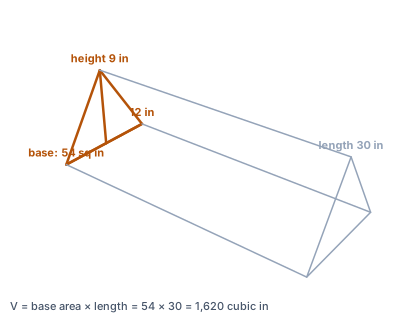
The picture is the triangular planter from the second worked example below. Look first at the highlighted triangle at the near end: that is the base of the prism, even though the planter does not stand on it. Its bottom edge is 12 in and its height, the highlighted line from the bottom edge straight up to the top corner, is 9 in, so its area is $\tfrac{1}{2} \times 12 \times 9 = 54$ square inches. Now follow the long edges to the far end, 30 in away: the same triangle appears there, and at every point in between. That is why the volume is $54 \times 30 = 1{,}620$ cubic inches. Keep the two heights apart: the 9 in belongs to the triangle, and the 30 in is the length of the prism.
To find a surface area, imagine cutting the solid along some edges and folding it flat. The flat pattern is called a net. Every face shows up in the net once, so the surface area is the area of the net.
A cube has 6 matching square faces. A cube with edges of 3 in has surface area $6 \times 9 = 54$ square inches.
A box (a rectangular prism) has 6 faces in 3 matching pairs: top and bottom, front and back, left and right. For a box 5 in by 4 in by 2 in the pairs are $2 \times 20$, $2 \times 10$ and $2 \times 8$, so the surface area is $40 + 20 + 16 = 76$ square inches.
A triangular prism has 5 faces: two triangles at the ends and three rectangles around the sides. Each side rectangle is as long as the prism, and as wide as one side of the triangle. The three rectangles are only the same size when the triangle has three equal sides.
Read each question carefully. A box with no lid has only 5 faces to paint. A tent without a floor has only 4 pieces of fabric.
The unit tells you what kind of answer you have. A length is in feet. An area is in square feet, written sq ft or ft². A volume is in cubic feet, written ft³.
Changing units needs extra care. One foot is 12 inches, but one square foot is $12 \times 12 = 144$ square inches, and one cubic foot is $12 \times 12 \times 12 = 1{,}728$ cubic inches. A cube 1 ft on each side really does hold 1,728 little inch cubes.
Some everyday units are volumes in disguise. One US gallon is exactly 231 cubic inches, and one cubic yard, the unit a garden center uses for soil or mulch, is $3 \times 3 \times 3 = 27$ cubic feet.
Every problem in this lesson follows the same steps.
Each step has a reason. Deciding first tells you whether to add areas or multiply by a length. Listing the faces stops you from forgetting one, or counting one twice. Working one piece at a time lets you find a mistake quickly.
How to check. Estimate with a simple box. A triangular prism holds exactly half of the box around it, so its volume must be less than the box's. A composite floor must have less area than the rectangle that surrounds it. For surface area, count your faces again: a box has 6, a triangular prism has 5. Last, look at the units. If you multiplied three lengths, the answer is cubic; if you multiplied two, it is square.
Paint cans say how much wall one gallon covers; for most interior paint it is about 350 to 400 square feet. Suppose a bedroom is 12 ft long, 10 ft wide and 8 ft tall. The four walls are two walls of $12 \times 8 = 96$ sq ft and two of $10 \times 8 = 80$ sq ft, so $192 + 160 = 352$ square feet. The door and window are not painted: take away about 21 sq ft for a door (3 ft by 7 ft) and 15 sq ft for a window, leaving 316 square feet. Two coats need $2 \times 316 = 632$ square feet of coverage, so a painter buys 2 gallons. Notice that the ceiling and the floor were left out: the job only covers some of the room's faces.
A common aquarium size in US pet stores is called a 29-gallon tank. It measures 30 inches long, 12 inches wide and 18 inches tall. It is a box, so its volume is $30 \times 12 \times 18 = 6{,}480$ cubic inches. A US gallon is exactly 231 cubic inches, so the tank holds $6{,}480 \div 231 \approx 28$ gallons when full to the brim. In practice it holds a little less, because the glass has thickness and the water stops below the rim, which is why the label is a rounded number. Knowing the gallons matters: fish food, water treatment and filter size are all chosen by the number of gallons.
A raised garden bed is a wooden box with no top and no bottom, filled with soil. A bed 8 ft long, 4 ft wide and 1 ft deep holds $8 \times 4 \times 1 = 32$ cubic feet of soil. Garden centers sell bulk soil by the cubic yard, and a cubic yard is 27 cubic feet, so this bed needs about $32 \div 27 \approx 1.2$ cubic yards. The wood for the sides is a surface area question instead: two sides of $8 \times 1 = 8$ sq ft and two ends of $4 \times 1 = 4$ sq ft make 24 square feet of board. The same bed needs one answer in cubic feet and another in square feet, because filling and covering are different questions.
The biggest mistake is mixing up surface area and volume. A cube with edges of 6 cm has surface area $6 \times 36 = 216$ square cm and volume $6 \times 6 \times 6 = 216$ cubic cm. The digits match by coincidence, but the two numbers measure different things. Paint, wrapping paper and fabric are surface area. Water, sand and soil are volume.
The second mistake is forgetting the half in a triangle. The volume of a triangular prism is not base times height times length; it is half of that.
The third is using the wrong length. For a triangular prism's sloping face, use the sloping edge, not the height of the triangle. The height stands straight up inside the triangle and is shorter than the slope.
The last is counting faces wrong: forgetting the bottom, or adding a lid the box does not have. Read the question, and list the faces before you calculate.
The end wall of a shed is a rectangle 10 ft wide and 8 ft tall, with a triangle 4 ft tall on top. Split the wall into its two pieces.
$\text{wall} = \text{rectangle} + \text{triangle}$
Each piece has a formula you already know.
Find the area of the rectangle.
$10 \times 8 = 80$
A rectangle's area is its width times its height.
Find the area of the triangle.
$\tfrac{1}{2} \times 10 \times 4 = 20$
The triangle's base is the full 10 ft width of the wall.
Add the two pieces.
$80 + 20 = 100 \text{ sq ft}$
The pieces do not overlap, so their areas add.
Check against the rectangle around the whole wall.
$10 \times 12 = 120 > 100$
The wall fits inside a 10 ft by 12 ft rectangle, so its area must be less than 120.
A planter is a triangular prism 30 in long. Its triangular end has a base of 12 in and a height of 9 in. Name the base of the prism.
$\text{base} = \text{the triangular end}$
The triangle is the slice that stays the same all along the planter.
Write the area of the triangle.
$\tfrac{1}{2} \times 12 \times 9$
A triangle is half of base times height.
Multiply 12 by 9, then halve the result.
$\tfrac{1}{2} \times 108 = 54 \text{ sq in}$
$12 \times 9 = 108$, and half of that is 54.
Write the prism rule.
$V = 54 \times 30$
Volume is the base area times the length.
Multiply the base area by the length.
$V = 1{,}620 \text{ cubic in}$
$54 \times 30 = 1{,}620$; the answer counts inch cubes.
Check with the box around the planter.
$12 \times 9 \times 30 = 3{,}240, \quad 3{,}240 \div 2 = 1{,}620$
The triangular prism is exactly half of the box that surrounds it.
A wooden ramp is a triangular prism 6 ft wide. Its side is a right triangle 4 ft along the ground, 3 ft tall at the back and 5 ft along the slope. Every face is painted except the bottom. List the faces.
$2 \text{ triangles} + \text{slope} + \text{back} + \text{bottom}$
A triangular prism has five faces; listing them stops you from missing one.
Find the area of one triangular side.
$\tfrac{1}{2} \times 4 \times 3 = 6$
The two legs of a right triangle are its base and height.
Double it for both sides.
$2 \times 6 = 12$
The left and right sides of the ramp match.
Find the area of the slope.
$5 \times 6 = 30$
The slope is a rectangle, the 5 ft sloping edge by the 6 ft width.
Find the area of the back.
$3 \times 6 = 18$
The back is a rectangle, the 3 ft height by the width.
Find the area of the bottom, which is not painted.
$4 \times 6 = 24$
It is a face of the prism, so work it out, but leave it out of the paint.
Add the painted faces.
$12 + 30 + 18 = 60 \text{ sq ft}$
Paint covers faces, so this is part of the surface area, in square feet.
Check with the whole surface area.
$60 + 24 = 84, \quad 84 - 24 = 60$
All five faces make 84 sq ft; taking away the bottom gives the same 60.
Find the top and bottom together.
$2 \times 5 \times 4 = 40$
They are matching rectangles, length by width.
Find the front and back together.
$2 \times 5 \times 3 = 30$
They are matching rectangles, length by height.
Find the two ends together.
Add the three pairs.
You want to know how much wrapping paper covers a gift box. Which measurement answers that question?
A shoebox is $10$ in long, $5$ in wide and $3$ in tall. Complete the worked solution for its surface area.
Find the area of the top and the bottom together.
$2 \times 10 \times 5 =$ tb
The top and bottom are matching rectangles, length by width.
Find the area of the front and the back together.
$2 \times 10 \times 3 =$ fb
The front and back are matching rectangles, length by height.
Find the area of the two ends together.
$2 \times 5 \times 3 = 30$
The two ends are matching rectangles, width by height.
Add the three pairs.
$SA =$ sa
Surface area is the total of all six faces, in square inches.
A prism has a triangular end with base $13$ cm and height $9$ cm. The prism is $14$ cm long. Which expression gives its volume in cubic cm?
Each edge of a cube is $4$ cm long. What is the cube's surface area, in square cm?
Answer:
The end of a prism is a triangle with base $2$ cm and height $9$ cm. The prism is $13$ cm long. What is the area of its triangular end, and what is its volume, in cubic cm?
End: e square cm. Volume: v cubic cm.
A bedroom floor is a rectangle $14$ ft by $16$ ft, except that a closet takes a $4$ ft by $3$ ft rectangle out of one corner. What is the area of the whole rectangle, and how many square feet of carpet cover the floor?
Whole rectangle: w sq ft. Carpet: c sq ft.
An arched window is a rectangle $20$ in tall and $8$ in wide, with a half circle sitting on its top edge. The half circle's diameter is the window's width. The glass has area $A + B\pi$ square inches. Fill in $A$ and $B$.
$A =$ a and $B =$ b
Lesson test: one question per skill, one attempt each, no hints. Your answers are checked when you submit.
A tent is a triangular prism $7$ ft long. Each triangular end has a base of $10$ ft, a height of $12$ ft and two sloping sides of $13$ ft. The tent has a sewn-in floor. How much fabric do the two ends take, how much do the two sloping walls take, and how many square feet make the whole tent?
Two ends: e sq ft. Two walls: w sq ft. Whole tent: t sq ft.
You can find the volume and surface area of a prism. Without looking: which one is measured in cubic units, what would you compute to work out how much paint a box needs, and why is a triangular prism's volume half of the box around it?
17. Your turn: the surface area of a box 5 cm by 4 cm by 3 cm, step 3
$2 \times 4 \times 3 = 24$
They are matching rectangles, width by height.
17. Your turn: the surface area of a box 5 cm by 4 cm by 3 cm, step 4
$40 + 30 + 24 = 94 \text{ sq cm}$
The six faces together make the surface area.