Back to the on-screen lesson ·
Two formulas, what $\pi$ actually is, and why one uses the radius squared.
Paper packet. Every task here also exists on screen, where it is checked automatically; answers written on paper are not assessed by Nydus. When you are back at a device, enter your answers there.
In this lesson you find the circumference and the area of a circle. You will see what $\pi$ is, the number of diameters that fit around the edge of every circle, and why the area formula squares the radius. You will work from a radius, a diameter or a circumference, give exact and decimal answers, and check them.
You can find the perimeter and the area of a rectangle, and you know that area is measured in square units. You can multiply decimals such as $3.14 \times 6$. A circle has no straight sides to add up and no length and width to multiply, so this lesson gives it two formulas of its own and shows where they come from.
| Term | What it means |
|---|---|
| Radius | The distance from the center of a circle to its edge, $r$. |
| Diameter | The distance straight across through the center, $d = 2r$. |
| Circumference | The distance around the circle, $C = \pi d = 2\pi r$. |
| Area | The space inside the circle, in square units, $A = \pi r^2$. |
| Pi, $\pi$ | The number of diameters that fit around any circle, about $3.14$ or $\frac{22}{7}$. |
| Exact answer | An answer that keeps $\pi$ as a symbol, such as $10\pi$; using $3.14$ gives an approximate one. |
Wrap a string around a soda can, then lay it straight next to the can's diameter. The string is a little more than three diameters long. Do it with a plate, a coin or a bicycle wheel and you get the same answer: the circumference is always about 3.14 times the diameter. That fixed number is called pi, written $\pi$. It is the same for every circle, large or small.
So the distance around a circle is
$$C = \pi d \quad\text{or, since } d = 2r, \quad C = 2\pi r.$$
The space inside the circle is
$$A = \pi r^2,$$
which means $\pi \times r \times r$. The circumference is a length, so it grows in step with the radius: double the radius and the circumference doubles. The area is a surface, and it grows with the radius squared: double the radius and the area becomes four times as large.
Another way: picture
Cut a paper circle into 16 thin wedges, like a pizza. Lay them side by side, points up and points down in turn. They form a shape very close to a rectangle. Its height is the radius $r$. Its length is half the circumference, $\pi r$, because half the crusts are on top and half on the bottom. Rectangle area is length times height: $\pi r \times r = \pi r^2$.
Another way: steps
Measure some round things and divide the circumference by the diameter.
| Object | Circumference | Diameter | $C \div d$ |
|---|---|---|---|
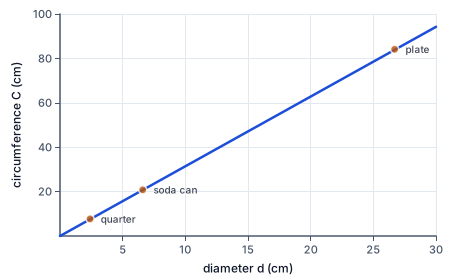
| Quarter | 7.6 cm | 2.4 cm | about 3.2 |
| Soda can | 20.7 cm | 6.6 cm | about 3.1 |
| Dinner plate | 84 cm | 26.7 cm | about 3.1 |
Each ratio is close to 3.14, and it would be exactly $\pi$ if we could measure perfectly. Pi is not a whole number or a simple fraction. Its decimal goes on forever without repeating: $3.14159\ldots$ For most work, $3.14$ or $\frac{22}{7}$ is close enough.
Because every circle is an enlargement of every other circle, the ratio of circumference to diameter never changes. That is why one number appears in every circle formula. If you remember only that the circumference is about three diameters, you can always check your work.
The graph plots the three objects from the table, with the diameter across and the circumference up. Look at where the dots land: all three sit on one straight line that starts at the origin, $(0, 0)$. That is the picture of a proportional relationship, and the constant is $\pi$. Read the line at a diameter of 10 cm and it gives about 31.4 cm; at 20 cm it gives about 62.8 cm, twice as much. A measured object whose dot sits far off the line has been measured wrongly.
The wedge picture shows where $\pi r^2$ comes from. Here is another way to see that the answer is sensible. Draw a square around a circle of radius $r$. The square's side is the diameter, $2r$, so its area is $2r \times 2r = 4r^2$. The circle fits inside with the corners left over, so its area is less than $4r^2$. A square drawn corner to corner inside the circle has area $2r^2$, so the circle's area is more than $2r^2$. The true answer, about $3.14r^2$, sits between them.
The square also explains why doubling the radius makes four times the area. Area is length times length. When the radius doubles, both lengths double, and $2 \times 2 = 4$. A pizza 16 inches across has four times the area of one 8 inches across, even though it is only twice as wide. Tripling the radius gives nine times the area.
Leaving $\pi$ in the answer gives an exact answer. A circle of radius 5 cm has circumference $10\pi$ cm and area $25\pi$ square cm. These are not unfinished: they are the most accurate form, and they show the pattern clearly.
To get a number you can measure, replace $\pi$ with $3.14$: $10\pi \approx 31.4$ cm and $25\pi \approx 78.5$ square cm. The sign $\approx$ means about equal to. When the radius is a multiple of 7, $\frac{22}{7}$ is often easier: a circle of radius 7 in has circumference $2 \times \frac{22}{7} \times 7 = 44$ in. Use whichever form the question asks for.
Many real shapes are parts of circles. A half circle, or semicircle, has half the area of the full circle, so its area is $\frac{1}{2}\pi r^2$. A semicircle of radius 4 ft has area $\frac{1}{2} \times 3.14 \times 16 = 25.12$ square feet. Its perimeter is trickier, because the edge is half the circumference plus the straight diameter across the bottom: $\frac{1}{2} \times 3.14 \times 8 + 8 = 12.56 + 8 = 20.56$ feet. Forgetting the straight edge is a common slip.
A quarter circle works the same way with one fourth. A slice of pie that is one sixth of the pie has one sixth of the area.
You can also work backward. If a circle's area is $49\pi$ square inches, then $r^2 = 49$. Ask which number times itself gives 49. The answer is 7, so the radius is 7 inches and the diameter is 14 inches. If the circumference is $18\pi$ cm, then $2r = 18$, so the radius is 9 cm. Undo each operation in reverse order, exactly as you would when solving an equation.
Every circle problem in this lesson follows the same path.
Each move has a reason. Step 2 comes first because both formulas are written with the radius. Squaring happens before multiplying by $\pi$ because powers come before multiplication.
How to check. For circumference, estimate three diameters. A circle 10 in across has a circumference near 30 in, so an answer of 314 is wrong. For area, estimate three radius squares. A circle of radius 10 has an area near $3 \times 100 = 300$, and it must be less than the $4 \times 100 = 400$ of the square around it. Finally, check the units match the question: a fence in square feet is a sign the wrong formula was used.
A bike computer counts how many times the front wheel turns and multiplies by the wheel's circumference. Take a mountain bike with 26 inch wheels, which means a diameter of about 26 inches. One turn carries the bike forward by $C = \pi d \approx 3.14 \times 26 = 81.64$ inches.
A mile is 5,280 feet, and each foot is 12 inches, so a mile is $5280 \times 12 = 63{,}360$ inches. The number of turns in a mile is $63{,}360 \div 81.64 \approx 776$. If a rider sets the computer for the wrong wheel, every mile it reports is wrong by the same factor. That is why the setup screen asks for the wheel size first.
Suppose the computer is set for a 29 inch wheel but the bike really has 26 inch wheels. It thinks each turn covers $3.14 \times 29 = 91.06$ inches when the bike really moves 81.64 inches. After a real ride of 10 miles it would report about $10 \times 91.06 \div 81.64 \approx 11.2$ miles. The diameters are in the ratio $29 \div 26$, and so are the circumferences, because $\pi$ is the same for both wheels.
A pizza shop sells a 12 inch pizza for \$12 and a 16 inch pizza for \$18. The sizes are diameters, so the radii are 6 in and 8 in. The areas are $3.14 \times 6^2 = 113.04$ square inches and $3.14 \times 8^2 = 200.96$ square inches.
Divide price by area to get the cost of one square inch: $12 \div 113.04 \approx 0.106$ dollars, about 10.6 cents, for the small pizza, and $18 \div 200.96 \approx 0.090$ dollars, about 9 cents, for the large one. The large pizza is only 4 inches wider, but it has almost 78% more pizza, so it is the better deal.
Flying over farms in the Great Plains, you can see huge green circles. Each is watered by a center-pivot sprinkler, a long pipe on wheels that swings around a fixed point. A common pivot is a quarter mile long, 1,320 feet, so it waters a circle of radius 1,320 ft. Its area is $3.14 \times 1320^2 \approx 5{,}471{,}000$ square feet. An acre is 43,560 square feet, so that is about 126 acres, out of the 160 acres in the square field around it. The corners stay dry.
The most common mistake is mixing up the two formulas. Remember what each one measures: $2\pi r$ is a length around the edge, and $\pi r^2$ is a surface. If your answer is in square units, it must have come from $r^2$.
The second is using the diameter where the radius belongs. A circle 10 cm across has area $\pi \times 5^2 = 25\pi$, not $\pi \times 10^2 = 100\pi$, which is four times too big. Halve first.
The third is doubling instead of squaring: $6^2$ is 36, not 12. The fourth is squaring $\pi r$ together: in $\pi r^2$ only the $r$ is squared. Last, some learners think doubling the radius doubles the area. It doubles the circumference, but it makes the area four times as large. A circle of radius 3 in has area $9\pi$; one of radius 6 in has area $36\pi$, which is four times as much.
Write the circumference formula.
$C = 2\pi r$
The circumference is $\pi$ diameters, and a diameter is two radii.
Substitute the radius.
$C = 2 \times \pi \times 5$
Here $r = 5$ cm.
Multiply the numbers, keeping $\pi$ as a symbol.
$C = 10\pi \text{ cm}$
$2 \times 5 = 10$. This is the exact answer.
Replace $\pi$ with $3.14$ for a decimal answer.
$C \approx 10 \times 3.14 = 31.4 \text{ cm}$
A measured length needs a number, and 3.14 is close to $\pi$.
Check with three diameters.
$3 \times 10 = 30 \approx 31.4$
The diameter is 10 cm, and the circumference is always a little more than three diameters.
The diameter is 12 in. Halve it to get the radius.
$r = 12 \div 2 = 6 \text{ in}$
The area formula is written with the radius.
Write the area formula.
$A = \pi r^2$
Area is a surface, so a length is multiplied by a length.
Substitute the radius.
$A = \pi \times 6^2$
Only the radius is squared.
Square the radius.
$6^2 = 6 \times 6 = 36 \;\Rightarrow\; A = 36\pi \text{ in}^2$
Squaring means multiplying by itself: 36, not 12.
Multiply by $3.14$ for a decimal answer.
$A \approx 3.14 \times 36 = 113.04 \text{ in}^2$
$3 \times 36 = 108$ and $0.14 \times 36 = 5.04$, which add to $113.04$.
Check between the two squares.
$2 \times 36 = 72 < 113.04 < 144 = 4 \times 36$
The circle's area must lie between the square inside it and the square around it.
A circular fountain has a circumference of 62.8 ft. Write the formula that links it to the diameter.
$C = \pi d \;\Rightarrow\; 62.8 = 3.14 \times d$
The area formula needs the radius, and the circumference leads to it through the diameter.
Divide both sides by $3.14$.
$d = \dfrac{62.8}{3.14} = 20 \text{ ft}$
Dividing undoes the multiplication by $\pi$.
Halve the diameter to get the radius.
$r = 20 \div 2 = 10 \text{ ft}$
The radius is half the diameter.
Write the area formula and substitute.
$A = \pi r^2 = \pi \times 10^2$
Now the radius is known, the area formula can be used.
Square the radius.
$10^2 = 100 \;\Rightarrow\; A = 100\pi \text{ ft}^2$
This is the exact area.
Multiply by $3.14$.
$A \approx 3.14 \times 100 = 314 \text{ ft}^2$
Multiplying by 100 moves the decimal point two places.
Check the size of the answer.
$3 \times 10^2 = 300 \approx 314$
The area is about three radius squares, so 314 square feet is sensible.
Write the circumference with the diameter.
$C = \pi d = \pi \times 8$
The diameter is given, so $C = \pi d$ is the quickest formula.
Write the exact answer.
Multiply by $3.14$.
A circle has radius $5$ cm. Which expression gives its area in square centimeters?
A circle has a diameter of $10$ ft. Taking $\pi$ as $3.14$, complete the worked solution for its radius, circumference and area.
Halve the diameter to get the radius.
$r = 10 \div 2 =$ r
The radius runs from the center to the edge, half of the way across.
Write the circumference as $\pi$ times the diameter.
$C = \pi d = 3.14 \times 10$
Every circumference is $\pi$ diameters long.
Multiply to find the circumference.
$C =$ c
The circumference is a length, so it is in feet.
Write the area as $\pi$ times the radius squared.
$A = \pi r^2 = 3.14 \times (\text{radius})^2$
Area uses the radius, multiplied by itself.
Square the radius and multiply by $3.14$.
$A =$ a
The area is a surface, so it is in square feet.
To work out tiles for a circular patio, which measurement of the circle do you need?
A circle has radius $8$ cm. Its circumference is $k\pi$ cm. What is $k$?
Answer:
A circle has diameter $20$ cm. Its area is $k\pi$ square cm. What is the radius, and what is $k$?
$r =$ r cm, and $k =$ k
A forester wraps a tape measure around a tree trunk and reads a circumference of $43.96$ inches. Taking $\pi$ as $3.14$, what is the trunk's diameter, in inches?
Answer:
A wheel has radius $11$ cm. It makes $18$ complete turns without slipping. The distance traveled is $k\pi$ cm. How far does one turn carry it, and what is $k$?
One turn: c$\pi$ cm. In all, $k =$ k
Lesson test: one question per skill, one attempt each, no hints. Your answers are checked when you submit.
The rope around a circular pond is $81.64$ feet long. Taking $\pi$ as $3.14$, what is the pond's radius, and what is its area, in square feet?
Radius: r ft. Area: ar square feet.
You can find a circle's circumference and area. Without looking: what does $\pi$ measure, which formula do you use for a fence around a round garden, and what happens to the area if you double the radius?
17. Your turn: the circumference of a circle 8 m across, step 2
$C = 8\pi \text{ m}$
Keeping $\pi$ gives the exact circumference.
17. Your turn: the circumference of a circle 8 m across, step 3
$C \approx 3.14 \times 8 = 25.12 \text{ m}$
Close to three diameters, 24 m, as it should be.