Back to the on-screen lesson ·
The two-dimensional shape a cut through a solid leaves behind.
Paper packet. Every task here also exists on screen, where it is checked automatically; answers written on paper are not assessed by Nydus. When you are back at a device, enter your answers there.
In this lesson you name the flat shape you get when a solid is sliced, and you find its size. The same solid gives different shapes for different cuts: a cylinder cut across gives a circle, and cut straight down gives a rectangle. You will learn the rules for level cuts, straight-down cuts and tilted cuts, and how to find the area of the slice from the solid's measurements.
You know the common solids: the cube, the rectangular prism, the cylinder, the pyramid and the cone. You can find the area of a rectangle, a square and a triangle. In this lesson you imagine cutting a solid with one straight, flat cut and describe the flat shape that the cut leaves behind.
| Term | What it means |
|---|---|
| Cross section | The flat shape you see on the cut surface when a solid is sliced by one flat cut. |
| Plane | A flat surface that goes on forever; the knife's path is part of one. |
| Parallel | Running in the same direction and never meeting, like two shelves. |
| Perpendicular | Meeting at a right angle, like a wall standing on a floor. |
| Prism | A solid with two matching bases joined by flat side faces, the same size all the way along. |
| Pyramid | A solid with one base and triangular sides that meet at a point, the apex. |
Slice a solid with one straight, flat cut and look at the cut surface. The flat shape you see is the cross section. The same solid can give very different cross sections, because the shape depends on which way the knife goes.
Two rules cover most cuts.
A third fact lets you check any cut: each flat face the knife crosses adds one straight side to the cross section. A curved surface adds a curve instead.
Another way: picture
Think of a loaf of bread. Every slice you cut across the loaf has the shape of the loaf's end. Now cut the loaf the long way, from top to bottom. The cut face is a long rectangle as tall as the loaf. Same loaf, two different cross sections, because the knife went two different ways.
Another way: steps
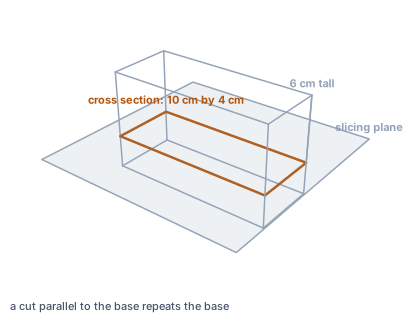
A prism is the same all the way along: its side faces go straight up from the base. So a cut parallel to the base gives an exact copy of the base, at any height. A box 10 cm long and 4 cm wide gives a 10 cm by 4 cm rectangle whether you slice it 1 cm up or 5 cm up. A cylinder, which is a prism with a circle for a base, gives the same circle at every height. That is why a roll of cookie dough gives round cookies of equal size.
A pyramid or a cone is different, because it narrows to a point. A cut parallel to the base still gives the base's shape: a square pyramid gives a square, and a cone gives a circle. But the slice gets smaller as the cut moves up toward the apex. The size shrinks evenly. A cut one third of the way down from the apex gives a square one third as wide as the base. Halfway down gives a square half as wide.
Look at the box in the picture: it is 10 cm long, 4 cm wide and 6 cm tall, and the flat slicing plane passes through it 2 cm above the floor. The highlighted outline is the cross section. Trace it with your finger and count its sides: four, one for each side face the plane crosses. Its sides are 10 cm and 4 cm, the same as the bottom edges, because the side faces stand straight up. Slide the plane up or down in your mind and the outline does not change, which is what "a prism is the same all the way along" means.
A cut perpendicular to the base runs from the top of the solid to the bottom, so the height shows up in the cross section.
| Solid | Cut straight down | Cross section |
|---|---|---|
| Rectangular prism | parallel to a side face | rectangle, the size of that face |
| Cylinder | through the center | rectangle, diameter by height |
| Cylinder | off center | narrower rectangle, same height |
| Square pyramid | through the apex | triangle, as tall as the pyramid |
| Square pyramid | not through the apex | trapezoid |
| Cone | through the apex | triangle |
For a cylinder, the widest vertical cut goes through the center, where the knife crosses the circle along a diameter. Move the knife toward the edge and the rectangle gets narrower, but it keeps the full height. For a pyramid, a cut through the apex reaches the top point, so its two slanted sides meet in a triangle. A cut that misses the apex stops short of the top and has a flat top edge, which makes a trapezoid.
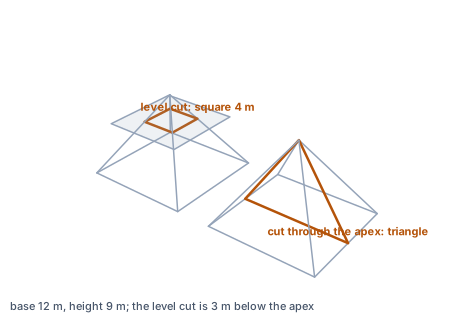
The picture shows the same square pyramid twice, with a base 12 m on each side and a height of 9 m. On the left, a level cut 3 m below the apex leaves a small square: it has the base's shape, but it is only 4 m wide, because the cut is one third of the way down. On the right, a cut straight down through the apex leaves a triangle as wide as the base at the bottom and as tall as the pyramid. Compare the two highlighted shapes: one solid, two cuts, two different cross sections. Turn the figure to see that the triangle stands straight up while the square lies flat.
A tilted cut can give shapes the base never had. The key is to count faces. Every flat face the knife passes through leaves one straight edge on the cross section. A cube has six faces, so a slice of a cube can have three, four, five or six sides, but never seven.
Curved surfaces work the same way. A cut through a cylinder that crosses the curved side only, at a tilt, gives an oval. A cut that crosses the curved side and the flat top and bottom gives a shape with two straight sides and two curved ones.
To find a cross section and its size, use the same four moves every time.
Each move has a reason. Step 1 matters because prisms keep their size and pyramids shrink. Step 2 matters because the same solid gives different shapes for different cuts. Step 3 works because the edges of the slice are exactly where the knife met the faces.
How to check. Compare the slice with the solid: no side of the slice can be longer than the solid allows, and a slice of a pyramid must be smaller than its base. Count again: the number of sides must equal the number of faces crossed. Best of all, try it. Slice a block of modeling clay or a potato cut into a box and look at the cut face.
A CT scanner takes X-ray pictures of the body one thin slice at a time. Each picture is a cross section: a doctor sees the inside of the chest as if it had been cut straight across, without any cut being made. Modern scanners can take slices less than a millimeter thick, and a computer stacks them back up to rebuild the body in three dimensions.
Suppose a scan covers 30 cm of a patient's chest with slices 1.25 mm thick. First make the units match: $30 \text{ cm} = 300 \text{ mm}$. Then $300 \div 1.25 = 240$ slices. A doctor can page through all 240 cross sections. The choice of cut matters, as it does in this lesson: slices across the body show a round outline, while slices from front to back show a tall shape running from the shoulders down. Radiologists look at more than one direction for the same reason you slice a cylinder two ways, because each direction shows something the other hides.
The glass pyramid at the entrance of the Louvre museum in Paris is a square pyramid about 35 m (115 ft) on each side of its base and 21.6 m (71 ft) tall. Imagine a level floor built halfway up. Its outline is a cross section parallel to the base, so it is a square. Halfway up is halfway down from the apex, so the square is half as wide as the base: $35 \div 2 = 17.5$ m on each side.
Its area is $17.5 \times 17.5 = 306.25$ square meters, while the base covers $35 \times 35 = 1225$ square meters. The halfway floor would be only one quarter of the base, because both its length and its width were halved. That is why the upper part of a pyramid holds so little space. A cut straight down through the apex would show a triangle 35 m wide and 21.6 m tall, with an area of $\frac{1}{2} \times 35 \times 21.6 = 378$ square meters.
The most common mistake is ignoring the direction of the cut and naming the base every time. A cylinder cut straight down is a rectangle, not a circle. Say which way the knife goes before you name anything.
The second is thinking a level cut of a pyramid or a cone is the same size as its base. It is the same shape, but it shrinks toward the apex. A cut halfway down is half as wide.
The third is mixing up the cross section with a face or with the net. A face is on the outside of the solid; a cross section is inside, where the knife went. Last, watch the width of a cut through a cylinder's center: it is the diameter, twice the radius. A cylinder of radius 4 in and height 10 in gives a rectangle 8 in by 10 in, with an area of 80 square inches, not 40. And when you find the area of a level slice of a box, leave the height out: it tells you where the cut is, not how big it is.
A box is 10 cm long, 4 cm wide and 6 cm tall. It is cut parallel to the base, 2 cm up. Say which way the knife goes.
$\text{cut} \parallel \text{base}$
The direction decides the shape, so it is named first.
Count the faces the knife crosses.
$4 \text{ side faces} \Rightarrow 4 \text{ sides}$
A level cut misses the top and the bottom and passes through the four side faces.
Find the length of each side of the slice.
$10 \text{ cm},\ 4 \text{ cm},\ 10 \text{ cm},\ 4 \text{ cm}$
The side faces go straight up, so at every height they are as long as the base edges below them.
Name the shape.
$\text{a rectangle, } 10 \text{ cm by } 4 \text{ cm}$
Four sides with square corners, the same as the base.
Find its area.
$10 \times 4 = 40 \text{ cm}^2$
Length times width. The height of the box and the 2 cm do not matter: a cut 5 cm up gives the same 40 square centimeters.
A cylinder has radius 3 in and height 8 in. First cut it parallel to the base.
$\text{cut} \parallel \text{base} \Rightarrow \text{circle, radius } 3 \text{ in}$
A cylinder is the same all the way up, so every level slice is a copy of the base.
Now cut straight down through the center. Name the shape.
$\text{cut} \perp \text{base} \Rightarrow \text{rectangle}$
The knife crosses the flat top and bottom in straight lines and runs down the curved side.
Find the width: through the center, the knife crosses the base along a diameter.
$2 \times 3 = 6 \text{ in}$
A diameter is twice the radius.
Find the height of the rectangle.
$8 \text{ in}$
The cut runs from the top of the cylinder to the bottom.
Multiply to find the area.
$6 \times 8 = 48 \text{ in}^2$
The area of a rectangle is width times height.
Move the cut off center and compare.
$\text{width} < 6 \text{ in}, \quad \text{height} = 8 \text{ in}$
Away from the center the knife crosses the circle on a shorter line, so the rectangle is narrower but just as tall.
A square pyramid has a base 12 m on each side and is 9 m tall. It is cut parallel to the base, 3 m below the apex. Name the shape.
$\text{cut} \parallel \text{base} \Rightarrow \text{a square}$
A level cut repeats the shape of the base, and the base is a square.
Find what fraction of the height lies above the cut.
$\dfrac{3}{9} = \dfrac{1}{3}$
The pyramid widens evenly from the apex down, so the width grows in step with the distance from the apex.
Scale the base side by that fraction.
$12 \times \dfrac{1}{3} = 4 \text{ m}$
One third of the way down, the square is one third as wide as the base.
Find the area of the slice.
$4 \times 4 = 16 \text{ m}^2$
The area of a square is side times side.
Compare with the area of the base.
$12 \times 12 = 144, \qquad \dfrac{16}{144} = \dfrac{1}{9}$
The side shrank to one third, and both directions shrank, so the area is one ninth.
Now cut straight down through the apex, parallel to one base edge. Name the shape.
$\text{a triangle with base } 12 \text{ m and height } 9 \text{ m}$
The cut runs from the apex down to the middle of the base, so it is as wide as the base at the bottom and a point at the top.
Find the area of that triangle.
$\dfrac{1}{2} \times 12 \times 9 = 54 \text{ m}^2$
The area of a triangle is half of base times height.
Name the shape of the slice.
$\text{cut} \parallel \text{a face} \Rightarrow \text{a square}$
A level cut through a cube repeats the face it is parallel to.
Find the side of the square.
Find the area.
A rectangular prism is sliced parallel to its base. What shape is the cross section?
A box is $10$ in long, $8$ in wide and $4$ in tall. Complete the worked solution to find the area of a slice parallel to each pair of faces.
Name the shape of every slice parallel to a face.
$\text{cut} \parallel \text{a face} \Rightarrow \text{a copy of that face, a rectangle}$
A box is the same size all the way through in each of its three directions.
Cut parallel to the base: multiply the length by the width.
$10 \times 8 =$ b
The base is the face with the length and the width as its edges.
Cut parallel to the front: multiply the length by the height.
$10 \times 4 =$ f
The front face is as long as the box and as tall as the box.
Cut parallel to the end: multiply the width by the height.
$8 \times 4 =$ e
The end face is as wide as the box and as tall as the box.
Check the order of the three areas.
$\text{base} > \text{front} > \text{end}$
The length is the longest edge and the height the shortest, so the face without the height is largest and the face without the length is smallest.
Match each sliced solid to the shape of its cross section.
| a rectangle | a triangle | a square | |
|---|---|---|---|
| A rectangular prism cut parallel to its base | |||
| A square pyramid cut straight down through its apex and the middle of two opposite base edges | |||
| A cube cut parallel to one of its faces |
A rectangular prism is $12$ cm long, $11$ cm wide and $10$ cm tall. It is sliced parallel to its base, $2$ cm above the base. What is the area of the cross section, in square centimeters?
Answer:
A cylinder has radius $5$ in and height $4$ in. It is sliced straight down through the center of its circular base. How wide is the cross section, and what is its area, in square inches?
Width: d in. Area: ar square inches.
A glass paperweight is a square pyramid with a base $9$ cm on each side, and it is $6$ cm tall. It is cut parallel to the base, $2$ cm below the apex. How long is a side of the cross section, and what is its area, in square centimeters?
Side of the slice: s cm. Area: ar square centimeters.
A block of cheese is a rectangular prism $5$ in long. Each end is $8$ in wide and $6$ in tall, and the slanted line from a top edge of the end to the opposite bottom edge measures $10$ in. A cheesemaker cuts the block along that slant for its whole length. What is the area of the cut face, in square inches?
Answer:
Lesson test: one question per skill, one attempt each, no hints. Your answers are checked when you submit.
A glass paperweight is a square pyramid with a base $20$ cm on each side, and it is $16$ cm tall. It is cut parallel to the base, $4$ cm below the apex. How long is a side of the cross section, and what is its area, in square centimeters?
Side of the slice: s cm. Area: ar square centimeters.
You can name the cross section of a sliced solid and find its area. Without looking: what shape do you get slicing a cylinder parallel to its base, and what if you slice it straight down through the center? Why can a slice of a cube never have seven sides?
15. Your turn: a cube with 5 inch edges, cut parallel to one face, step 2
$5 \text{ in}$
A cube is the same size all the way through, so the slice is as wide as a face.
15. Your turn: a cube with 5 inch edges, cut parallel to one face, step 3
$5 \times 5 = 25 \text{ in}^2$
The area of a square is side times side.