Back to the on-screen lesson ·
Finding $k$ from a table, a graph or a story, and saying what it means.
Paper packet. Every task here also exists on screen, where it is checked automatically; answers written on paper are not assessed by Nydus. When you are back at a device, enter your answers there.
In this lesson you find the constant $k$ in $y = kx$ from a table, a graph, an equation or a story, and say what it means in the situation. It is always a unit rate with units, such as dollars per pound or miles per hour. Reading it in those words is what makes it useful: once you know $k$, one multiplication gives any other value.
You can already find a unit rate. If 4 tickets cost 36 dollars, one ticket costs $36 \div 4 = 9$ dollars. You know that in a proportional relationship the ratio of $y$ to $x$ stays the same, and that its graph is a straight line through the origin. You can also divide by a fraction by multiplying by its reciprocal. In this lesson that unit rate gets a name, the constant of proportionality, and a place in an equation.
| Term | What it means |
|---|---|
| Proportional relationship | A relationship where $y$ is always the same multiple of $x$, so every ratio $y : x$ is equal. |
| Constant of proportionality | The number $k$ in $y = kx$. It is the value of $y$ when $x$ is 1. |
| Unit rate | An amount for one unit, such as 12 dollars per hour or 3 miles per hour. |
| Origin | The point $(0, 0)$. The graph of every proportional relationship passes through it. |
| Reciprocal | The number you multiply by to get 1: the reciprocal of $\tfrac{2}{5}$ is $\tfrac{5}{2}$. |
| Complex fraction | A fraction with a fraction in its top, its bottom or both, such as $\dfrac{1/2}{1/4}$. |
In a proportional relationship, $y$ is always the same number times $x$:
$$y = kx$$
The number $k$ is the constant of proportionality. It is the unit rate: the amount of $y$ for one unit of $x$. To find it, divide:
$$k = \frac{y}{x}$$
using any pair from the relationship except $(0, 0)$.
For example, if 5 pounds of apples cost 7.50 dollars, then $k = 7.50 \div 5 = 1.50$ dollars per pound, and the equation is $c = 1.5p$. Once you know $k$, every other value follows by multiplying: 8 pounds cost $1.5 \times 8 = 12$ dollars.
The constant always has units, and they are units of $y$ per unit of $x$: dollars per pound, miles per hour, pages per minute. Saying it in those words is how you know what it means.
Another way: picture
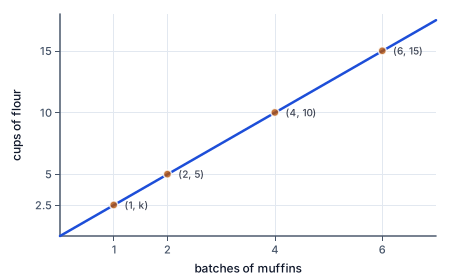
On a graph, a proportional relationship is a straight line through the origin. Walk 1 unit to the right from the origin and look straight up: the line is at height $k$. So the point $(1, k)$ is always on the line. The bigger $k$ is, the steeper the line.
Another way: story
Think of $k$ as the price tag for one. One pound of apples, one hour of work, one gallon of gas. The total is always the price for one times how many.
In a table, divide each $y$ value by its $x$ value. If every row gives the same number, the relationship is proportional and that number is $k$.
| Batches of muffins, $x$ | Cups of flour, $y$ | $y \div x$ |
|---|---|---|
| 2 | 5 | 2.5 |
| 3 | 7.5 | 2.5 |
| 6 | 15 | 2.5 |
Every row gives 2.5, so $k = 2.5$ cups of flour per batch and $y = 2.5x$.
If the rows give different numbers, there is no constant of proportionality. For example, a gym that charges a 20-dollar sign-up fee plus 10 dollars a month costs 30 dollars for 1 month and 40 dollars for 2 months. The quotients are 30 and 20, so the cost is not proportional to the months.
The graph of $y = kx$ is a straight line through the origin. Two points on it have special meanings.
If the point at $x = 1$ is hard to read, choose any other point where the line crosses the grid exactly, such as $(4, 10)$, and divide: $k = 10 \div 4 = 2.5$. Every point on the line gives the same answer, because every point has $y$ equal to $k$ times $x$.
The chart draws the muffin line: k is the height at x = 1, and every marked point gives the same quotient.
When the relationship is already written as an equation like $t = 0.08c$, the constant is the number in front of the variable: here 0.08. If $t$ is sales tax and $c$ is the price in dollars, the constant means 0.08 dollars of tax for every dollar spent, which is an 8% tax.
In a story, look for one matching pair and divide. "A printer prints 150 pages in 6 minutes" gives $k = 150 \div 6 = 25$ pages per minute, so $p = 25m$. Always check that the story really is proportional: the printer must print at a steady rate, and 0 minutes must mean 0 pages.
Sometimes both amounts are fractions. If a snail crawls $\frac{1}{2}$ foot in $\frac{1}{4}$ minute, its constant is still distance divided by time:
$$k = \frac{1}{2} \div \frac{1}{4} = \frac{1}{2} \times \frac{4}{1} = 2 \text{ feet per minute}$$
The answer is bigger than $\frac{1}{2}$, and that makes sense: a quarter of a minute is short, so a whole minute covers four times as far. A fraction written over another fraction, like $\dfrac{1/2}{1/4}$, is called a complex fraction, and it means exactly this division.
Every proportional relationship has two unit rates, one for each direction. If 4 pounds of rice cost 6 dollars, then rice costs $6 \div 4 = 1.50$ dollars per pound, and one dollar buys $4 \div 6 = \frac{2}{3}$ pound. Both are true.
Which one is $k$ depends on which quantity is $y$. The constant is always $y$ divided by $x$. If the equation gives cost from pounds, cost is $y$, so $k = 1.50$. Writing the units in words, dollars per pound, tells you right away which number goes on top.
The equation $y = kx$ answers two kinds of question.
The second kind of question is where many learners get stuck, because they reach for multiplication out of habit and get $600 \times 7.5 = 4{,}500$ minutes, which is more than three days. A quick size check saves you: filling 600 gallons at 7.5 gallons a minute should take a lot of minutes, but not thousands of them. When the unknown is $x$, undo the multiplication by $k$ with a division.
Use these steps for any problem in this lesson.
Each step has a reason. Checking proportionality first matters because the division only gives a constant when the ratio really is constant. Saying the units out loud catches the most common mistake, dividing the wrong way.
How to check. Put a second pair into your equation: it must fit. Ask whether $k$ is a sensible size for the story, since a walking speed of 30 miles per hour or a gas price of 40 dollars a gallon means something went wrong. And the point $(1, k)$ should lie on the graph.
Many jobs pay by the hour, and pay is proportional to the hours worked. The federal minimum wage in the United States has been 7.25 dollars per hour since 2009, though many states and cities set a higher one. At that rate, pay is $p = 7.25h$. A student who works 12 hours in a week earns $7.25 \times 12 = 87$ dollars, and one who works 20 hours earns $7.25 \times 20 = 145$ dollars. The graph of pay against hours is a straight line through the origin: zero hours, zero pay. The point $(1, 7.25)$ shows the constant, the pay for one hour.
Light from lightning reaches you almost at once, but the sound of thunder travels much more slowly, about 1,125 feet per second in air. That is roughly a mile every 5 seconds, so the distance to the lightning is close to proportional to the seconds you count between the flash and the thunder, with a constant of about $1 \div 5 = 0.2$ miles per second. The equation is $d = 0.2t$. Count 10 seconds and the strike was about $0.2 \times 10 = 2$ miles away. Count 15 seconds and it was about 3 miles away. Weather safety groups use this rule because lightning can strike several miles from a storm, so hearing thunder at all is a sign to go indoors.
Every new car sold in the United States carries a sticker with its fuel economy in miles per gallon. That number is a constant of proportionality: on a steady drive, distance is proportional to the gas used. A car rated at 32 miles per gallon follows $d = 32g$. With 11 gallons in the tank it can go about $32 \times 11 = 352$ miles. Planning a 480-mile trip, the driver can divide to find the gas needed: $480 \div 32 = 15$ gallons. Real driving is not perfectly steady, so the true numbers wobble a little, but the constant gives a good plan.
The most common mistake is dividing the wrong way. The constant is $y \div x$, not $x \div y$. If 3 hours of work earn 45 dollars, $k$ is 15 dollars per hour, not $3 \div 45 = 0.0\overline{6}$. Saying the units, dollars per hour, tells you the dollars go on top.
The second is finding k from a relationship that is not proportional. A taxi that charges a 3-dollar starting fee plus 2 dollars a mile is not proportional, so dividing one fare by its miles gives a different answer for every trip.
The third is mixing up the points $(1, k)$ and $(k, 1)$ on a graph. The $x$ value comes first, and the constant is a value of $y$.
The last is forgetting the units. The number 4.5 on its own means nothing; 4.50 dollars per pound tells you how to use it.
A store's table shows 2 pounds of trail mix for 9 dollars, 3 pounds for 13.50 dollars and 5 pounds for 22.50 dollars. Name the quantities.
$x = \text{pounds}, \quad y = \text{cost in dollars}$
The cost depends on how much you buy.
Divide the first cost by its pounds.
$9 \div 2 = 4.5$
Cost divided by pounds gives the cost of one pound.
Divide the other two rows.
$13.5 \div 3 = 4.5, \quad 22.5 \div 5 = 4.5$
Every row gives the same quotient, so the table is proportional.
State the constant with its units.
$k = 4.50 \text{ dollars per pound}$
The constant is the unit rate: the price of one pound.
Write the equation.
$c = 4.5p$
The cost is always 4.50 dollars times the number of pounds.
A graph shows gallons of water in a pool against minutes of filling. It is a straight line through $(0, 0)$. Decide whether it is proportional.
$\text{straight line through } (0, 0)$
Both facts together mean the relationship is proportional.
Choose a point where the line crosses the grid exactly.
$(4, 30)$
An exact point avoids guessing between gridlines.
Divide $y$ by $x$ at that point.
$k = 30 \div 4 = 7.5$
The constant is $y$ divided by $x$ at any point on the line.
Name the point that shows the constant.
$(1, 7.5)$
After 1 minute the pool holds 7.5 gallons, so the hose gives 7.5 gallons per minute.
Write the equation.
$g = 7.5m$
Gallons are 7.5 times the minutes.
Use the equation to predict 20 minutes of filling.
$7.5 \times 20 = 150 \text{ gallons}$
Once $k$ is known, any value comes from one multiplication.
Shop A charges 27 dollars for 3 hours and 45 dollars for 5 hours. Find its cost for one hour.
$27 \div 3 = 9$
Cost divided by hours gives the rate for one hour.
Check Shop A's second pair.
$45 \div 5 = 9$
Both pairs give the same quotient, so Shop A's price is proportional.
Write Shop A's equation.
$c = 9h$
Shop A's constant is 9 dollars per hour.
Shop B's graph is a line through the origin and $(2, 19)$. Find its constant.
$19 \div 2 = 9.5$
Any point on a line through the origin gives the constant.
Write Shop B's equation.
$c = 9.5h$
Shop B's constant is 9.50 dollars per hour.
Compare the two constants.
$9 < 9.5$
The smaller constant means less money for each hour, so Shop A is cheaper.
Find each cost for a 6-hour rental.
$9 \times 6 = 54, \quad 9.5 \times 6 = 57$
Multiply each constant by the hours.
Find how much Shop A saves.
$57 - 54 = 3 \text{ dollars}$
A difference of 0.50 dollars per hour for 6 hours is 3 dollars.
Divide the pages by the minutes.
$k = 90 \div 3 = 30$
The constant is the number of pages printed in one minute.
Write the equation.
Predict the pages printed in 7 minutes.
At a gas station, the cost $c$ in dollars of $g$ gallons of gas is $c = 3.90g$. What does the number $3.90$ tell you?
A car on the highway drives at a steady speed and covers $110$ miles in $2$ hours. Complete the worked solution to find how far it goes in $6$ hours at the same speed.
Write the relationship between distance and time.
$d = kt$
At a steady speed, distance is proportional to time.
Divide the distance by the time to find the constant.
$k = 110 \div 2 =$ k
The constant is the distance for one hour, which is the speed in miles per hour.
Multiply the constant by the new time.
$d = k \times 6 =$ d
Once $k$ is known, any distance is $k$ times the hours.
The graph of a proportional relationship is a straight line through $(0, 0)$ and $(8, 56)$. Which point on the line shows the constant of proportionality?
The quantity $y$ is proportional to $x$. When $x = 8$, $y = 12$. Find the constant of proportionality $k$.
$k =$ answer
Nia's pay is proportional to the hours she works. Her pay stubs show $48$ dollars for $3$ hours, $96$ dollars for $6$ hours and $160$ dollars for $10$ hours. What is the constant of proportionality, in dollars per hour?
Answer:
A printer prints $132$ pages in $4$ minutes, always at the same rate. How many pages does it print per minute, and how many minutes does it take to print $792$ pages?
k pages per minute, so t minutes.
Late one afternoon, a fence post $3$ feet tall casts a shadow $6$ feet long. At the same moment, a flagpole casts a shadow $60$ feet long. Shadows at the same moment are proportional to heights. How tall is the flagpole, in feet?
answer feet
Lesson test: one question per skill, one attempt each, no hints. Your answers are checked when you submit.
Rosa walks at a steady pace. She covers $\tfrac{2}{3}$ mile in $\tfrac{1}{6}$ hour. What is the constant of proportionality, in miles per hour, and how far does she walk in $3$ hours at this pace? Give decimals or whole numbers.
$k =$ k miles per hour. In $3$ hours: d miles.
You can find the constant of proportionality and explain it. Without looking: how do you find $k$ from a graph, which point on the graph shows it, and what are its units if $y$ is cost in dollars and $x$ is weight in pounds?
19. Your turn: a printer that prints 90 pages in 3 minutes, step 2
$p = 30m$
Pages are 30 times the minutes.
19. Your turn: a printer that prints 90 pages in 3 minutes, step 3
$30 \times 7 = 210 \text{ pages}$
Multiply the constant by the new number of minutes.