Back to the on-screen lesson ·
Trapping a root between perfect squares to place it on a number line.
Paper packet. Every task here also exists on screen, where it is checked automatically; answers written on paper are not assessed by Nydus. When you are back at a device, enter your answers there.
In this lesson you estimate a number like the square root of 40 by trapping it between the two perfect squares on either side, 36 and 49, so you know it lies between 6 and 7, and nearer 6. Then you zoom in to tenths. That is enough to put it on a number line and to compare it with a fraction, which is what irrational numbers are usually needed for.
You know the perfect squares: $1, 4, 9, 16, 25, 36, 49, 64, 81, 100, 121, 144, 169, 196, 225$. You know that $\sqrt{49} = 7$ because $7 \times 7 = 49$, and that a number like $\sqrt{40}$ is irrational: its decimal never ends and never repeats, so no fraction and no calculator display can show it exactly. You can also square a decimal, such as $1.5^2 = 2.25$, and compare and order decimals on a number line. This lesson puts those together to find out roughly how big an irrational number is, without a calculator, and to say how good the estimate is.
| Term | What it means |
|---|---|
| Perfect square | A whole number times itself, such as $36 = 6^2$. Its square root is a whole number. |
| Irrational number | A number that cannot be written as a fraction of whole numbers, such as $\sqrt{40}$ or $\pi$. |
| Estimate | A value close to the true one, given with an idea of how close it is. |
| Consecutive whole numbers | Whole numbers next to each other, like $6$ and $7$. |
| Trap (bound) | Two numbers with the unknown one between them: $6 < \sqrt{40} < 7$. |
| Approximately equal, $\approx$ | Close to but not exactly equal: $\sqrt{40} \approx 6.3$. |
You cannot write $\sqrt{40}$ as an exact decimal, but you can say a lot about it. The key fact is that squaring keeps order for positive numbers: if one positive number is bigger than another, its square is bigger too. So to find where $\sqrt{40}$ sits, look at where $40$ sits among the perfect squares.
$40$ is between $36$ and $49$. Their square roots are $6$ and $7$. So $\sqrt{40}$ is between $6$ and $7$:
$$36 < 40 < 49 \quad\Rightarrow\quad 6 < \sqrt{40} < 7.$$
That is the first trap. It already tells you the whole-number part. To get closer, notice that $40$ is only $4$ above $36$ but $9$ below $49$, so the root is nearer $6$ than $7$.
Then zoom in on the tenths. Square some decimals between $6$ and $7$: $6.3^2 = 39.69$ and $6.4^2 = 40.96$. Since $39.69 < 40 < 40.96$, the root is between $6.3$ and $6.4$. Each round of trapping pins down one more decimal place. You could keep going for ever, because the decimal never ends, but one or two places is almost always enough.
The same method works for cube roots, using perfect cubes, and for $\pi$, using what you know about circles.
Another way: picture
On a number line, the whole numbers are fence posts. Squaring tells you which two posts the root is between; squaring tenths tells you which of the ten gaps between those posts it is in.
Another way: a guessing game
Think of it as "higher or lower?" You guess $6.5$; squaring gives $42.25$, too high. Guess $6.3$: $39.69$, too low. Guess $6.4$: $40.96$, too high. The answer is between the last low and the last high guess.
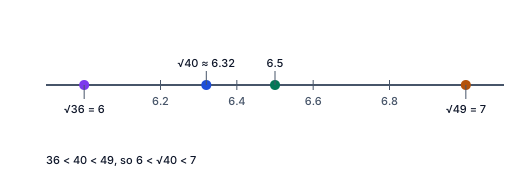
The number line runs from $6$ to $7$. The dots at the two ends are $\sqrt{36} = 6$ and $\sqrt{49} = 7$, the roots of the two perfect squares that trap $40$. The dot marked $6.5$ is the halfway point. The dot labeled $\sqrt{40}$ sits at about $6.32$. Look at where it is: well to the left of halfway, because $40$ is much nearer $36$ than $49$.
The picture also shows a quick way to guess the tenths. $40$ is $4$ steps into a gap of $13$ between $36$ and $49$, and $\frac{4}{13}$ is about $0.31$. That fraction-of-the-way estimate gives $6.31$, very close to the true value $6.3246\ldots$ Distances between squares and distances between roots are not exactly the same, but for a first guess they are near enough.
Comparing distances to the two squares is quick, but it can mislead when the number is near the middle. Try $\sqrt{56}$. It is between $7$ and $8$, because $49 < 56 < 64$. $56$ is $7$ above $49$ and $8$ below $64$, so it seems a little nearer $7$. To be sure, square the halfway number:
$$7.5^2 = 56.25.$$
$56$ is less than $56.25$, so $\sqrt{56}$ is less than $7.5$, and it rounds to $7$. In general $(n + 0.5)^2 = n^2 + n + 0.25$. That is the dividing line: numbers up to $n^2 + n$ round down, and numbers from $n^2 + n + 1$ up round up. For roots between $7$ and $8$ the line is $56.25$, not the middle of $49$ and $64$, which is $56.5$. The halfway point of the squares sits a little above the square of the halfway point.
To estimate to the nearest tenth, first trap between whole numbers. Then square tenths inside that interval until you pass the number. For $\sqrt{40}$: $6.1^2 = 37.21$, $6.2^2 = 38.44$, $6.3^2 = 39.69$, $6.4^2 = 40.96$. The number $40$ falls between the squares of $6.3$ and $6.4$.
You rarely need to square every tenth. Start with the one your first estimate points to. $40$ is about a third of the way from $36$ to $49$, so try $6.3$ first, then $6.4$.
To say which tenth is nearer, use the halfway test again: $6.35^2 = 40.3225$, which is more than $40$, so $\sqrt{40}$ is below $6.35$ and rounds to $6.3$. A calculator gives $6.324555\ldots$, which agrees.
Cube roots are trapped by perfect cubes: $8, 27, 64, 125, 216, 343, 512, 729, 1000$. Since $27 < 30 < 64$, $\sqrt[3]{30}$ is between $3$ and $4$, and much nearer $3$.
Pi is the distance around a circle divided by the distance across. You know $\pi \approx 3.14$, and $\frac{22}{7} \approx 3.143$ is a handy fraction that is a little too big. To estimate an expression with $\pi$, use bounds: $3.14 < \pi < 3.15$, so $2\pi$ is between $6.28$ and $6.30$. For $\pi^2$, square the bounds: $3.14^2 = 9.8596$ and $3.15^2 = 9.9225$, so $\pi^2$ is a little under $10$.
Once each number has an estimate, you can compare and order a mixed list of roots, fractions, decimals and $\pi$, which is what estimates are most often needed for.
An estimate is only useful if you know how good it is, so always say what your trap is. "$\sqrt{40}$ is between $6.3$ and $6.4$" is a complete, honest answer: the true value is somewhere in a gap one tenth wide. "$\sqrt{40} \approx 6.3$" says the same thing more briefly.
How many places you need depends on the job. To place a root on a number line marked in whole numbers, the first trap is enough. To compare $\sqrt{40}$ with $6.25$, you need tenths. To cut a board, a carpenter works to about an eighth of an inch. An engineer might need four decimal places. Each extra place takes one more round of squaring, and each round makes the gap ten times narrower. No number of rounds ever makes it exact, which is what being irrational means.
Why it works. For positive numbers, squaring keeps order, so trapping the square traps the root.
How to check. Square your estimate: it should land close to the original number, and just under it if you rounded down. $6.3^2 = 39.69$, close to $40$. If your square is far away, a multiplication slipped.
TV sizes are measured across the diagonal. A $55$-inch TV with the usual $16:9$ shape is about $48$ inches wide and $27$ inches tall. By the Pythagorean theorem its diagonal is $\sqrt{48^2 + 27^2} = \sqrt{2304 + 729} = \sqrt{3033}$ inches. Trap it: $55^2 = 3025$ and $56^2 = 3136$, so the diagonal is just over $55$ inches, since $3033$ is only $8$ above $3025$. That is why it is sold as a $55$-inch screen. Before buying, it is worth checking the width, not the diagonal, against the space on the wall.
A standard sheet of plywood in the United States is $4$ feet by $8$ feet. A carpenter bracing a wall frame of that size needs the diagonal, $\sqrt{4^2 + 8^2} = \sqrt{80}$ feet. Since $64 < 80 < 81$, it is between $8$ and $9$ feet, and very close to $9$. Zoom in: $8.9^2 = 79.21$ and $9^2 = 81$, so the diagonal is between $8.9$ and $9$ feet, about $8$ feet $11$ inches. A $10$-foot board is long enough to cut the brace from. The carpenter also uses the same number to check the frame is square: if the two diagonals measure the same, just under $9$ feet, the corners are right angles.
An acre is $43{,}560$ square feet, a unit US farmers and home buyers still use. How long is each side of a square lot of $2$ acres? Its area is $87{,}120$ square feet, so the side is $\sqrt{87120}$ feet. Trap it with round numbers first: $290^2 = 84{,}100$ and $300^2 = 90{,}000$. Then zoom in: $295^2 = 87{,}025$ and $296^2 = 87{,}616$. The side is just over $295$ feet, about the length of a football field without its end zones.
Halving instead of rooting. $\sqrt{40}$ is not $20$. Ask "what number times itself?"
Assuming the root is halfway. $\sqrt{40}$ is between $6$ and $7$ but not $6.5$; check with squares.
Using the wrong squares. $\sqrt{40}$ is not between $4$ and $5$ just because $40$ starts with $4$.
Ordering by the number under the root. Compare $\sqrt{10}$ and $3.5$ by squaring $3.5$ to get $12.25$, not by comparing $10$ with $3.5$.
Treating a calculator display as exact. $6.324555$ is still an estimate.
Estimate $\sqrt{70}$. Find the perfect square just below $70$.
$8^2 = 64$
$64$ is the largest perfect square under $70$.
Find the perfect square just above $70$.
$9^2 = 81$
$81$ is the smallest perfect square over $70$.
Trap the root.
$64 < 70 < 81 \;\Rightarrow\; 8 < \sqrt{70} < 9$
Squaring keeps order, so taking roots keeps it too.
Compare the distances to the two squares.
$70 - 64 = 6, \quad 81 - 70 = 11$
$70$ is nearer $64$, so the root is nearer $8$.
Confirm with the halfway number.
$8.5^2 = 72.25 > 70$
The root is below $8.5$, so $\sqrt{70} \approx 8$ to the nearest whole number.
Estimate $\sqrt{40}$ to the nearest tenth. Trap it first.
$36 < 40 < 49 \;\Rightarrow\; 6 < \sqrt{40} < 7$
$6^2 = 36$ and $7^2 = 49$.
Test the halfway number.
$6.5^2 = 42.25 > 40$
The root is in the lower half, between $6$ and $6.5$.
Square $6.3$ and compare it with $40$.
$6.3^2 = 39.69 < 40$
$6.3$ is a little too small.
Square $6.4$ and compare it with $40$.
$6.4^2 = 40.96 > 40$
$6.4$ is too big.
Test the halfway point between the tenths.
$6.35^2 = 40.3225 > 40$
The root is below $6.35$.
Round to the nearest tenth.
$\sqrt{40} \approx 6.3$
It is between $6.3$ and $6.35$, so it rounds down.
Order $\sqrt{20}$, $4.4$, $\pi + 1$ and $\frac{9}{2}$. Trap $\sqrt{20}$.
$16 < 20 < 25 \;\Rightarrow\; 4 < \sqrt{20} < 5$
$4^2 = 16$ and $5^2 = 25$.
Compare $\sqrt{20}$ with $4.4$ by squaring $4.4$.
$4.4^2 = 19.36 < 20$
So $4.4 < \sqrt{20}$.
Compare $\sqrt{20}$ with $4.5$.
$4.5^2 = 20.25 > 20$
So $\sqrt{20} < 4.5$: it is between $4.4$ and $4.5$.
Estimate $\pi + 1$.
$3.14 + 1 = 4.14$
$\pi \approx 3.14$.
Write $\frac{9}{2}$ as a decimal.
$9 \div 2 = 4.5$
A fraction is easy to compare once it is a decimal.
Put the estimates in order.
$4.14 < 4.4 < 4.4\ldots < 4.5$
Smallest first, using the bounds found above.
Write the original numbers in that order.
$\pi + 1 < 4.4 < \sqrt{20} < \frac{9}{2}$
Check: a calculator gives $\sqrt{20} \approx 4.47$, between $4.4$ and $4.5$.
Trap it between perfect cubes.
$27 < 30 < 64 \;\Rightarrow\; 3 < \sqrt[3]{30} < 4$
$3^3 = 27$ and $4^3 = 64$.
Cube $3.1$ and compare it with $30$.
$3.1^3 = 29.791 < 30$
$3.1 \times 3.1 = 9.61$, and $9.61 \times 3.1 = 29.791$.
Cube $3.2$ and compare it with $30$.
State the trap.
Put the numbers in order from least to greatest.
Number the steps in order (write the number in the box):
Complete the worked solution that estimates $\sqrt{38}$ by how far $38$ lies between two perfect squares.
Square the whole number just below the root.
$6^2 =$ p
This perfect square is just under $38$.
Square the next whole number.
$7^2 =$ q
This perfect square is just over $38$.
Subtract the two squares to get the width of the gap.
$\text{upper square} - \text{lower square} =$ r
$38$ is $2$ steps into that gap, so the root is about that fraction of the way from $6$ to $7$.
$\sqrt{102}$ is between $10$ and $11$. Which whole number is it closer to?
Between which two consecutive whole numbers is $\sqrt{130}$?
$\sqrt{130}$ is between a and b.
How far is $118$ from the perfect squares on either side, and which whole number is $\sqrt{118}$ closer to?
Distance to the square below: d. Distance to the square above: u. Closer to: w
$\sqrt{88}$ is between $9$ and $10$. Use the halfway number $9.5$ to round it to the nearest whole number.
$9.5^2 =$ h, so $\sqrt{88}$ rounds to r.
A square rug has an area of $191$ square feet. The hallway it is for is $14$ feet wide. Can the rug lie flat without folding?
Lesson test: one question per skill, one attempt each, no hints. Your answers are checked when you submit.
Between which two consecutive whole numbers is $\sqrt[3]{33}$?
$\sqrt[3]{33}$ is between a and b.
You can estimate an irrational number and place it on a number line. Without looking: between which two whole numbers does the square root of 40 lie, and which is it closer to?
18. Your turn: between which two tenths is $\sqrt[3]{30}$?, step 3
$3.2^3 = 32.768 > 30$
$3.2 \times 3.2 = 10.24$, and $10.24 \times 3.2 = 32.768$.
18. Your turn: between which two tenths is $\sqrt[3]{30}$?, step 4
$3.1 < \sqrt[3]{30} < 3.2$
$30$ is between the cubes of $3.1$ and $3.2$.