Back to the on-screen lesson ·
A function gives each input exactly one output: telling one from a table, a graph or a story, and using function notation.
Paper packet. Every task here also exists on screen, where it is checked automatically; answers written on paper are not assessed by Nydus. When you are back at a device, enter your answers there.
In this lesson you learn what makes a rule a function: every input has exactly one output. You test tables, lists of pairs, graphs and descriptions, use the vertical line test, evaluate functions written as $f(x)$, and work backward from an output to the inputs that give it.
You have used rules that turn one number into another: a recipe that needs $2$ cups of flour for every batch, or a phone plan that costs $15$ dollars plus $5$ dollars per gigabyte. You can make a table of values for a rule, plot the pairs as points $(x, y)$ on a grid, and substitute a number into an expression such as $3x^2 - 1$, squaring before multiplying. You also know that $(-4)^2 = 16$, since a negative times a negative is positive. This lesson gives a name to the rules that behave well, the ones that always give a single, definite answer, and it shows how to recognize them in every form a rule can take.
| Term | What it means |
|---|---|
| Input | The number you put into a rule, usually $x$. |
| Output | The number the rule gives back, usually $y$ or $f(x)$. |
| Function | A rule that assigns to each input exactly one output. |
| Function notation | Writing $f(x)$ for the output of the function $f$ at the input $x$. Read it as "$f$ of $x$". |
| Ordered pair | An input and its output written together, $(x, y)$: one point of the graph. |
| Vertical line test | A graph is a function's graph when no vertical line crosses it more than once. |
A function is a rule that takes an input and gives back exactly one output. Think of a vending machine that works properly: press B4 and you get the snack in slot B4, every time. A machine that sometimes gives chips and sometimes gives a cookie for the same button is broken, and a rule like that is not a function.
Two things are allowed and one is not:
The test always starts from the input. Take any one input and ask: can it lead to more than one output? If never, the rule is a function.
Each input and its output form an ordered pair, $(\text{input}, \text{output})$, and the graph of a function is the set of all those pairs plotted as points. So a function can be given as a rule in words, an equation, a table, a list of pairs or a graph, and in every form the question is the same.
Another way: mapping diagram
Write the inputs in one oval and the outputs in another, and draw an arrow from each input to its output. A function has exactly one arrow leaving each input. Two arrows may land on the same output.
Another way: words
"Each person's height" is a function of the person: one person, one height at a time. "The person with a given height" is not a function of the height, because many people are $5$ feet $4$ inches tall.
In a table or a list of ordered pairs, look at the input column only. If every input appears once, the table is a function, whatever the outputs do.
If an input appears twice, look at its two outputs. The pairs $(5, 1)$ and $(5, 7)$ give the input $5$ two outputs, so the table is not a function. The pairs $(5, 1)$ and $(5, 1)$ are just the same pair written twice, which is harmless.
Repeated outputs never matter. The pairs $(1, 4)$, $(2, 4)$ and $(3, 4)$ send every input to $4$. That is a perfectly good function, a constant one, like a parking lot that charges $4$ dollars however long you stay. Checking the wrong column is the most common mistake in this lesson.
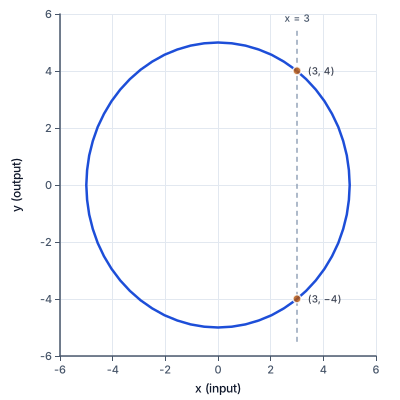
On a graph, all the points with the same input lie on one vertical line. So an input has two outputs exactly when some vertical line crosses the graph twice. That gives a quick test: if any vertical line meets the graph more than once, it is not the graph of a function.
Look at the chart. The circle $x^2 + y^2 = 25$ has radius $5$ and its center at the origin. The dashed vertical line $x = 3$ crosses it at two marked points, $(3, 4)$ and $(3, -4)$. Both pairs satisfy the equation, since $9 + 16 = 25$, so the input $3$ has two outputs and the circle fails the test. Slide the dashed line anywhere between $x = -5$ and $x = 5$ and it still crosses twice.
A non-vertical straight line passes: every vertical line crosses it exactly once. A U-shaped parabola such as $y = x^2$ passes too, even though a horizontal line can cross it twice. Horizontal crossings are repeated outputs, and those are allowed.
Functions are often named with a letter, such as $f$, and the output for the input $x$ is written $f(x)$. If $f(x) = 3x - 2$, then $f(5)$ means "the output when the input is $5$": replace $x$ with $5$ to get $3(5) - 2 = 13$. So $f(5) = 13$, and $(5, 13)$ is a point on the graph of $f$.
The brackets in $f(5)$ do not mean multiplication. $f(5)$ is not $f \times 5$. It is the output at $5$.
With a negative input, use brackets when you substitute. For $g(x) = x^2 + 4x$, $g(-3) = (-3)^2 + 4(-3) = 9 - 12 = -3$. Without the brackets, $-3^2$ would be read as $-9$ and the answer would come out wrong.
Different letters name different functions, so a problem can compare $f$ and $g$, or use $h$ for height and $C$ for cost. The letter in brackets can change too: $A(s) = s^2$ is the area of a square with side $s$.
Sometimes you know the output and want the input. For $g(x) = 4x + 1$, which input gives $g(x) = 29$? Set $4x + 1 = 29$, subtract $1$ to get $4x = 28$, and divide to get $x = 7$. Check: $g(7) = 29$.
Working backward can give more than one input. For $f(x) = x^2$, the output $25$ comes from both $5$ and $-5$. That does not stop $f$ from being a function, because each of those inputs has one output. It only means that the reverse rule, from output back to input, is not a function.
So the direction matters. "Each student's seat number" is a function of the student, but "the student in a seat" may not be a function of the seat number if a class meets in the same room at different times.
A function does not need an equation. "The number of letters in a word" is a function of the word: cat gives $3$ and pencil gives $6$, and no word has two different lengths. "The high temperature on each day of July" is a function of the date, because each day has one high, even though nobody can write a formula for it. A table from a weather station is enough to define it.
Some rules in words are not functions. "A number whose square is $36$" does not name one output for the input $36$: both $6$ and $-6$ fit. "A friend of Maria" is not a function of Maria, since she has many friends. When you meet a rule in words, ask the same question as always: given one input, is the answer settled, or is there a choice?
Deciding whether a relationship is a function.
Evaluating a function.
Why this works. A function is defined by the one-output rule, so the only way to break it is an input with two outputs. Repeated outputs never break it.
How to check. For a table, cover the output column and ask whether any input is listed twice. For an evaluation, plot the pair you found on the graph if you have one, or evaluate again with the input written in brackets.
The US Postal Service assigns every mailing address a five-digit ZIP code, and there are more than $40{,}000$ of them. The ZIP code is a function of the address: give the post office one address and it has exactly one ZIP code. The reverse is not a function. One ZIP code covers thousands of addresses, so knowing the ZIP code does not tell you the house. That is why a letter needs the street address as well as the ZIP code. The sorting machines use the function direction, address to ZIP code, to send each letter to the right post office first.
Sound travels faster in warm air than in cold air. A good rule for dry air is $v(T) = 331 + 0.6T$, where $T$ is the temperature in degrees Celsius and $v$ is the speed in meters per second. It is a function: each temperature gives one speed. On a $20$-degree day, $v(20) = 331 + 12 = 343$ meters per second. On a $0$-degree day, $v(0) = 331$. Working backward, at what temperature is the speed $346$? Solve $331 + 0.6T = 346$: $0.6T = 15$, so $T = 25$ degrees. You can use the rule to judge a thunderstorm: at $20$ degrees, thunder heard $6$ seconds after the flash has traveled about $6 \times 343 \approx 2{,}060$ meters, a little over a mile.
Checking the outputs instead of the inputs. A repeated output is fine; only a repeated input with different outputs breaks a function.
Using a horizontal line for the graph test. The test uses vertical lines, because all the points on a vertical line share an input.
Reading $f(3)$ as $f$ times $3$. It means the output at the input $3$.
Dropping the brackets around a negative input. $(-2)^2 = 4$, but $-2^2 = -4$.
Assuming the reverse is a function too. Students to lockers can be a function while lockers to students is not.
A table pairs the inputs $2, 5, 5, 8$ with the outputs $3, 1, 7, 3$. List the inputs.
$2, \; 5, \; 5, \; 8$
The one-output rule is about inputs, so start with that column.
Look for an input that appears more than once.
$5 \text{ appears twice}$
An input that appears once can only have one output.
Read the outputs paired with that input.
$(5, 1) \text{ and } (5, 7)$
The two rows with input $5$ give different outputs.
Notice the repeated output, and set it aside.
$(2, 3) \text{ and } (8, 3)$
Two inputs sharing the output $3$ is allowed.
Decide whether the table describes a function.
$\text{not a function}$
The input $5$ has two outputs, so the rule does not say what $5$ gives.
Find $f(-2)$ for $f(x) = 2x^2 - 3x + 1$. Substitute $-2$ for every $x$, in brackets.
$f(-2) = 2(-2)^2 - 3(-2) + 1$
$f(-2)$ is the output when the input is $-2$.
Square the input.
$(-2)^2 = 4$
Powers come before multiplication, and a negative squared is positive.
Multiply the squared term.
$2 \times 4 = 8$
The coefficient multiplies the square.
Multiply the middle term.
$-3 \times (-2) = 6$
A negative times a negative is positive.
Add the three terms.
$8 + 6 + 1 = 15$
So $f(-2) = 15$.
Write the result as a point on the graph.
$(-2, 15)$
Every input and its output make one point of the function's graph.
For $f(x) = x^2 - 5$, find every input with $f(x) = 11$. Set the rule equal to the output.
$x^2 - 5 = 11$
The inputs we want are the ones that make the rule give $11$.
Add $5$ to both sides.
$x^2 = 16$
That undoes the subtraction the rule does last.
Take the square root.
$x = 4 \text{ or } x = -4$
Both numbers square to $16$.
Check the positive input.
$f(4) = 16 - 5 = 11$
It gives the right output.
Check the negative input.
$f(-4) = 16 - 5 = 11$
It gives the same output.
Ask whether $f$ is still a function.
$4 \to 11, \quad -4 \to 11$
Each input has one output; two inputs sharing an output is allowed.
Ask whether the reverse, from output to input, is a function.
$11 \to 4 \text{ and } 11 \to -4$
One output leads back to two inputs, so the reverse rule is not a function.
Say what this looks like on the graph.
$(4, 11) \text{ and } (-4, 11)$
A horizontal line meets the U-shaped graph twice, but every vertical line meets it once.
Substitute $4$ for $x$.
$g(4) = 10 - 3(4) = -2$
Multiply before subtracting.
Set the rule equal to $25$.
$10 - 3x = 25$
Now the output is known and the input is not.
Subtract $10$ from both sides.
Divide both sides by $-3$.
A table pairs the inputs $2, 7, 7, 12$ with the outputs $15, 3, 7, 15$, in that order. Is the output a function of the input?
Complete the worked solution: find $h(-5)$ for $h(x) = 3x^2 + 7$.
Substitute the input in brackets and square it.
$(-5)^2 =$ p
A negative number times itself is positive.
Multiply the square by the coefficient $3$.
$3x^2 =$ q
In the rule, the square is multiplied before anything is added.
Add the constant term $7$.
$h(-5) =$ r
The output is the value of the whole rule at this input.
A rule squares a number and adds $7$. Its table pairs the inputs $-3, 0, 3$ with the outputs $16, 7, 16$. Is the output a function of the input?
For $f(x) = x^2 + 2x$, find $f(6)$ and $f(-5)$.
$f(6) =$ p and $f(-5) =$ q
For $g(x) = 3x - 3$, which input gives the output $g(x) = 15$?
$3x =$ t, so the input is x
A function's table pairs the inputs $1, 2, 3, 4$ with the outputs $5, 8, 13, 20$. The outputs do not go up by equal steps. Write the rule $f(x)$.
Answer:
At a middle school of $476$ students, every student is assigned exactly one locker, and $39$ of the lockers are shared by two students. Which of these is a function?
Lesson test: one question per skill, one attempt each, no hints. Your answers are checked when you submit.
For $f(x) = x^2 - 3$, find both inputs that give the output $f(x) = 22$.
$x =$ p or $x =$ m
You can decide whether a relationship is a function and evaluate $f(x)$. Without looking: why is a repeated output allowed but a repeated input with two outputs not, and what is $f(-3)$ for $f(x) = x^2 + 2x$?
17. Your turn: for $g(x) = 10 - 3x$, find $g(4)$ and the input with $g(x) = 25$, step 3
$-3x = 15$
That leaves only the $x$ term on the left.
17. Your turn: for $g(x) = 10 - 3x$, find $g(4)$ and the input with $g(x) = 25$, step 4
$x = -5$
Check: $10 - 3(-5) = 25$.