Back to the on-screen lesson ·
Tell rational from irrational numbers, and move between fractions and their ending or repeating decimals in both directions.
Paper packet. Every task here also exists on screen, where it is checked automatically; answers written on paper are not assessed by Nydus. When you are back at a device, enter your answers there.
In this lesson you meet numbers that cannot be written as fractions. Rational numbers have decimals that end or repeat; irrational numbers like the square root of $2$ and $\pi$ go on forever without repeating. You classify numbers, explain why a fraction's decimal must end or repeat, and turn a repeating decimal back into the fraction it came from.
You can turn a fraction into a decimal by dividing the top by the bottom: $\frac{3}{8} = 3 \div 8 = 0.375$. You have seen that some divisions never stop, such as $\frac{2}{3} = 0.666\ldots$, and you know the bar notation $0.\overline{6}$ for a digit that repeats forever. You know the perfect squares and that $\sqrt{64} = 8$. You have met $\pi$, the number of diameters that fit around a circle. This lesson sorts all of these numbers into two kinds, and shows how to go from a repeating decimal back to the fraction it came from.
| Term | What it means |
|---|---|
| Rational number | A number that can be written as $\frac{a}{b}$ with $a$ and $b$ integers and $b \neq 0$. The word comes from ratio. |
| Irrational number | A real number that cannot be written as such a fraction. Its decimal never ends and never repeats. |
| Terminating decimal | A decimal that stops, such as $0.375$. |
| Repeating decimal | A decimal in which a block of digits repeats forever, such as $0.\overline{27} = 0.272727\ldots$ |
| Repeating block | The digits under the bar: $27$ in $0.\overline{27}$. |
| Real numbers | All the rational and irrational numbers together: every point on the number line. |
Every number on the number line is either rational or irrational, never both.
A number is rational if it can be written as a fraction of two integers. That includes the obvious fractions like $\frac{5}{11}$, but also every integer ($7 = \frac{7}{1}$, $-3 = \frac{-3}{1}$), every terminating decimal ($2.25 = \frac{9}{4}$) and every repeating decimal ($0.\overline{27} = \frac{3}{11}$). The decimal of a rational number always ends or repeats.
A number is irrational if no fraction of integers equals it exactly. Its decimal goes on forever without settling into a repeating block. The square root of any whole number that is not a perfect square is irrational: $\sqrt{2} = 1.41421356\ldots$, $\sqrt{40} = 6.32455\ldots$ So is $\pi = 3.14159265\ldots$
This gives a test you can use: write the number as a decimal, or think about what its decimal must look like. Ends or repeats means rational. Never ends and never repeats means irrational.
The two directions both matter. From fraction to decimal you divide. From repeating decimal back to fraction there is a neat trick: multiply by a power of ten to shift the repeating part, and subtract so the endless tails cancel.
Another way: a sorting picture
Think of two bins on the number line. Into the rational bin go $\frac{1}{4}$, $-6$, $0.3$, $0.\overline{3}$ and $\sqrt{25}$. Into the irrational bin go $\sqrt{3}$, $\sqrt{50}$ and $\pi$. Every real number lands in exactly one bin.
Another way: a question to ask
"Could a calculator show this number exactly if its screen were long enough, either by stopping or by showing a pattern that obviously repeats?" If yes, rational. If no pattern could ever capture it, irrational.
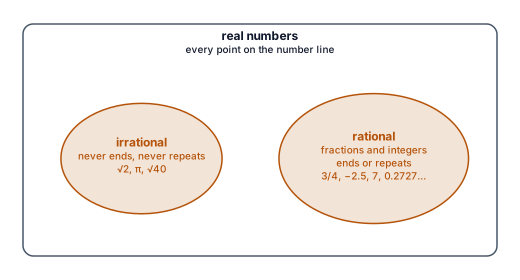
The diagram shows the real numbers, every point on the number line, as a large box. Inside are two separate ovals. The right one holds the rational numbers: fractions, all the integers and whole numbers, and every decimal that ends or repeats. The left one holds the irrational numbers, such as $\sqrt{2}$, $\pi$ and $\sqrt{40}$. The ovals do not overlap, because no number can be both. And between them they fill the box: every real number is one or the other.
Both kinds are everywhere on the line. Between any two fractions there is an irrational number, and between any two irrationals there is a fraction. They are not in separate places; they are mixed together as closely as you like.
Divide $5$ by $11$ by long division. $50 \div 11 = 4$ remainder $6$. $60 \div 11 = 5$ remainder $5$. Now the remainder is $5$ again, the same as the number we started with, so the same steps happen again and again: $\frac{5}{11} = 0.454545\ldots = 0.\overline{45}$.
This always happens. When you divide by $11$, the only possible remainders are $0$ to $10$. After at most $11$ steps, a remainder must come back, and from then on the digits repeat. If the remainder $0$ turns up, the decimal simply ends. So every fraction gives a decimal that ends or repeats, and the repeating block can be no longer than the denominator minus one.
Which fractions end? Those whose denominator, in lowest terms, has no prime factors except $2$ and $5$, because only those denominators divide a power of ten. $\frac{7}{40}$ ends, since $40 \times 25 = 1000$ gives $\frac{175}{1000} = 0.175$. $\frac{7}{12}$ repeats, because $12$ has a factor of $3$.
Let $x = 0.\overline{27}$. The block has two digits, so multiply by $100$: $100x = 27.\overline{27}$. The two numbers have exactly the same tail. Subtract: $100x - x = 27.\overline{27} - 0.\overline{27} = 27$. So $99x = 27$ and $x = \frac{27}{99} = \frac{3}{11}$.
The pattern is worth remembering: a repeating block over as many nines as it has digits. $0.\overline{4} = \frac{4}{9}$, $0.\overline{27} = \frac{27}{99}$, $0.\overline{142} = \frac{142}{999}$. Then simplify.
If some digits come before the repeat, as in $0.8\overline{3}$, shift twice. $10x = 8.\overline{3}$ and $100x = 83.\overline{3}$ have the same tail, so $90x = 75$ and $x = \frac{75}{90} = \frac{5}{6}$. The key idea is always the same: line up two copies with identical tails and subtract.
Square roots of non-squares. If a whole number is not a perfect square, its square root is not a whole number, and it cannot be a fraction either. Here is why for $\sqrt{2}$: squaring a fraction in lowest terms, such as $\frac{7}{5}$, gives $\frac{49}{25}$, which is still a fraction in lowest terms and never a whole number like $2$. Mathematicians in ancient Greece proved this more than two thousand years ago.
Pi. $\pi$ is irrational too, which was proved in 1761. Fractions like $\frac{22}{7} = 3.\overline{142857}$ are close but repeat, so they are not $\pi$.
Patterns that do not repeat. $0.101001000100001\ldots$, with one more zero each time, has a pattern, but no block repeats, so it is irrational.
Careful: $\sqrt{\frac{9}{16}} = \frac{3}{4}$ and $\sqrt{0.49} = 0.7$ are rational. Check what is under the root before you decide.
Suppose $\sqrt{2}$ were a fraction $\frac{a}{b}$ in lowest terms. Squaring gives $\frac{a^2}{b^2} = 2$, so $a^2 = 2b^2$. Now look only at last digits. A perfect square can only end in $0, 1, 4, 5, 6$ or $9$ (check: $1, 4, 9, 16, 25, 36, 49, 64, 81, 100$). Doubling a perfect square gives a number ending in $0, 2, 8, 0, 2$ or $8$. The only last digit both lists share is $0$. So $a^2$ ends in $0$, which means $a$ ends in $0$. And $2b^2$ ends in $0$, which means $b^2$ ends in $0$ or $5$, so $b$ ends in $0$ or $5$. Then $a$ and $b$ are both multiples of $5$, and the fraction was not in lowest terms after all. That is impossible, so no such fraction exists, and $\sqrt{2}$ is irrational. The same kind of argument works for the root of any whole number that is not a perfect square.
To classify a number:
To turn a repeating decimal into a fraction:
How to check. Divide your fraction back out, with a calculator or long division. It must give the decimal you started with.
A store sells three bottles of juice for $5$ dollars. What does one cost? $5 \div 3 = 1.666\ldots = 1.\overline{6}$ dollars, a rational number that cannot be paid in cents exactly. The register rounds, usually to $1.67$ dollars, and if you buy one bottle you pay a fraction of a cent more than your share of the deal. Buy all three and you pay exactly $5$ dollars, because $3 \times \frac{5}{3} = 5$. Stores rely on fractions like this, and the rounding is always on the unit price, never on the bundle.
A square room measures $12$ feet on each side. Its diagonal, from corner to corner, is $\sqrt{12^2 + 12^2} = \sqrt{288}$ feet. $288$ is not a perfect square ($16^2 = 256$ and $17^2 = 289$), so the diagonal is irrational: about $16.97$ feet. No tape measure can mark it exactly; a builder rounds to the nearest sixteenth of an inch, about $16$ feet $11 \frac{5}{8}$ inches, and that is close enough for any real room. The exact value is written $\sqrt{288}$, or $12\sqrt{2}$, when the math has to be exact, as in a blueprint's calculations.
A baseball batting average is hits divided by at-bats, printed to three decimal places. A player with $1$ hit in $3$ at-bats has $1 \div 3 = 0.\overline{3}$, printed as $.333$. With $5$ hits in $11$ at-bats the average is $0.\overline{45}$, printed as $.455$ after rounding. Every average is rational, because it is a fraction of whole numbers, so its full decimal always ends or repeats; the scoreboard just cuts it off. Two players printed at $.333$ may not be tied: $1$ for $3$ is $0.3333\ldots$ but $166$ for $499$ is $0.33266\ldots$
"It never ends, so it is irrational." $0.\overline{3}$ never ends but repeats, so it is rational: $\frac{1}{3}$.
"Every square root is irrational." $\sqrt{36} = 6$ is rational.
"$\pi = \frac{22}{7}$." $\frac{22}{7}$ is only close to $\pi$.
Using the wrong power of ten. A two-digit block needs $100x$, not $10x$; otherwise the tails do not line up.
Forgetting to simplify. $\frac{27}{99}$ is correct but $\frac{3}{11}$ is simpler.
Divide $5$ by $11$. Start with $50$ tenths.
$50 \div 11 = 4 \text{ remainder } 6$
$11 \times 4 = 44$, and $50 - 44 = 6$. The first digit is $4$.
Bring down a zero to the remainder.
$60 \div 11 = 5 \text{ remainder } 5$
$11 \times 5 = 55$, and $60 - 55 = 5$. The second digit is $5$.
Compare the new remainder with the start.
$\text{remainder } 5 = \text{starting } 5$
The same remainder means the same steps will come again.
Write the decimal with a bar.
$\frac{5}{11} = 0.\overline{45}$
The block $45$ repeats forever.
Classify the number.
$0.\overline{45} \text{ is rational}$
It is a fraction of integers, and its decimal repeats.
Write $0.\overline{27}$ as a fraction. Call it $x$.
$x = 0.272727\ldots$
Naming the number lets us do algebra with it.
Multiply both sides by $100$.
$100x = 27.272727\ldots$
Two digits repeat, so shift two places.
Subtract $x$ from $100x$.
$100x - x = 27.2727\ldots - 0.2727\ldots$
The tails after the point are identical.
Simplify both sides.
$99x = 27$
The tails cancel exactly.
Divide by $99$ and simplify.
$x = \frac{27}{99} = \frac{3}{11}$
$27$ and $99$ share a factor of $9$.
Check by dividing.
$3 \div 11 = 0.2727\ldots$
It matches the decimal we started with.
Write $0.8\overline{3}$ as a fraction. Call it $x$.
$x = 0.8333\ldots$
Only the $3$ repeats; the $8$ does not.
Multiply by $10$ so the repeat starts right after the point.
$10x = 8.333\ldots$
Now the tail after the point is all $3$'s.
Multiply $x$ by $100$ to shift one more digit.
$100x = 83.333\ldots$
This has the same tail as $10x$.
Subtract $10x$ from $100x$.
$100x - 10x = 83.333\ldots - 8.333\ldots$
Subtract $10x$, not $x$, so that the tails match.
Simplify both sides.
$90x = 75$
The tails cancel and whole numbers are left.
Divide by $90$.
$x = \frac{75}{90}$
Undo multiplying by $90$.
Simplify the fraction.
$\frac{75}{90} = \frac{5}{6}$
Divide top and bottom by $15$.
Check by dividing.
$5 \div 6 = 0.8333\ldots$
It matches, so $0.8\overline{3} = \frac{5}{6}$.
Test the numerator.
$16 = 4^2$
$16$ is a perfect square.
Test the denominator.
$25 = 5^2$
$25$ is a perfect square too.
Take the square root.
Classify the result as rational or irrational.
Match each number to rational or irrational.
| rational | irrational | |
|---|---|---|
| $\sqrt{39}$ | ||
| $\frac{4}{2}$ | ||
| $\pi$ | ||
| $\sqrt{36}$ |
Complete the worked solution that writes $x = 0.\overline{839}$ as a fraction.
Multiply $x$ by the power of ten that moves one whole block of three digits.
p $x = 839.\overline{839}$
Now the repeating tail lines up with the tail of $x$.
Subtract $x$ from both sides.
q $x = 839$
The tails cancel, leaving the block as a whole number.
Divide both sides by the number of $x$'s.
$x =$ r
The block over as many nines as it has digits.
Is $\sqrt{225}$ rational or irrational?
Show that $\sqrt{38}$ is irrational by finding the perfect squares just below and just above $38$.
a $< 38 <$ b, so $38$ is not a perfect square.
Write $x = 8.\overline{2}$ (that is, $8.222\ldots$) as a fraction.
$9x =$ n, so $x =$ f
Write $x = 0.\overline{65}$ (that is, $0.6565\ldots$) as a fraction.
$99x =$ n, so $x =$ f
A woodworker is cutting a square tabletop whose area must be exactly $39$ square feet. The order form asks for the side length as an exact fraction of feet. Can she fill it in exactly?
Lesson test: one question per skill, one attempt each, no hints. Your answers are checked when you submit.
Write $x = 0.9\overline{4}$ (that is, $0.9444\ldots$) as a fraction.
$90x =$ n, so $x =$ f
You can tell rational from irrational numbers and convert repeating decimals to fractions. Explain why $0.333\ldots$ is rational but $\sqrt{3}$ is not, and write $0.\overline{45}$ as a fraction.
18. Your turn: is $\sqrt{\frac{16}{25}}$ rational or irrational?, step 3
$\sqrt{\frac{16}{25}} = \frac{4}{5}$
$\frac{4}{5} \times \frac{4}{5} = \frac{16}{25}$.
18. Your turn: is $\sqrt{\frac{16}{25}}$ rational or irrational?, step 4
$\frac{4}{5} = 0.8 \text{, rational}$
It is a fraction of integers, and its decimal ends.