Back to the on-screen lesson ·
Slope as rise over run, why it is the same all along a line, and the equation $y = mx + b$.
Paper packet. Every task here also exists on screen, where it is checked automatically; answers written on paper are not assessed by Nydus. When you are back at a device, enter your answers there.
In this lesson you find the slope of a line as rise over run, see from similar triangles why it is the same between any two points of the line, and write the equation $y = mx + b$ from a slope and a point. Slope is the unit rate of a proportional relationship, and it is how the equations and systems of this unit are read from their graphs.
You can plot a point $(x, y)$ on a coordinate grid: across first, then up. You know that a proportional relationship, such as $3$ dollars for every pound of apples, has a constant unit rate, and that its graph is a straight line through the origin. You can subtract signed numbers, so you know that $4 - (-2) = 6$ and $-2 - 7 = -9$. You can also solve a one-step equation such as $5 = 2 + b$. This lesson puts those together. It measures how steep a line is with one number, the slope, and shows how that number and the point where the line crosses the $y$-axis give the line's whole equation.
| Term | What it means |
|---|---|
| Run | The horizontal change between two points: second $x$ minus first $x$. |
| Rise | The vertical change between the same two points: second $y$ minus first $y$. |
| Slope | Rise divided by run: how much $y$ changes for each step of $1$ in $x$. Written $m$. |
| Slope triangle | A right triangle drawn under a line, with a horizontal run and a vertical rise. |
| $y$-intercept | The $y$-value where a line crosses the $y$-axis, at $x = 0$. Written $b$. |
| Slope-intercept form | The equation $y = mx + b$ of a line with slope $m$ and $y$-intercept $b$. |
Walk along a straight line from one point to another. You move some distance across, the run, and some distance up or down, the rise. The slope is the rise divided by the run:
$$m = \frac{\text{rise}}{\text{run}} = \frac{y_2 - y_1}{x_2 - x_1}.$$
It tells you how much $y$ changes for every step of $1$ in $x$. A slope of $3$ means up $3$ for each $1$ across, which is steep. A slope of $\frac{1}{4}$ means up only $1$ for every $4$ across, which is gentle. A negative slope means the line goes down as you move right.
The remarkable fact about a straight line is that its slope is the same everywhere. Pick any two points on it, and rise over run gives the same number. That is what straight means: the line never gets steeper or flatter.
Because of that, one number and one point pin a line down completely. If a line crosses the $y$-axis at $(0, b)$ and has slope $m$, then every step of $x$ away from $0$ adds $m$ to $y$, so its equation is $y = mx + b$. The slope and the $y$-intercept are the two numbers you can read straight off the equation.
Another way: picture
Draw a staircase under the line $y = 2x + 1$: from $(0, 1)$ go $1$ right and $2$ up to $(1, 3)$, then $1$ right and $2$ up to $(2, 5)$. Every step is the same shape, which is what a constant slope looks like.
Another way: table
For $y = 2x + 1$: $x = 0, 1, 2, 3$ gives $y = 1, 3, 5, 7$. Each time $x$ goes up by $1$, $y$ goes up by $2$, the slope. The value at $x = 0$ is $1$, the intercept.
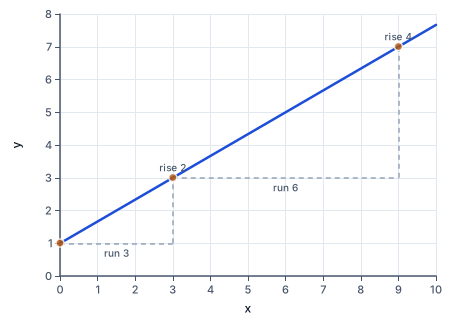
Look at the chart. The line is $y = \frac{2}{3}x + 1$, and it crosses the $y$-axis at $(0, 1)$. The dashed lines draw two slope triangles under it. The small one starts at $(0, 1)$, runs $3$ to the right and rises $2$ to reach the line again at $(3, 3)$. The large one starts at $(3, 3)$, runs $6$ and rises $4$ to reach $(9, 7)$. Compare them: $\frac{2}{3}$ and $\frac{4}{6}$ are the same number. The big triangle is the small one enlarged by a scale factor of $2$.
That is always true. Any two slope triangles on one line have a horizontal side, a vertical side and a right angle, and the sloping side makes the same angle with the horizontal in both, because it is the same line. Two angles match, so the triangles are similar, and similar triangles have their sides in the same ratio. So rise over run cannot depend on which two points you choose. You can use whichever points are easiest to read, and you can scale a triangle up or down: a slope of $\frac{2}{3}$ also means a rise of $10$ for a run of $15$.
Read a line from left to right, the way you read a sentence.
The size of the slope tells steepness whatever its sign. $y = -5x$ is steeper than $y = 2x$, because $5$ is bigger than $2$; it just goes the other way.
When a line goes through the origin, its intercept is $0$ and its equation is simply $y = mx$. That is a proportional relationship, and the slope is its unit rate. If a car's graph of distance against time passes through $(0, 0)$ and $(3, 165)$, the slope is $165 \div 3 = 55$, so the car travels $55$ miles per hour and $d = 55t$.
This lets you compare two relationships given in different forms. Suppose a second car is described by $d = 62t$. Its unit rate is $62$, the slope, so its line is steeper and the car is faster. You do not need to draw both lines to see that: compare the slopes. A line that does not pass through the origin, such as $y = 55x + 20$, has the same rate but is not proportional, because doubling $x$ does not double $y$.
In $y = mx + b$ the slope is the number multiplying $x$ and the intercept is the number added. In $y = -4x + 7$, $m = -4$ and $b = 7$. In $y = x - 3$, $m = 1$ and $b = -3$: the minus sign belongs to the intercept.
An equation in another form must be rearranged first, so that $y$ stands alone. For $6x + 3y = 12$: subtract $6x$ from both sides to get $3y = -6x + 12$, then divide every term by $3$ to get $y = -2x + 4$. Now $m = -2$ and $b = 4$. A common mistake is to read the $6$ as the slope before $y$ is alone.
Going the other way, from a point and a slope to an equation, uses the same form. A line with slope $3$ through $(2, 5)$ must satisfy $5 = 3 \times 2 + b$, so $b = -1$ and $y = 3x - 1$.
Finding a slope from two points.
Writing the equation.
Why the moves are allowed. Slope triangles on a line are similar, so any pair of points gives the same ratio. Subtracting both coordinates in reverse order flips the sign of the rise and of the run, and the two sign changes cancel in the division.
How to check. Put the other point into your equation: it must come out true. Then check the sign against a sketch. If the second point is higher and to the right, the slope must be positive. And look at the size: a slope of $20$ between points that are $10$ apart across and $2$ apart up means the rise and run were swapped.
A yellow sign showing a truck on a slope warns drivers of a steep grade, a slope written as a percent. A $6\%$ grade drops $6$ feet for every $100$ feet traveled horizontally, a slope of $-\frac{6}{100} = -0.06$. Over a stretch of $2$ miles, which is $10{,}560$ feet, the road drops about $0.06 \times 10{,}560 \approx 634$ feet. That is why truckers shift to a low gear before the hill: brakes that are used the whole way down overheat. Grades are easy to compare because they are all slopes over the same run of $100$.
Most US homes follow a building code that allows each step to rise at most $7\frac{3}{4}$ inches and requires each tread to be at least $10$ inches deep. A builder needs stairs to climb $105$ inches from one floor to the next and picks a rise of $7$ inches per step: $105 \div 7 = 15$ steps up. With $14$ treads of $10$ inches between them, the stairs run $140$ inches across. The slope is $\frac{105}{140} = \frac{3}{4}$. Every step is the same slope triangle, $7$ up and $10$ across, so the handrail along the step edges is a straight line. Stairs with uneven steps are dangerous exactly because the slope suddenly changes under your feet.
Run over rise. Slope is rise over run: the change in $y$ goes on top.
Mixing the order. $\frac{y_2 - y_1}{x_1 - x_2}$ gives the wrong sign. Subtract in the same order top and bottom.
Reading the slope before $y$ is alone. In $2y = 8x + 6$ the slope is $4$, not $8$.
Losing the sign of the intercept. In $y = 5x - 2$, $b = -2$.
Calling a vertical line's slope zero. A flat line has slope $0$; a vertical line has no slope at all.
On the line $y = \frac{2}{3}x + 1$ in the chart, read two points: where it crosses the $y$-axis and the next grid point it passes through.
$(0, 1) \text{ and } (3, 3)$
Points where the line meets grid corners are exact, so they are the easiest to use.
Find the run between them.
$3 - 0 = 3$
The run is how far across the second point is.
Find the rise between them.
$3 - 1 = 2$
The rise is how far up the second point is.
Divide the rise by the run.
$m = \dfrac{2}{3}$
This matches the number in front of $x$ in the equation.
Repeat with the larger triangle, from $(3, 3)$ to $(9, 7)$.
$\dfrac{7 - 3}{9 - 3} = \dfrac{4}{6} = \dfrac{2}{3}$
The larger triangle is similar to the smaller one, so the ratio is the same.
Find the slope of the line through $(-2, 7)$ and $(4, -2)$. Label the points.
$(x_1, y_1) = (-2, 7), \quad (x_2, y_2) = (4, -2)$
Naming them fixes the order of subtraction for both coordinates.
Find the run.
$4 - (-2) = 6$
Subtracting a negative number adds its size.
Find the rise.
$-2 - 7 = -9$
The second point is lower, so the rise is negative.
Divide and simplify.
$m = \dfrac{-9}{6} = -\dfrac{3}{2}$
Both $9$ and $6$ share a factor of $3$.
Check by subtracting in the other order.
$\dfrac{7 - (-2)}{-2 - 4} = \dfrac{9}{-6} = -\dfrac{3}{2}$
Both signs flip, so the quotient does not change.
Say what the slope means.
$\text{down } 3 \text{ for every } 2 \text{ to the right}$
A negative slope falls from left to right.
Write the equation of the line through $(-3, 5)$ and $(3, 1)$. Find the run.
$3 - (-3) = 6$
Second $x$ minus first $x$.
Find the rise.
$1 - 5 = -4$
Second $y$ minus first $y$, in the same order.
Divide and simplify.
$m = \dfrac{-4}{6} = -\dfrac{2}{3}$
The line falls $2$ for every $3$ across.
Put the slope and the point $(3, 1)$ into $y = mx + b$.
$1 = -\dfrac{2}{3}(3) + b$
The point is on the line, so it makes the equation true.
Multiply out the slope term.
$1 = -2 + b$
Two thirds of $3$ is $2$.
Add $2$ to both sides.
$b = 3$
That leaves the intercept on its own.
Write the equation and test the other point.
$y = -\dfrac{2}{3}x + 3, \quad -\dfrac{2}{3}(-3) + 3 = 5$
The point $(-3, 5)$ fits, so the equation is right.
Use the equation to find $y$ when $x = 6$.
$y = -\dfrac{2}{3}(6) + 3 = -1$
The point $(6, -1)$ is on the line too, three steps further along.
Subtract $4x$ from both sides.
$2y = -4x + 10$
The $y$ term has to be alone before anything can be read off.
Divide every term by $2$.
$y = -2x + 5$
Now the equation is in the form $y = mx + b$.
Read the slope.
Read the intercept.
A line passes through $(1, 1)$ and $(3, -1)$. Reading from left to right, which way does it go?
Complete the worked solution: find the slope of the line through $(1, 2)$ and $(6, 22)$.
Find the run by subtracting the $x$-coordinates.
$6 - 1 =$ p
The run is the horizontal change from one point to the other.
Find the rise by subtracting the $y$-coordinates in the same order.
$22 - 2 =$ q
The rise is the vertical change over that same stretch.
Divide the rise by the run.
$m =$ s
The slope is the rise for each single unit of run.
Find the run, the rise and the slope of the line through $(-3, 2)$ and $(0, -2)$.
Run u, rise r, slope m
A line crosses the $y$-axis at $(0, 4)$. Every time $x$ goes up by $3$, $y$ changes by $-3$. Write $y$ in terms of $x$.
Answer:
A line has slope $-1$ and passes through $(-1, 7)$. Where does it cross the $y$-axis?
$-1 \times -1 =$ t, so $b =$ b
A line is written as $5y = -25x + 35$. What are its slope and its $y$-intercept?
The slope is m and the $y$-intercept is b.
A wheelchair ramp may have a slope of at most $\frac{1}{12}$. A library's front door is $23$ inches above the sidewalk. What is the shortest run the ramp can have, in inches and in feet?
At least i inches, which is f feet.
Lesson test: one question per skill, one attempt each, no hints. Your answers are checked when you submit.
A line passes through $(-1, 4)$ and $(3, 16)$. Write its equation in the form $y = mx + b$.
$m =$ m, $b =$ b
You can find a slope from two points and write the equation of a line. Without looking: why do two different slope triangles on one line give the same slope, and what are the slope and intercept of $3x + y = 7$?
16. Your turn: find the slope and intercept of $4x + 2y = 10$, step 3
$m = -2$
It is the number multiplying $x$.
16. Your turn: find the slope and intercept of $4x + 2y = 10$, step 4
$b = 5$
It is the number added, so the line crosses the $y$-axis at $(0, 5)$.