Back to the on-screen lesson ·
Why the squares on the two shorter sides add to the square on the longest.
Paper packet. Every task here also exists on screen, where it is checked automatically; answers written on paper are not assessed by Nydus. When you are back at a device, enter your answers there.
In this lesson you meet one of the most useful facts in geometry: in a right triangle, the squares on the two shorter sides add to the square on the longest. You will see why it is true, with a proof that rearranges four copies of the triangle, use it to find a missing side in flat and solid figures, and use its converse to test whether a corner is a right angle.
You know that the area of a square with side $s$ is $s^{2}$, and that the square root undoes squaring: $\sqrt{49} = 7$ because $7^{2} = 49$. You know that a right angle is $90^\circ$ and that a triangle's angles add to $180^\circ$, so a triangle can have at most one right angle. You can solve an equation such as $x^{2} + 36 = 100$ by subtracting and then taking a square root.
| Term | What it means |
|---|---|
| Right triangle | A triangle with one angle of exactly $90^\circ$. |
| Hypotenuse | The side across from the right angle. It is always the longest side. |
| Legs | The two shorter sides of a right triangle, which meet at the right angle. |
| Square (of a number) | The number times itself: $7^{2} = 7 \times 7 = 49$. It is the area of a square with that side. |
| Square root | The positive number whose square is the given number: $\sqrt{49} = 7$. |
| Converse | A statement with its "if" and "then" swapped. The converse of the theorem lets you test whether a triangle has a right angle. |
| Pythagorean triple | Three whole numbers that fit $a^{2} + b^{2} = c^{2}$, such as $3, 4, 5$ or $5, 12, 13$. |
In a right triangle with legs $a$ and $b$ and hypotenuse $c$,
$$a^{2} + b^{2} = c^{2}.$$
In words: the square of the hypotenuse equals the sum of the squares of the two legs. The hypotenuse is the one squared on its own, so the first job in every problem is to find it: it is across from the right angle and it is the longest side.
For example, legs $3$ and $4$ give $3^{2} + 4^{2} = 9 + 16 = 25 = 5^{2}$, so the hypotenuse is $5$.
The theorem also works backward. This is the converse: if the sides of a triangle fit $a^{2} + b^{2} = c^{2}$, with $c$ the longest side, then the triangle has a right angle across from $c$. If they do not fit, it has no right angle.
The theorem is named after Pythagoras, a Greek thinker of about 500 BC, but builders and mathematicians in Babylon, India and China knew and used it too.
Another way: picture
Draw a square on each side of a right triangle, facing outward. The theorem is about the areas of those squares: the two smaller squares, together, have exactly the same area as the big square on the hypotenuse. With legs $3$ and $4$, the small squares hold $9$ and $16$ unit squares, and the big one holds $25$. You could cut up the two small squares and fit the pieces exactly into the big one.
Another way: steps
To use the theorem: find the right angle; label the side across from it $c$; write $a^{2} + b^{2} = c^{2}$ with the numbers you know put in; square; add (for the hypotenuse) or subtract (for a leg); take the square root; check that $c$ is the longest side.
Take four copies of a right triangle with legs $a$ and $b$ and hypotenuse $c$. Arrange them inside a big square with side $a + b$, one in each corner, each turned a quarter turn from the last. The four hypotenuses make a tilted square in the middle, with side $c$.
Now count the area of the big square two ways.
Way 1: its side is $a + b$, so its area is $(a + b)^{2} = a^{2} + 2ab + b^{2}$.
Way 2: it is made of the tilted square, area $c^{2}$, plus four triangles, each with area $\frac{1}{2}ab$. That is $c^{2} + 4 \times \frac{1}{2}ab = c^{2} + 2ab$.
Both ways measure the same square, so
$$a^{2} + 2ab + b^{2} = c^{2} + 2ab.$$
Take $2ab$ from both sides and $a^{2} + b^{2} = c^{2}$ is left. Nothing in this argument depends on the particular sizes of $a$ and $b$, so it proves the theorem for every right triangle.
Why must the middle shape be a square? Its sides are all $c$. At each of its corners, the two sharp angles of a triangle and the corner of the middle shape make a straight line. The two sharp angles add to $90^\circ$ (the triangle's angles total $180^\circ$ and one is $90^\circ$), so the middle corner is $180^\circ - 90^\circ = 90^\circ$.
When the unknown is a leg, the hypotenuse is already known, so the equation is solved by subtracting. With hypotenuse $10$ and one leg $6$:
$$x^{2} + 36 = 100 \quad\Rightarrow\quad x^{2} = 64 \quad\Rightarrow\quad x = 8.$$
A quick way to remember which to do: longest side wanted, add; shorter side wanted, subtract.
Many right triangles do not have whole-number sides. Legs $1$ and $1$ give $c^{2} = 2$, so $c = \sqrt{2} \approx 1.414$. Legs $2$ and $5$ give $c^{2} = 29$, and $\sqrt{29}$ is between $5$ and $6$ (since $25 < 29 < 36$), about $5.39$. Leave the answer as a square root when an exact answer is asked for, and round it when a measurement is.
Whole-number sets such as $3, 4, 5$ and $5, 12, 13$ and $8, 15, 17$ are worth knowing. Any multiple of one works too: $6, 8, 10$ and $30, 40, 50$ are $3, 4, 5$ scaled up, so they are similar triangles.
The converse turns the theorem into a test that needs only a tape measure. Square the three sides. If the two smaller squares add up to exactly the largest, the triangle has a right angle, across from the longest side.
When they do not match, the comparison still says something. Hinge two sticks of lengths $3$ and $4$ together. At a right angle, the gap between their ends is $5$. Open the hinge wider and the gap grows past $5$; close it and the gap shrinks below $5$. So:
Sides $4, 5, 7$ give $16 + 25 = 41 < 49$, so that triangle has a wide angle.
The theorem works in three dimensions too, by using it twice.
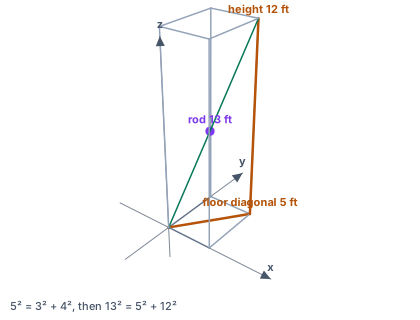
Look at the box in the picture: $3$ feet wide, $4$ feet long and $12$ feet tall. The orange line across the floor joins two opposite bottom corners. It is the long side of a right triangle lying flat on the floor, with legs $3$ and $4$, so it is $5$ feet. Now follow the second orange line straight up the $12$-foot edge. The floor diagonal and that edge meet at a right angle, so together with the green rod they make a second right triangle, standing up inside the box. Its legs are $5$ and $12$, so the rod is $13$ feet: the longest straight thing that fits in the box.
Why each move is allowed. The theorem in step 3 was proved for every right triangle. Steps 5 and 6 undo operations on both sides of an equation, which keeps it true: subtracting undoes adding, and the square root undoes squaring.
How to check. First, the hypotenuse must be the longest side, but shorter than the two legs added together. Second, put your answer back in: square all three sides and confirm that the two smaller squares add to the largest. Third, for a whole-number answer, see whether it belongs to a triple you know.
To use the converse, square all three sides and compare the two smaller squares' total with the largest square. Equal means right-angled.
A TV is sold by its diagonal. A "65-inch" TV with the usual 16:9 shape is about $56.7$ inches wide and $31.9$ inches tall. Check with the theorem: $56.7^{2} + 31.9^{2} \approx 3215 + 1018 = 4233$, and $\sqrt{4233} \approx 65.1$ inches. So the advertised size is the hypotenuse of the screen, not its width, which is worth knowing before you buy a TV stand.
On a baseball diamond the bases are $90$ feet apart, and the base paths meet at right angles, making a square. A catcher throwing from home plate to second base throws along the diagonal: $\sqrt{90^{2} + 90^{2}} = \sqrt{16\,200} \approx 127.3$ feet, about $37$ feet farther than a throw along the base line.
Builders laying out a deck, a patio or the walls of a house need corners that are exactly $90^\circ$, and a big square corner is hard to check with a small tool. They use the converse instead. From the corner, measure $3$ feet along one side and mark it; measure $4$ feet along the other side and mark it. If the distance between the marks is exactly $5$ feet, the corner is square, because $3^{2} + 4^{2} = 5^{2}$.
For a bigger layout, a larger multiple is more accurate: $6$, $8$ and $10$ feet, or $9$, $12$ and $15$ feet. If the diagonal is $10$ feet $2$ inches instead of $10$ feet, the corner is a little more than $90^\circ$, and the builder pushes the sides in until it reads exactly $10$ feet.
The Americans with Disabilities Act (ADA) rules say a wheelchair ramp may rise at most $1$ inch for every $12$ inches it runs along the ground. A doorway $30$ inches above the sidewalk therefore needs a ramp that runs $30 \times 12 = 360$ inches ($30$ feet) along the ground.
How long is the ramp's sloping surface? The rise is vertical and the run is level, so they are the legs of a right triangle, and the surface is the hypotenuse: $\sqrt{30^{2} + 360^{2}} = \sqrt{900 + 129\,600} = \sqrt{130\,500} \approx 361.2$ inches. That is only about $1.2$ inches more than the run, because the ramp is so gentle. A builder ordering decking boards uses the hypotenuse, not the run.
Squaring the wrong side on its own. The side on its own in $a^{2} + b^{2} = c^{2}$ is always the hypotenuse, across from the right angle. It is not "whichever side is labeled $c$" in a drawing.
Adding the sides instead of their squares. Legs $6$ and $8$ do not make a hypotenuse of $14$: $6^{2} + 8^{2} = 100$, so it is $10$. A straight line is shorter than going around the corner.
Forgetting the square root. $c^{2} = 100$ tells you the area of the square on the hypotenuse, not its side. The side is $\sqrt{100} = 10$.
Subtracting the lengths. For a leg, subtract the squares: with hypotenuse $13$ and leg $5$, the other leg is $\sqrt{169 - 25} = 12$, not $13 - 5 = 8$.
Using the theorem without a right angle. It is true only for right triangles. For other triangles, $a^{2} + b^{2}$ and $c^{2}$ do not match.
A right triangle has legs $6$ and $8$. Write the theorem with $c$ for the hypotenuse.
$c^{2} = 6^{2} + 8^{2}$
The legs are the sides that meet at the right angle, and the hypotenuse is squared on its own.
Square each leg.
$c^{2} = 36 + 64$
$6 \times 6 = 36$ and $8 \times 8 = 64$.
Add the squares.
$c^{2} = 100$
The two smaller squares together have the area of the square on the hypotenuse.
Take the square root.
$c = \sqrt{100} = 10$
$10 \times 10 = 100$, and a length is positive.
Check that the hypotenuse is the longest side but shorter than the legs added.
$8 < 10 < 6 + 8 = 14$
The straight side is longer than either leg but shorter than walking along both.
A right triangle has hypotenuse $13$ and one leg $5$. Write the theorem with $x$ for the other leg.
$x^{2} + 5^{2} = 13^{2}$
The $13$ is across from the right angle, so it is the side squared on its own.
Square the known numbers.
$x^{2} + 25 = 169$
$5 \times 5 = 25$ and $13 \times 13 = 169$.
Subtract $25$ from both sides.
$x^{2} = 169 - 25$
Subtracting undoes the $+ 25$ and leaves $x^{2}$ alone.
Do the subtraction.
$x^{2} = 144$
$169 - 25 = 144$.
Take the square root.
$x = \sqrt{144} = 12$
$12 \times 12 = 144$.
Check by putting all three sides back in.
$5^{2} + 12^{2} = 25 + 144 = 169 = 13^{2}$
The squares balance, and the hypotenuse is still the longest side.
A box is $3$ feet wide, $4$ feet long and $12$ feet tall. Find the diagonal $d$ across the bottom first.
$d^{2} = 3^{2} + 4^{2}$
The width and length meet at a right angle on the floor of the box, so they are legs.
Square and add.
$d^{2} = 9 + 16 = 25$
Square each leg, then add.
Take the square root.
$d = \sqrt{25} = 5 \text{ feet}$
This is the longest straight line across the floor of the box.
Now picture a new right triangle standing up inside the box: the floor diagonal, the height, and the diagonal $r$ from a bottom corner to the opposite top corner.
$r^{2} = 5^{2} + 12^{2}$
The height is vertical and the floor diagonal is level, so they meet at a right angle.
Square and add.
$r^{2} = 25 + 144 = 169$
Square each leg, then add.
Take the square root.
$r = \sqrt{169} = 13 \text{ feet}$
$13 \times 13 = 169$.
Check that the answer makes sense.
$12 < 13 < 3 + 4 + 12$
The rod must be longer than the tallest edge and shorter than a path along three edges. A $13$-foot pole fits, slanting corner to corner.
Pick out the longest side.
$c = 15$
Only the longest side can be the hypotenuse.
Square the two shorter sides and add.
$9^{2} + 12^{2} = 81 + 144 = 225$
This is $a^{2} + b^{2}$.
Square the longest side.
Compare and decide.
A triangle has sides $21$, $20$ and $29$. Is it a right triangle?
A right triangle has legs $24$ and $32$. Complete the worked solution to find the hypotenuse $c$.
Write the theorem.
$c^{2} = 24^{2} + 32^{2}$
The legs are squared and added; the hypotenuse is squared on its own.
Square each leg.
$c^{2} = 576 + 1024$
A square is a number times itself.
Add the two squares.
$c^{2} =$ s
This total is the area of the square drawn on the hypotenuse.
Take the square root of the total.
$c =$ c
The side of a square is the square root of its area.
A triangle has sides $3$, $5$ and $7$. Is it a right triangle?
A right triangle has legs of length $3$ and $4$. How long is the hypotenuse?
The hypotenuse is answer units long.
A right triangle has a hypotenuse of length $13$ and one leg of length $12$. How long is the other leg?
The other leg is answer units long.
A $13$-foot ladder leans against a wall. Its foot is $5$ feet from the bottom of the wall, on level ground. How high up the wall does the ladder reach, in feet?
Answer:
A carpenter builds a gate frame $50$ inches along one side and $120$ inches along the next. She has no protractor, so she measures straight across the corner, from end to end, and gets $130$ inches. Is the corner a right angle?
Lesson test: one question per skill, one attempt each, no hints. Your answers are checked when you submit.
A right triangle has a hypotenuse of length $10$ and one leg of length $6$. How long is the other leg?
The other leg is answer units long.
You can find a missing side of a right triangle and test whether three lengths make a right angle. Without looking: state the theorem, and say which side is the one that gets squared on its own.
17. Your turn: is a triangle with sides $9$, $12$ and $15$ a right triangle?, step 3
$15^{2} = 225$
This is $c^{2}$.
17. Your turn: is a triangle with sides $9$, $12$ and $15$ a right triangle?, step 4
$225 = 225 \quad\Rightarrow\quad \text{right angle across from } 15$
By the converse, equal squares mean a right angle. The triangle is $3, 4, 5$ scaled by $3$.