Back to the on-screen lesson ·
Translations, reflections, rotations and dilations as rules on coordinates, and what a dilation does to lengths, areas and volumes.
Paper packet. Every task here also exists on screen, where it is checked automatically; answers written on paper are not assessed by Nydus. When you are back at a device, enter your answers there.
In this lesson you move figures with rules on coordinates: translations, reflections across the axes, rotations about the origin and dilations. You learn what each transformation keeps, why the order of a sequence matters, and how a dilation by $k$ multiplies lengths by $k$, areas by $k^2$ and the volume of a solid by $k^3$.
You can plot points in all four quadrants of the coordinate plane and read their coordinates, including negative ones. You can find the length of a horizontal or vertical segment by subtracting coordinates, and the length of a slanted one with the Pythagorean theorem. You know that congruent figures have the same size and shape and that similar figures have the same shape, with sides in one ratio. You also know the volume of a box is length times width times height. This lesson treats the moves that carry one figure onto another as rules on coordinates, so you can move a figure exactly without drawing it, predict what the move keeps, and see what a dilation does to a solid.
| Term | What it means |
|---|---|
| Transformation | A rule that moves every point of a figure to a new point. |
| Image | Where a point or figure ends up; the image of $P$ is written $P'$. |
| Translation | A slide: every point moves the same distance in the same direction. |
| Reflection | A flip across a line, the mirror line. |
| Rotation | A turn through an angle about a fixed point, the center. |
| Dilation | A stretch or shrink from a center by a scale factor $k$: every distance from the center is multiplied by $k$. |
| Rigid motion | A translation, reflection or rotation: it keeps every length and angle. |
A transformation takes every point of a figure and sends it to a new point, its image. On the coordinate plane, each kind of transformation is a simple rule on the coordinates:
| Transformation | Rule |
|---|---|
| translate $a$ across, $b$ up | $(x, y) \to (x + a, y + b)$ |
| reflect across the $x$-axis | $(x, y) \to (x, -y)$ |
| reflect across the $y$-axis | $(x, y) \to (-x, y)$ |
| rotate $90^\circ$ counterclockwise about the origin | $(x, y) \to (-y, x)$ |
| rotate $180^\circ$ about the origin | $(x, y) \to (-x, -y)$ |
| rotate $90^\circ$ clockwise about the origin | $(x, y) \to (y, -x)$ |
| dilate by $k$ from the origin | $(x, y) \to (kx, ky)$ |
Translations, reflections and rotations are rigid motions: they move a figure without changing it. Segments keep their lengths, angles keep their measures, straight lines stay straight, and parallel lines stay parallel. The image is congruent to the original. A reflection does reverse the figure's orientation, the way a right glove becomes a left one in a mirror.
A dilation is different. It keeps angles, straight lines and parallel lines, but it multiplies every length by the scale factor $k$, so the image is similar to the original, bigger when $k > 1$ and smaller when $0 < k < 1$.
Because every transformation is a rule on coordinates, you can apply it to the corners of a figure one at a time and join the images. The corners carry the whole figure with them.
Another way: picture
Put a sheet of tracing paper over the grid and trace a triangle. Slide the paper for a translation, flip it over for a reflection, or pin one point and turn it for a rotation. The traced triangle never changes size, which is why those three moves are rigid.
Another way: one point
Follow $P(3, 1)$: a translation $2$ left gives $(1, 1)$; a reflection across the $x$-axis gives $(3, -1)$; a quarter turn counterclockwise gives $(-1, 3)$; a dilation by $2$ gives $(6, 2)$.
Why does a quarter turn counterclockwise send $(x, y)$ to $(-y, x)$? Picture the point $P(4, 1)$: $4$ steps along the $x$-axis, then $1$ step up. Turn the whole grid a quarter turn to the left. The $4$ steps that went right now go up, along the $y$-axis. The $1$ step that went up now goes left. So the image is $1$ step left and $4$ steps up: $(-1, 4)$. The old $y$ became the new $x$ with its sign changed, and the old $x$ became the new $y$.
Two quarter turns make a half turn: $(x, y) \to (-y, x) \to (-x, -y)$. A half turn changes the sign of both coordinates, so $(4, 1)$ goes to $(-4, -1)$, straight through the origin to the other side. Three quarter turns counterclockwise are the same as one quarter turn clockwise, $(x, y) \to (y, -x)$.
A good check for any rotation about the origin: the point and its image are the same distance from the origin, since a turn does not stretch anything. For $(4, 1)$ and $(-1, 4)$, both have $4^2 + 1^2 = 17$.
A dilation with center the origin multiplies every coordinate by the scale factor. In space a point has three coordinates, and the rule is the same: $(x, y, z) \to (kx, ky, kz)$.
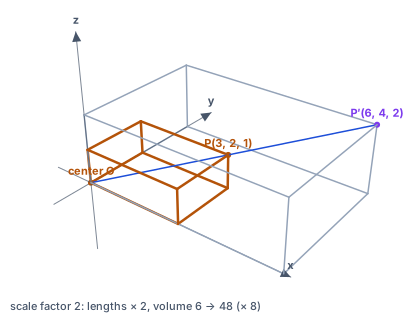
Look at the two boxes. Both have a corner at the center $O$, the origin, and their edges lie along the axes. The small orange box is $3$ long, $2$ wide and $1$ tall, and its far corner is $P(3, 2, 1)$. A dilation by a scale factor of $2$ sends $P$ to $P'(6, 4, 2)$. Follow the blue line from $O$: it passes through $P$ and goes on to $P'$, twice as far from the center. Every other corner does the same, so the image is the large gray box, $6$ by $4$ by $2$.
Now compare sizes. Each edge doubled. The volume went from $3 \times 2 \times 1 = 6$ to $6 \times 4 \times 2 = 48$ cubic units, which is $8$ times as much, because each of the three measurements doubled: $2 \times 2 \times 2 = 8$. In the same way, the area of each face is multiplied by $2 \times 2 = 4$. For any scale factor $k$, lengths are multiplied by $k$, areas by $k^2$ and volumes by $k^3$.
Transformations can be done one after another: the image of the first move is the starting figure for the second. Two figures are congruent exactly when a sequence of rigid motions carries one onto the other, and similar when a sequence of rigid motions and dilations does.
The order can change the result. Take $(2, 3)$. Reflect across the $x$-axis, then translate $4$ up: $(2, -3)$, then $(2, 1)$. Translate first, then reflect: $(2, 7)$, then $(2, -7)$. Different answers. The reflection flips the direction of any slide done before it.
Some pairs do not care about order. Two translations can be done either way round, because adding numbers can. A rotation and a dilation about the same center can too. When a question lists several moves, do them in the order given unless you are sure the order cannot matter.
A rigid motion keeps everything about the shape: side lengths, angle measures, perimeter and area. That is why you can check a translation, reflection or rotation by measuring. If a triangle has a side of length $5$, its image must too.
A dilation keeps angles and the shape. It multiplies lengths by $k$, areas by $k^2$ and, for solids, volumes by $k^3$. A photo enlarged by a factor of $3$ has corners that are still right angles, a width $3$ times as big, and $9$ times the area.
Every transformation keeps straight lines straight and parallel lines parallel. A rectangle's image is always a rectangle, though a reflection may list its corners in the opposite direction around the shape.
Why the moves are allowed. Each transformation is defined by what it does to every point, so applying the rule to the corners and joining them gives the image of the whole figure: segments go to segments.
How to check. Measure one side of the original and of the image: equal for a rigid motion, $k$ times as long for a dilation. For a rotation about the origin, check that each point and its image are the same distance from the origin. For a reflection across an axis, check that the axis is halfway between each point and its image. And sketch it: a point in the first quadrant turned a quarter turn counterclockwise must land in the second.
In Tetris, pieces fall into a well $10$ squares wide, and pressing a button turns the falling piece a quarter turn. A program can store each square of a piece as coordinates relative to a center square and turn it with the rule $(x, y) \to (-y, x)$. An L-shaped piece with squares at $(0, 0)$, $(0, 1)$, $(0, -1)$ and $(1, -1)$ becomes $(0, 0)$, $(-1, 0)$, $(1, 0)$ and $(1, 1)$ after one turn. Moving the piece one column to the right adds $1$ to every $x$-coordinate, a translation. Every move in the game is a rigid motion, so a piece never changes shape, which is the whole point of the puzzle.
A student designs a model rocket body on a computer and 3D-prints a test version at half size, a dilation with scale factor $\frac{1}{2}$. Every length is halved, so a $24$-centimeter body prints $12$ centimeters tall. The plastic used depends on the volume, which is multiplied by $\left(\frac{1}{2}\right)^3 = \frac{1}{8}$. If the full-size print needs $160$ grams of plastic, the test print needs only about $160 \div 8 = 20$ grams, and it prints in roughly an eighth of the time. Printing at double size would go the other way: $2^3 = 8$ times the plastic, $1{,}280$ grams.
Mixing up the two reflections. Across the $x$-axis the $y$ changes sign; across the $y$-axis the $x$ changes sign. The coordinate measured along the mirror stays the same.
Forgetting to swap in a quarter turn. $(x, y) \to (-y, x)$ swaps the coordinates as well as changing a sign.
Doing a sequence in the wrong order. Reflect-then-slide and slide-then-reflect can land in different places.
Adding the scale factor. A dilation multiplies coordinates by $k$; it does not add $k$.
Doubling the volume for a scale factor of $2$. Volume is multiplied by $2^3 = 8$.
Rotate $P(4, 1)$ by $90^\circ$ counterclockwise about the origin. Write the rule.
$(x, y) \to (-y, x)$
A quarter turn left carries the positive $x$-axis onto the positive $y$-axis.
Swap the coordinates.
$(1, 4)$
The old $y$ goes first and the old $x$ second.
Change the sign of the new first coordinate.
$P'(-1, 4)$
The rule puts a minus sign on the old $y$.
Check the distance from the origin, squared.
$4^2 + 1^2 = 17, \quad (-1)^2 + 4^2 = 17$
A turn about the origin cannot move a point closer to it or farther away.
Check the quadrant.
$\text{quadrant I} \to \text{quadrant II}$
A quarter turn counterclockwise moves a first-quadrant point into the second.
Reflect the segment from $A(-3, 2)$ to $B(1, 5)$ across the $x$-axis. Write the rule.
$(x, y) \to (x, -y)$
The mirror is horizontal, so each point keeps its $x$ and flips its height.
Find the image of $A$.
$A'(-3, -2)$
$A$ is $2$ above the axis, so $A'$ is $2$ below it.
Find the image of $B$.
$B'(1, -5)$
$B$ is $5$ above the axis, so $B'$ is $5$ below it.
Find the length of $AB$ with the Pythagorean theorem.
$\sqrt{4^2 + 3^2} = \sqrt{25} = 5$
The segment runs $4$ across and $3$ up.
Find the length of $A'B'$ the same way.
$\sqrt{4^2 + (-3)^2} = \sqrt{25} = 5$
The image runs $4$ across and $3$ down.
Compare the two segments.
$AB = A'B' = 5$
A reflection is a rigid motion, so the length is kept; only the direction of the slant is reversed.
Start with $Q(2, -3)$. Dilate it with center the origin and scale factor $3$.
$(3 \times 2, \; 3 \times (-3)) = (6, -9)$
A dilation from the origin multiplies both coordinates by the scale factor.
Translate that image $4$ left and $5$ up.
$(6 - 4, \; -9 + 5) = (2, -4)$
Left subtracts from $x$; up adds to $y$.
Now do it the other way round. Translate $Q$ first.
$(2 - 4, \; -3 + 5) = (-2, 2)$
The same slide, applied to the original point.
Then dilate that image by $3$.
$(3 \times (-2), \; 3 \times 2) = (-6, 6)$
The dilation now also stretches the slide.
Compare the two results.
$(2, -4) \neq (-6, 6)$
The two orders land in different places.
Find how far apart the two results are in each coordinate.
$-6 - 2 = -8, \quad 6 - (-4) = 10$
The gap is $(-8, 10)$.
Compare that gap with the slide.
$(-8, 10) = 2 \times (-4, 5)$
Translating first lets the dilation stretch the slide $3$ times instead of once, an extra $2$ slides.
State the lesson of the example.
$\text{dilate, then translate} \neq \text{translate, then dilate}$
Do a sequence of transformations in the order it is given.
Apply the half-turn rule.
$(-2, 5) \to (2, -5)$
A half turn changes the sign of both coordinates.
Apply the reflection across the $y$-axis.
$(2, -5) \to (-2, -5)$
Only the $x$-coordinate changes sign.
Compare with the starting point.
Name the single move that does the same.
A transformation sends $P(6, 2)$ to $P'(-6, 2)$. Which transformation is it?
Complete the worked solution: dilate $F(3, 4)$ with center the origin and scale factor $4$, then translate the image $5$ right and $9$ up.
Multiply the $x$-coordinate by the scale factor.
$x$ becomes p
A dilation from the origin scales each coordinate.
Multiply the $y$-coordinate by the scale factor.
$y$ becomes q
The same factor is used on both coordinates.
Add the translation to each coordinate of the image.
$F''($ r $,$ s $)$
A translation adds the same amounts to every point.
Translate the point $A(5, 1)$ by the rule $(x, y) \to (x - 5, y + 2)$.
$A'($ x $,$ y $)$
Reflect the points $B(-5, -7)$ and $C(4, 0)$ across the $y$-axis. Where does $B$ land?
$B'($ x $,$ y $)$
Rotate the point $D(5, -2)$ by $90^\circ$ counterclockwise about the origin.
$D'($ x $,$ y $)$
Dilate $E(-3, -4)$ with center the origin and scale factor $3$. A segment of the figure through $E$ is $9$ units long. Find the image of $E$ and the length of the image segment.
$E'($ x $,$ y $)$, length l
A designer makes a mirror image of a logo for the back of a team jersey. On her screen grid, the tip of the logo is at $(6, 3)$. She reflects the logo across the $y$-axis, then slides it $4$ units right and $4$ units down. Where is the tip now?
The tip is at $($ x $,$ y $)$.
Lesson test: one question per skill, one attempt each, no hints. Your answers are checked when you submit.
Rotate the point $P(6, -2)$ by $90^\circ$ clockwise about the origin, then translate the image by $-3$ in $x$ and $-3$ in $y$. Where does $P$ end up?
$P''($ x $,$ y $)$
You can transform points and figures with coordinate rules. Without looking: where does $(5, -2)$ go under a $90^\circ$ counterclockwise rotation about the origin, and what happens to a box's volume under a dilation with scale factor $3$?
16. Your turn: rotate $R(-2, 5)$ by $180^\circ$ about the origin, then reflect it across the $y$-axis, step 3
$(-2, 5) \to (-2, -5)$
Only the sign of $y$ has changed overall.
16. Your turn: rotate $R(-2, 5)$ by $180^\circ$ about the origin, then reflect it across the $y$-axis, step 4
$\text{reflection across the } x\text{-axis}$
A half turn followed by a flip across the $y$-axis equals one flip across the $x$-axis.