Back to the on-screen lesson ·
Three formulas, and the relationships between them worth noticing.
Paper packet. Every task here also exists on screen, where it is checked automatically; answers written on paper are not assessed by Nydus. When you are back at a device, enter your answers there.
In this lesson you find the volumes of cylinders, cones and spheres. Three formulas is a lot to hold unless you notice how they relate: a cone is exactly a third of the cylinder that contains it, and a sphere is exactly two thirds of it. You will also work backward from a volume to a missing length, and use volumes to answer real questions about cans, balls and piles.
You know that the volume of a rectangular box is length times width times height, and that you can also read that as the area of the bottom times the height. You know that the area of a circle is $\pi r^{2}$, where $r$ is the radius, and that the diameter is twice the radius. You can square and cube numbers: $5^{2} = 25$ and $5^{3} = 125$. You know $\pi$ is about $3.14$. This lesson puts those pieces together to measure three round solids: the cylinder, the cone and the sphere.
| Term | What it means |
|---|---|
| Volume | The amount of space a solid takes up, measured in cubic units such as cubic inches ($\text{in}^{3}$) or cubic centimeters ($\text{cm}^{3}$). |
| Cylinder | A solid with two equal, parallel circles as its ends and a curved side joining them, like a soup can. |
| Cone | A solid with one circle for its base and a curved side that narrows to a single point, the apex. |
| Sphere | A perfectly round ball: every point on its surface is the same distance from the center. |
| Radius ($r$) | The distance from the center of a circle or sphere to its edge. |
| Diameter ($d$) | The distance straight across a circle or sphere through its center: $d = 2r$. |
| Height ($h$) | For a cylinder or cone, the straight-up distance from the base to the top, measured at a right angle to the base. |
A cylinder is a stack of identical circles. Its volume is the area of one circle times the height of the stack:
$$V_{\text{cylinder}} = \pi r^{2} h.$$
Now fit a cone inside that cylinder, with the same base and the same height. Fill the cone with sand and pour it into the cylinder: it takes exactly three cones to fill it. So a cone is one third of its cylinder:
$$V_{\text{cone}} = \frac{1}{3}\pi r^{2} h.$$
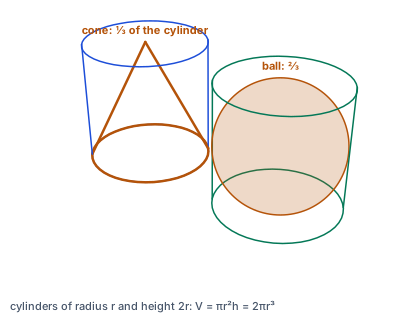
Finally, fit a ball of radius $r$ snugly inside a cylinder. The ball touches the top and the bottom, so the cylinder's height is the ball's diameter, $2r$. That cylinder holds $\pi r^{2} \times 2r = 2\pi r^{3}$. The Greek mathematician Archimedes proved that the ball fills exactly two thirds of it, and $\frac{2}{3} \times 2\pi r^{3} = \frac{4}{3}\pi r^{3}$:
$$V_{\text{sphere}} = \frac{4}{3}\pi r^{3}.$$
So you need one picture, a cylinder, and two fractions: a cone is $\frac{1}{3}$ of it and a sphere is $\frac{2}{3}$ of it (when the cylinder is as tall as the sphere is wide). Put a cone and a sphere of the same radius into that tall cylinder and they fill it exactly: $\frac{1}{3} + \frac{2}{3} = 1$.
Another way: picture
Picture a tennis ball can with one ball in it, cut to fit the ball exactly. Pour water into the can around the ball: the water fills one third of the can, and the ball takes the other two thirds. Now picture a paper cone that just fits the can: three cones of water fill it.
Another way: numbers
Take radius $3$ and height $6$. The cylinder holds $\pi \times 9 \times 6 = 54\pi$. The cone with that base and height holds $18\pi$, one third. The sphere of radius $3$ is $6$ across, so it fits this cylinder, and it holds $\frac{4}{3}\pi \times 27 = 36\pi$, two thirds. And $18\pi + 36\pi = 54\pi$.
Think of a stack of quarters. Each coin is a thin circle, and the stack is a cylinder. If one coin covers $B$ square units and the stack is $h$ units tall, then a layer $1$ unit thick holds $B$ cubic units, and there are $h$ such layers. So the volume is $B \times h$.
This is the same rule you used for a box, where $B$ was length times width. The only change is the shape of the base. For a cylinder the base is a circle, so $B = \pi r^{2}$ and $V = \pi r^{2} h$.
The rule does not care whether the stack is neat. If you push the quarters so the stack leans, each coin still has the same area and there are still the same number of coins, so the volume does not change. That is why the height is always measured straight up, at a right angle to the base, and never along a slanted side.
Notice the units. The radius is a length, say in inches. Squaring it gives square inches (an area), and multiplying by the height gives cubic inches (a volume). If your answer is not in cubic units, a step is missing.
There are two good ways to write a volume.
Do the multiplying by $\pi$ last. Work out the number in front of $\pi$ with whole numbers first, and only at the end turn it into a decimal. That keeps the arithmetic easy and avoids rounding errors piling up.
Using $3.14$ and using a calculator's $\pi$ give slightly different answers: $20\pi$ is $62.8$ with $3.14$ and $62.83$ with the $\pi$ key. Both are fine; use what the question asks for.
Watch whether you are given a radius or a diameter. Labels and packages often give the diameter, the width across. A pipe "$4$ inches across" has a radius of $2$ inches. Using $4$ as the radius makes a cylinder four times too big, because the radius gets squared, and a sphere eight times too big, because it gets cubed.
Sometimes you know the volume and need a length. Write the formula, put in everything you know, and undo the operations one at a time.
A cylinder holds $180\pi$ cubic centimeters and has radius $6$ cm. How tall is it? The base area is $\pi \times 6^{2} = 36\pi$, so $36\pi \times h = 180\pi$. Divide both sides by $36\pi$: $h = 5$ cm.
A cone holds $32\pi$ cubic inches and has height $6$ inches. What is its radius? Here $\frac{1}{3}\pi r^{2} \times 6 = 32\pi$, which is $2\pi r^{2} = 32\pi$. Divide by $2\pi$: $r^{2} = 16$, so $r = 4$ inches, since a length is positive.
A sphere holds $36\pi$ cubic feet. What is its radius? Here $\frac{4}{3}\pi r^{3} = 36\pi$. Divide by $\pi$ and multiply by $\frac{3}{4}$: $r^{3} = 27$, so $r = \sqrt[3]{27} = 3$ feet. A cube root undoes a cube, just as a square root undoes a square.
In each case, check by putting the length back into the formula. You should get the volume you started with.
Why each move is allowed. A volume is a base area times a height, and a circle's area is $\pi r^{2}$. The cone and sphere fractions come from comparing them with a cylinder, which people have checked by pouring and Archimedes proved by reasoning. Multiplication can be done in any order, so you can divide by $3$ early whenever that keeps the numbers whole.
How to check. Compare with the matching cylinder: a cone must be exactly a third of it, and a sphere must be smaller than the cylinder that just holds it. Estimate: $\pi$ is a bit more than $3$, so $20\pi$ must be a bit more than $60$. Check the units: a volume is always in cubic units. And if you worked backward, put your length back into the formula.
Both cylinders in the picture have radius $r = 1$ and height $2$, so each holds $\pi \times 1^{2} \times 2 = 2\pi$. The cone on the left has the same base and the same height, so it holds one third: $\frac{2\pi}{3}$. The ball on the right has radius $1$ and just touches the top, the bottom and the sides, so it holds two thirds: $\frac{4\pi}{3}$, which is $\frac{4}{3}\pi r^{3}$. Add them: $\frac{2\pi}{3} + \frac{4\pi}{3} = 2\pi$. A cone and a ball together fill exactly one of these cylinders. Turn the figure and look from above: all three are the same circle, which is why they share the $\pi r^{2}$.
A standard $12$-ounce soda can is about $2.6$ inches across and $4.8$ inches tall. Treat it as a cylinder with radius $1.3$ inches:
$$V \approx 3.14 \times 1.3^{2} \times 4.8 = 3.14 \times 1.69 \times 4.8 \approx 25.5 \text{ in}^{3}.$$
A US gallon is exactly $231$ cubic inches, and a gallon is $128$ fluid ounces, so $12$ fluid ounces is $12 \times \frac{231}{128} \approx 21.7$ cubic inches. The can's shape holds about $25.5$, so the soda fills only about $85\%$ of it. Part of the gap is real (the top and bottom of a can are narrower than the middle), and part is headspace: a little room for the gas, so the can does not burst when it gets warm.
A men's regulation basketball has a circumference of about $29.5$ inches. Since the circumference is $2\pi r$, the radius is $29.5 \div (2 \times 3.14) \approx 4.7$ inches. Its volume is
$$\frac{4}{3} \times 3.14 \times 4.7^{3} \approx \frac{4}{3} \times 3.14 \times 103.8 \approx 435 \text{ in}^{3}.$$
That is $435 \div 231 \approx 1.9$ gallons of space inside one ball. A store that ships basketballs in boxes $9.5$ inches on each side is shipping $9.5^{3} \approx 857$ cubic inches of box for each ball, so nearly half of every box is empty space, more than the one third a ball leaves in a cylinder that just fits it.
Towns store road salt for winter in piles that settle into cones. Suppose a pile is $40$ feet across at the bottom and $15$ feet high. The radius is $20$ feet, so the pile holds
$$\frac{1}{3} \times 3.14 \times 20^{2} \times 15 = 3.14 \times 400 \times 5 = 6280 \text{ ft}^{3}.$$
A road crew that knows a cubic foot of rock salt weighs roughly $80$ pounds can estimate the pile at about $500\,000$ pounds, or $250$ tons, without weighing a single truckload. If they had used the cylinder formula by mistake they would have guessed $750$ tons and thought they had three times the salt they really had.
Using the diameter as the radius. A ball $10$ cm across has radius $5$ cm. Using $10$ makes the sphere $2^{3} = 8$ times too big.
Forgetting the one third for a cone. A cone is never the same volume as the cylinder around it; it is a third.
Squaring or cubing the wrong thing. In $\pi r^{2} h$ only the radius is squared. In $\frac{4}{3}\pi r^{3}$, $r^{3}$ is $r \times r \times r$, not $3r$: for $r = 4$ it is $64$, not $12$.
Measuring a slanted height. The height of a cone is straight up from the center of the base to the tip, not along the sloping side.
Square units for a volume. An answer in $\text{cm}^{2}$ is an area. A volume is always in cubic units.
A can of beans has radius $3$ inches and height $8$ inches. Write the cylinder formula.
$V = \pi r^{2} h$
A cylinder is a stack of equal circles: base area times height.
Square the radius.
$r^{2} = 3^{2} = 9$
The base is a circle, whose area is $\pi r^{2}$.
Write the base area.
$B = 9\pi \text{ in}^{2}$
Keeping $\pi$ as a symbol keeps the answer exact for now.
Multiply by the height.
$V = 9\pi \times 8 = 72\pi \text{ in}^{3}$
There are $8$ one-inch layers, each holding $9\pi$ cubic inches.
Replace $\pi$ with $3.14$.
$V \approx 72 \times 3.14 = 226.08 \text{ in}^{3}$
A decimal tells you how much the can really holds; $72 \times 3$ is $216$, so a bit more than that is sensible.
A funnel is a cone with radius $4$ cm and height $9$ cm. Write the cone formula.
$V = \frac{1}{3}\pi r^{2} h$
The cone is one third of the cylinder with the same base and height.
Square the radius.
$r^{2} = 4^{2} = 16$
The base is a circle, just as for a cylinder.
Find the matching cylinder's volume.
$\pi \times 16 \times 9 = 144\pi$
This is the cylinder the cone fits inside exactly.
Take one third.
$V = 144\pi \div 3 = 48\pi \text{ cm}^{3}$
Three cones of water fill that cylinder.
Replace $\pi$ with $3.14$.
$V \approx 48 \times 3.14 = 150.72 \text{ cm}^{3}$
The question is about a real funnel, so a decimal is useful.
Check against the cylinder.
$3 \times 48\pi = 144\pi\; \checkmark$
Three times the cone should give back the cylinder, and it does.
A globe is $12$ inches across. Halve the diameter to get the radius.
$r = 12 \div 2 = 6$
The sphere formula uses the radius, and $12$ inches is the width across.
Write the sphere formula.
$V = \frac{4}{3}\pi r^{3}$
A sphere is two thirds of the cylinder that just holds it.
Cube the radius.
$r^{3} = 6 \times 6 \times 6 = 216$
A cube means three equal factors, not multiplying by $3$.
Divide by $3$.
$216 \div 3 = 72$
Dividing first keeps the numbers whole; the order of multiplying and dividing does not matter.
Multiply by $4$.
$V = 4 \times 72\pi = 288\pi \text{ in}^{3}$
This completes $\frac{4}{3}$ of $216$.
Replace $\pi$ with $3.14$.
$V \approx 288 \times 3.14 = 904.32 \text{ in}^{3}$
This is how much air the globe encloses.
Check with the cylinder that holds the globe.
$\pi \times 6^{2} \times 12 = 432\pi, \quad \frac{2}{3} \times 432\pi = 288\pi\; \checkmark$
The cylinder is as tall as the globe is wide, and the sphere is two thirds of it.
Square the radius.
$r^{2} = 5^{2} = 25$
The base is a circle.
Multiply by the height.
$25 \times 6 = 150$
This gives the matching cylinder, $150\pi$.
Take one third.
Replace $\pi$ with $3.14$.
A cylindrical glass holds $192$ milliliters. A paper cone has exactly the same circular opening and the same height as the glass. How much water does the cone hold?
Complete the worked solution to find the exact volume of a cone with radius $8$ m and height $12$ m.
Square the radius.
$r^{2} =$ s
The base is a circle of area $\pi r^{2}$.
Multiply by the height to get the cylinder's volume.
$\pi r^{2} h = $ c $\pi$
This is the cylinder with the same base and height as the cone.
Take one third of the cylinder.
$V = \frac{1}{3} \times$ cylinder $=$ v $\pi \text{ m}^{3}$
A cone holds exactly a third of its cylinder.
A cylinder has radius $4$ centimeters and height $9$ centimeters. Using $3.14$ for $\pi$, find its volume in cubic centimeters.
Answer:
A cone has a base of radius $3$ inches and a height of $6$ inches. Using $3.14$ for $\pi$, find its volume in cubic inches.
Answer:
A ball has a diameter of $6$ inches. Its volume is $k\pi$ cubic inches. Find $k$.
Answer:
A cylindrical water tank on a farm has a radius of $5$ feet and holds $175\pi$ cubic feet of water when full. How tall is the tank, in feet?
Answer:
An ice cream stand sells one round scoop with a radius of $6$ cm, or a cylindrical cup filled level to the top, with a radius of $6$ cm and a height of $4$ cm. Which holds more ice cream?
Lesson test: one question per skill, one attempt each, no hints. Your answers are checked when you submit.
A cone has a base of radius $5$ inches and a height of $12$ inches. Using $3.14$ for $\pi$, find its volume in cubic inches.
Answer:
You can find the volume of a cylinder, a cone and a sphere. Without looking: what fraction of its containing cylinder is a cone, and what fraction is a sphere?
17. Your turn: find the volume of a cone with radius $5$ ft and height $6$ ft, step 3
$150 \div 3 = 50, \quad V = 50\pi \text{ ft}^{3}$
A cone is a third of its cylinder.
17. Your turn: find the volume of a cone with radius $5$ ft and height $6$ ft, step 4
$V \approx 50 \times 3.14 = 157 \text{ ft}^{3}$
A decimal for a real measurement.