Another way: picture
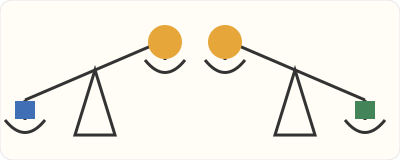
Find the lower pan in each separate trial.
Back to the on-screen lesson ·
Comparing two things by weight using holding and balance observations.
Paper packet. Every task here also exists on screen, where it is checked automatically; answers written on paper are not assessed by Nydus. When you are back at a device, enter your answers there.
Today we compare weight and use a balance to check a guess about heavier and lighter.
| Term | What it means |
|---|---|
| Heavier | Having more weight than another object. |
| Lighter | Having less weight than another object. |
Choose two small objects that are safe to hold. Feel one in each hand. Which seems heavier? Swap hands and check. Your guess can be wrong, especially when weights are close. An adult can help you use an equal-arm balance that starts level with empty pans. Wait until it stops moving before reading it.
Another way: picture
Find the lower pan in each separate trial.
On this balance, the heavier side settles lower. The lighter side rises. Level pans show equal weight within what the balance can detect. A big hollow object can be lighter than a small solid object. We need a fair comparison, not a guess from color, size or which side holds it.
Compare two small pretend parcels. Predict, test, then describe the result. Change one parcel's contents and test again. Ask an adult for help with the balance; never lift something that feels too heavy.
Find the lower first pan.
Blue block side.
It pulls down more.
Compare the objects.
Blue block heavier.
The larger ball is higher.
Find the higher second pan.
Yellow ball side.
This side rises.
Name the comparison.
An adult tests pairs on a balanced, equal-arm scale. Match each observation to the heavier object.
| Stone | Book | |
|---|---|---|
| Stone pan lower than sponge pan | ||
| Book pan lower than scarf pan |
Audio transcript: None
Now match each observed comparison to the LIGHTER object.
| Ribbon | Sock | |
|---|---|---|
| Ribbon pan higher than shell pan | ||
| Sock pan higher than toy car pan |
Audio transcript: None
Match each set of balance results to the heaviest object in that set.
| Red bag | Tin | |
|---|---|---|
| Red bag heavier than white bag and black bag | ||
| Tin heavier than cup and lid |
Audio transcript: None
A small clay ball pulls its pan below a large empty box. Which is heavier?
Audio transcript: None
A toy delivery cart needs the heavier object from EACH trial. Mark one object on each balance.
This task has no paper form; do it on a device.
Audio transcript: None
Lesson test: one question per skill, one attempt each, no hints. Your answers are checked when you submit.
Mark the lighter object in EACH pictured trial.
This task has no paper form; do it on a device.
Audio transcript: None
Explain why a larger object could be lighter and show how you would check safely.
7. Second balance, step 2
Yellow ball lighter.
The green block pulls down more.