Another way: picture
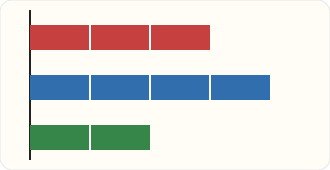
Check the starting line before the far ends.
Back to the on-screen lesson ·
Compare length fairly and choose appropriate tests for length, weight and capacity.
Paper packet. Every task here also exists on screen, where it is checked automatically; answers written on paper are not assessed by Nydus. When you are back at a device, enter your answers there.
Today we compare length from aligned ends and distinguish length from other measurable properties.
| Term | What it means |
|---|---|
| Align | Put matching starting ends together. |
| Equal length | The same distance from end to end. |
Length tells how far something reaches from one end to the other. To compare two straight ribbons, put their starting ends together. Smooth them without stretching. Look at their other ends. The one reaching farther is longer; the one stopping sooner is shorter. If both ends match, their lengths are equal. Moving a ribbon across the table does not make it longer.
Another way: picture
Check the starting line before the far ends.
Length, weight and capacity ask different questions. Align ends for length. Use a fair balance for weight. Pour carefully to compare capacity. A longer container need not be heavier or hold more. Equal small blocks can help record length: place them end to end without gaps or overlaps, always using the same block size.
Choose a ribbon for a toy doorway. Compare it directly with the opening. Explain whether it is too short, long enough, or needs trimming.
Check both starting ends.
Same line.
This makes a fair comparison.
Compare their far ends.
Red is longer.
It reaches one block beyond green.
Count equal blocks.
Blue four; red three.
Every block has the same length.
Name the longer ribbon.
All bars begin at the same left edge. Match each pair to its longer bar.
| Blue | Yellow | |
|---|---|---|
|   | ||
|   |
Audio transcript: None
For each pair with matching starting ends, name the shorter bar.
| Yellow | Blue | |
|---|---|---|
|   | ||
|   |
Audio transcript: None
Two ribbon sets were aligned and measured with the same small block. Match each set to its longest ribbon.
| Red | Green | |
|---|---|---|
| A: red 4 blocks, blue 2, green 3 | ||
| B: red 1 block, blue 3, green 5 |
Audio transcript: None
 Which ribbon is longer than the red ribbon?
Audio transcript: None
 A toy craft needs the blue ribbon shortened to the red ribbon's length. How many equal block-lengths must be removed?
Answer:
Audio transcript: None
Two ribbons start at different places. One ends farther right. What should you do before deciding which is longer?
Audio transcript: None
Lesson test: one question per skill, one attempt each, no hints. Your answers are checked when you submit.
 How many equal block-lengths must be added to green to make it as long as blue?
Answer: block-lengths
Audio transcript: None
Show how to line up two objects fairly before deciding which one is longer.
7. Blue and red, step 2
Blue.
Four equal lengths exceed three.