Another way: picture
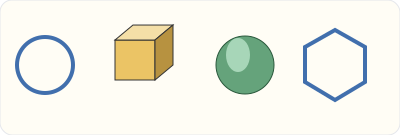
These pictures represent two flat outlines and two solid toys.
Back to the on-screen lesson ·
Describe more flat shapes and distinguish flat outlines from solid objects.
Paper packet. Every task here also exists on screen, where it is checked automatically; answers written on paper are not assessed by Nydus. When you are back at a device, enter your answers there.
Today we describe shape properties and tell a flat design from a solid object.
| Term | What it means |
|---|---|
| Flat shape | A shape in a surface. |
| Solid | A shape extending in three directions. |
A hexagon has six straight sides. A rhombus has four equal straight sides; a square is a special rhombus with square corners. An oval has a stretched-round curved outline. A star has points and inward turns. Check the boundary instead of naming a shape from its color or which way it points.
Another way: picture
These pictures represent two flat outlines and two solid toys.
A circle is flat. A ball is a solid, like a sphere: it takes up space in every direction. A cube block is solid too, with flat square faces. Tracing one face can make a flat square, but that square is not the whole block. Pictures of solids remain flat pictures; think about the objects they represent.
Find a safe solid toy and trace one outline. Describe how they differ. Put the toy beside, above or below the drawing and name that relationship to a partner.
Look at the second object.
A cube block.
Several faces are shown.
Imagine tracing one face.
A flat square.
One face is not the whole solid.
Find the third object.
A ball.
It represents a solid sphere.
Compare the first design.
Which shape is an oval with a curved outline and no corners?
Audio transcript: None
 What name fits this six-sided shape?
Audio transcript: None
A toy ball is round in every direction and takes up space. Which describes the ball itself?
Audio transcript: None
Match each flat shape to its number of straight sides.
| 4 | 6 | |
|---|---|---|
|  | ||
|  |
Audio transcript: None
A toy designer wants the two FLAT OUTLINE designs, not the solid toys represented here. Mark both flat designs.
This task has no paper form; do it on a device.
Audio transcript: None
A child holds a ball ABOVE a circle drawn on a mat. Which statement describes the solid and its position?
Audio transcript: None
Lesson test: one question per skill, one attempt each, no hints. Your answers are checked when you submit.
Mark both drawings that represent solid toys you could turn in your hands.
This task has no paper form; do it on a device.
Audio transcript: None
Explain how a ball differs from its circle outline and describe the ball's position near another object.
7. Ball and outline, step 2
A flat circle.
An outline is not the whole ball.