Another way: picture
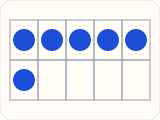
One extra bottom dot changes six to seven.
Back to the on-screen lesson ·
Connect adding or removing one object with neighboring counting numbers.
Paper packet. Every task here also exists on screen, where it is checked automatically; answers written on paper are not assessed by Nydus. When you are back at a device, enter your answers there.
Today we find one more and one fewer, and check changes by moving real counters.
| Term | What it means |
|---|---|
| One more | The amount after adding one. |
| One fewer | The amount after removing one. |
Add one counter to a group. The new amount is the next counting number: one more. Remove one counter instead. The new amount is the number just before: one fewer. Say the starting amount before making a change. If you forget the next or previous word, count the objects again. Counting from one is a useful check, not a mistake.
Another way: picture
One extra bottom dot changes six to seven.
You can also split a small collection. Five counters can be two here and three there, or one here and four there. Push the parts together to check that the whole is still five. Moving counters between parts changes each part, but it does not change the whole unless counters arrive or leave.
Use five pretend crackers. Put some in a box and leave the rest on a tray. Name both parts, recombine them, and find a different split.
Start with six dots.
Six already there.
Keep the original collection.
Add one in an empty space.
Seven dots.
Seven follows six.
Start with eight dots.
Remove one.
One object leaves.
Name what remains.
A collection has 1 counters. Add exactly one. How many now?
One more than 1 is more.
There are 3 counters. Remove exactly one. How many remain?
One fewer than 3 is fewer.
Match each frame to its amount AFTER adding one dot to an empty space.
| 7 | 10 | |
|---|---|---|
|  | ||
|  |
Audio transcript: None
Start with six counters each time. In one trial add one; in a separate trial remove one. Record both new amounts.
After adding one: more. After removing one: fewer.
Audio transcript: None
A toy party has 7 guests and one cup for each. One new guest arrives. How many cups are needed altogether now?
Answer:
Audio transcript: None
Five pretend crackers are on a tray. Put two in a lunch box. How many stay on the tray?
Answer:
Audio transcript: None
Split five toy buttons between two trays. First put one in the left tray; record how many belong on the right. Start again with five and put two on the left; record the new right part.
| Buttons on right | |
|---|---|
| Left tray has 1 | |
| Left tray has 2 |
Audio transcript: None
Lesson test: one question per skill, one attempt each, no hints. Your answers are checked when you submit.
Ten toy animals are waiting. One goes home. How many animals still need a waiting place?
Answer:
Audio transcript: None
Show what changes when one object arrives and what changes when one object leaves a collection.
7. Remove a counter, step 2
Seven dots.
Seven comes before eight.