Another way: picture
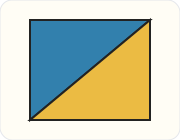
Follow the diagonal to see the parts; follow the outside to see the whole.
Back to the on-screen lesson ·
Making a bigger shape from smaller ones.
Paper packet. Every task here also exists on screen, where it is checked automatically; answers written on paper are not assessed by Nydus. When you are back at a device, enter your answers there.
Today we join pieces and describe both the parts and the whole outside shape.
| Term | What it means |
|---|---|
| Seam | Where two pieces meet. |
| Boundary | The outside edge of the whole. |
Two shapes can meet along an edge to make a larger shape. The place where they meet is a seam. To name the whole, follow its outside boundary. Do not turn down an inside seam. The smaller shapes are still parts of the whole, even when the whole has a different name.
Another way: picture
Follow the diagonal to see the parts; follow the outside to see the whole.
Join two equal squares along a full edge. Their outside makes a rectangle. Slide one square away: now there is a gap, so they no longer fill that rectangle. Turn or slide pieces until edges meet without gaps or overlaps. Just touching at one corner is not the same arrangement.
Use paper shapes to cover a toy floor. Move pieces until there are no gaps. Show a partner one part, then trace the whole. An adult can observe your building; a screen answer cannot prove it.

Trace outside both pieces.
Four sides.
The middle seam is inside.
Name the whole outline.
A rectangle.
It has four square corners.

Keep to the outside.
Six straight edges.
Ignore the inside lines.
Name this whole shape.
 What is the whole outside shape?
Audio transcript: None
 Which pieces make this rectangle?
Audio transcript: None
 How many corners are on the OUTSIDE boundary?
Audio transcript: None
Match each pictured arrangement to the whole outline it makes.
| Rectangle | Hexagon | |
|---|---|---|
|  | ||
|  |
Audio transcript: None
 A toy builder makes this roof from colored triangle tiles. How many separate tiles are used?
Answer: tiles
Audio transcript: None
Lesson test: one question per skill, one attempt each, no hints. Your answers are checked when you submit.
 How many corners belong to the whole outside outline of this roof?
Answer:
Audio transcript: None
Show how the outside boundary differs from a line where two pieces meet inside.
7. Many parts, step 2
A hexagon.
Hexagons have six sides.