Another way: picture
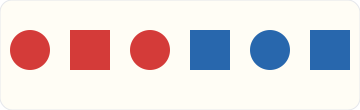
Sort these by shape, then imagine starting again by color.
Back to the on-screen lesson ·
Putting things in groups and then counting each group.
Paper packet. Every task here also exists on screen, where it is checked automatically; answers written on paper are not assessed by Nydus. When you are back at a device, enter your answers there.
Today we use a sorting rule, count each group and sometimes check two attributes together.
| Term | What it means |
|---|---|
| Attribute | A property, such as color or shape. |
| Rule | What an object must satisfy to belong. |
Sorting puts objects together for a reason. A shape rule collects all circles, whatever their color. A color rule collects all red tiles, whatever their shape. Say the rule before moving anything. Then check every object once. An object that does not fit stays outside that group; it is not a mistake to leave it out.
Another way: picture
Sort these by shape, then imagine starting again by color.
A rule can require both color and shape: red circles. Check red, then check circle. A red square passes only one check. After sorting, count each group separately and record its amount. Pair objects from two groups to compare them. A group spread across more space need not have more objects.
Sort pretend craft supplies into useful groups. Tell a partner your rule, then ask them to test a new piece. Count again if the group changes.
Check color only.
First three tiles.
They are all red.
Count this group.
Three red tiles.
The square belongs under a color rule.
Start with the red group.
Three red tiles.
All pass the first check.
Keep only squares.
 How many circles are in this collection? Count both colors.
Answer:
Audio transcript: None
A sorted tray holds ● ● ● ● and ■ ■. Which shape group has more?
Audio transcript: None
Match each sorted group to its count: ▲ ▲; ● ● ● ● ●; ■.
| 2 | 5 | 1 | |
|---|---|---|---|
| ▲ ▲ | |||
| ● ● ● ● ● | |||
| ■ |
Audio transcript: None
 Change the rule to SHAPE only. Count circles and squares, including every color.
Circles: round. Squares: square.
Audio transcript: None
 A toy badge needs tiles that are BOTH red AND round. How many can be used?
Answer: red circles
Audio transcript: None
A toy-window tray is for BLUE SQUARES. A new tile is blue and round. What should happen?
Audio transcript: None
Lesson test: one question per skill, one attempt each, no hints. Your answers are checked when you submit.
 Record the blue squares and red squares separately.
Blue squares: blue. Red squares: red.
Audio transcript: None
Show why a blue circle does not belong in a group made only for blue squares.
7. Red and square, step 2
One red square.
Both circles fail the second check.