Back to the on-screen lesson ·
The difference quotient, the limit that tames it, and the slope, rate and approximation it gives at once.
Paper packet. Every task here also exists on screen, where it is checked automatically; answers written on paper are not assessed by Nydus. When you are back at a device, enter your answers there.
By the end of this lesson you will be able to compute a derivative from the definition for a polynomial, a reciprocal and a square root — cancelling the $h$ before taking any limit — write the tangent line at a point using both the value and the derivative, read the derivative as a slope, as an instantaneous rate and as a linear approximation, give its units from the units of the function, and recognise a limit that is a derivative in disguise so that it need not be computed from scratch.
A limit was defined so that the value at the point could be ignored, and the whole apparatus of one-sided limits, laws and continuity was built on it. This is what it was for. The object below is $0/0$ at the point it is evaluated at — not by accident but by construction — and nothing short of a limit can make sense of it.
The derivative of $f$ at $a$ is $$f'(a) = \lim_{h \to 0} \frac{f(a + h) - f(a)}{h},$$ when the limit exists; equivalently $\lim_{x \to a} \dfrac{f(x) - f(a)}{x - a}$, which is the same quotient with $x = a + h$.
The quotient before the limit is the average rate of change over the interval from $a$ to $a + h$ — a slope of a secant line, a mean velocity, an average cost per item. At $h = 0$ it is $0/0$ and undefined, which is exactly why the limit is taken and exactly why the $0 < |h|$ in the definition of a limit matters.
The same number means three things at once, and they are the same thing seen from three directions:
| Reading | What it is |
|---|---|
| geometric | the slope of the tangent to $y = f(x)$ at $\bigl(a, f(a)\bigr)$ |
| physical | the instantaneous rate of change of $f$ at $a$ |
| approximating | the best linear approximation to $f$ near $a$ |
The tangent line is $$y = f(a) + f'(a)(x - a),$$ and it needs both numbers: $f(a)$ puts it in the right place, $f'(a)$ points it in the right direction.
Units. The derivative's units are the output's over the input's. Position in metres against time in seconds gives metres per second; cost in pounds against quantity in items gives pounds per item. The units are usually enough to say what the number means.
Another way: picture
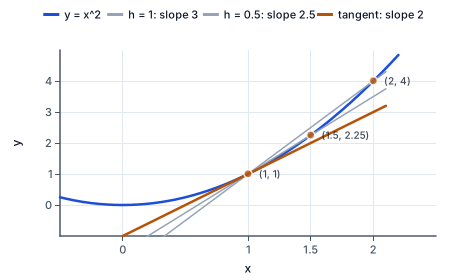
Two points on a curve joined by a secant line. Slide the second point towards the first: the secant pivots, and its slope approaches a limiting value. The tangent is the line the secants approach, and the derivative is its slope. It is worth noticing that the tangent is defined this way — as a limit of secants — rather than as "the line touching at one point", which is a description that fails on plenty of curves.
Another way: steps
To differentiate from the definition:
Step 3 looks like luck and is not. If $f$ is continuous at $a$ then $f(a+h) - f(a) \to 0$ as $h \to 0$, so the numerator vanishes with $h$ and the quotient is a genuine $0/0$ — the kind that algebra can clear.
For a polynomial, the binomial expansion of $f(a+h)$ has a constant term that is exactly $f(a)$ and every other term carrying an $h$. Subtracting removes the constant; dividing removes one $h$ from each remaining term; letting $h \to 0$ kills everything that still has one. What survives is the coefficient of $h^1$ — which is the derivative, and is the first hint of the Taylor series.
When the $h$ does not cancel, that is information. For $f(x) = |x|$ at $a = 0$ the quotient is $|h|/h$, which is $1$ for $h > 0$ and $-1$ for $h < 0$: no algebra removes the $h$ because the two sides genuinely disagree, and the derivative does not exist. Failing to cancel is the symptom of non-differentiability, not a sign that you have made an error.
The chart shows the quotient for $f(x) = x^2$ at $a = 1$. With $h = 1$ the secant joins $(1, 1)$ to $(2, 4)$ and its slope is $\dfrac{4 - 1}{1} = 3$; with $h = 0.5$ it joins $(1, 1)$ to $(1.5, 2.25)$ and its slope is $\dfrac{2.25 - 1}{0.5} = 2.5$. In general the quotient simplifies to $2 + h$, so as $h$ shrinks the secants pivot about $(1, 1)$ toward the highlighted tangent $y = 2x - 1$, whose slope $2$ is $f'(1)$.
Substituting $h = 0$ before cancelling. That gives $0/0$ and nothing else. The cancellation has to come first, and it is legitimate because $h \ne 0$ throughout — the limit never evaluates at $h = 0$.
Expanding $f(a + h)$ wrongly. $(a+h)^2$ is $a^2 + 2ah + h^2$, not $a^2 + h^2$. This one error accounts for a large share of wrong derivatives computed from the definition.
Confusing the derivative with the value. $f(a)$ and $f'(a)$ are different numbers with different units, and the tangent line needs both.
Reading the difference quotient as the derivative. Before the limit it is an average rate over an interval; after it, an instantaneous rate at a point. The distinction is the entire subject.
Writing the tangent as $y = f'(a)x$. That is a line through the origin with the right slope, and it touches the curve only by coincidence.
Leibniz wrote $\dfrac{dy}{dx}$ because the object really is the limit of a ratio $\dfrac{\Delta y}{\Delta x}$, and the notation is a good one precisely because it remembers that. But $dy$ and $dx$ are not numbers being divided: the whole symbol names one limit.
The practical consequence is that manipulations which look like fraction arithmetic — cancelling $dx$ against $dx$, splitting $\dfrac{dy}{dx}$ into two pieces — are theorems where they hold, not algebra. The chain rule, $\dfrac{dy}{dx} = \dfrac{dy}{du}\dfrac{du}{dx}$, looks like cancellation and is a theorem with a proof and hypotheses. Separation of variables in a differential equation looks like multiplying through by $dx$ and is a theorem too. Each earns its licence; none of them is permitted by the notation.
$f(x) = \sqrt{x}$ at $a = 9$. The quotient is $\dfrac{\sqrt{9+h} - 3}{h}$, and expanding is not available.
No binomial to expand.
Multiply above and below by $\sqrt{9+h} + 3$: the numerator becomes $(9 + h) - 9 = h$, so the quotient is $\dfrac{h}{h(\sqrt{9+h}+3)} = \dfrac{1}{\sqrt{9+h}+3}$.
The conjugate manufactures the $h$ that cancels.
Letting $h \to 0$: $f'(9) = \dfrac{1}{6}$. Sanity check against the power rule, $\tfrac12 x^{-1/2}$ at $9$: $\tfrac{1}{2 \cdot 3} = \tfrac16$. Agreed.
$f(x) = |x|$ at $a = 0$. The quotient is $\dfrac{|0 + h| - 0}{h} = \dfrac{|h|}{h}$.
As simple as the quotient ever gets.
For $h > 0$ it is $1$; for $h < 0$ it is $-1$. The one-sided limits are $1$ and $-1$.
Both exist, and they differ.
So the two-sided limit does not exist and $f'(0)$ does not exist — even though $f$ is perfectly continuous at $0$. The graph has a corner, and a corner has no single tangent direction.
Continuity is not enough.
$f(2+h) = (2+h)^2 + 3(2+h) = 4 + 4h + h^2 + 6 + 3h$, and $f(2) = 10$.
Expand and subtract.
The difference is $7h + h^2$, so the quotient is $7 + h$.
Divide; the $h$ goes.
Letting $h \to 0$: $f'(2) = 7$.
Match each tangent-line fact to its consequence.
| The line passes through $(a,b)$ | The line has slope $m$ | $y=f(a)+f'(a)(x-a)$ | May be inaccurate because linearization is local | |
|---|---|---|---|---|
| $f(a)=b$ | ||||
| $f'(a)=m$ | ||||
| Tangent line at $x=a$ | ||||
| A tangent-line estimate far from $a$ |
Match each derivative representation to its interpretation.
| Average slope from $a$ to $a+h$ | Tangent slope at $a$ | The graph rises locally as input increases | The tangent is horizontal, though not necessarily an extremum | |
|---|---|---|---|---|
| $[f(a+h)-f(a)]/h$ | ||||
| $\lim_{h\to0}[f(a+h)-f(a)]/h$ | ||||
| $f'(a)>0$ | ||||
| $f'(a)=0$ |
Match each representation of a derivative to what it tells you.
| The definition as a limit of average rates | The slope of the tangent at $x=a$ | The tangent line through $(a,f(a))$ | Derivative units are metres per second | |
|---|---|---|---|---|
| $\lim_{h\to0}(f(a+h)-f(a))/h$ | ||||
| $f'(a)=m$ | ||||
| $y=f(a)+f'(a)(x-a)$ | ||||
| Height is metres and time is seconds |
$f(x) = 5x^2 - 7x$. Compute $f'(1)$ from the definition.
Answer:
$f(x) = \dfrac{1}{x}$. Compute $f'(2)$ from the definition.
Answer:
Find $\displaystyle\lim_{h \to 0} \frac{(2 + h)^{3} - 8}{h}$ without expanding the bracket.
Answer:
Lesson test: one question per skill, one attempt each, no hints. Your answers are checked when you submit.
$f(x) = 2x^2$, so $f(4) = 32$ and $f'(4) = 16$. Write the tangent line at $x = 4$ in the form $y = mx + b$.
Answer:
You can differentiate from the definition and write a tangent line. Say in your own words why the $h$ in the denominator always cancels for a polynomial, and what it means when it does not. Next: the derivative as a function, and where it fails to exist.
9. Your turn: $f(x) = x^2 + 3x$ at $a = 2$, from the definition, step 3