Back to the on-screen lesson ·
A solid is the sum of its plates, so $V = \int A(x)\,dx$; for a solid of revolution the face is a disc or a washer.
Paper packet. Every task here also exists on screen, where it is checked automatically; answers written on paper are not assessed by Nydus. When you are back at a device, enter your answers there.
By the end of this lesson you will be able to cut a solid perpendicular to its axis of revolution, decide from the picture whether a plate is a disc or a washer, measure radii from the axis of revolution rather than from a coordinate axis, subtract the squares of the two radii instead of squaring their difference, set the limits along the direction of the cut, handle a solid whose cross-sections are given outright and carry no $\pi$, and say why the square belongs inside the integral.
The last lesson swept a vertical segment from one crossing to another and called the result an area. The segment had a length and the sweep gave it a width.
This lesson does the same thing one dimension up. A solid is cut into thin plates; each plate has a face with an area and a thickness $dx$, so its volume is area times thickness; and the integral adds the plates up. The only new work is describing the face, and for a solid of revolution the face is a circle or a circle with a hole. Every application of the integral is the same move: write what one thin slice contributes, then add the slices up. Get the slice right and the integral writes itself; reach for a remembered formula instead and the first unfamiliar region defeats you.
A plate is a thin slice cut perpendicular to some direction, with thickness $dx$ or $dy$.
A disc is a plate whose face is a full circle — what you get when the region being revolved reaches the axis. A washer is a plate whose face is a circle with a concentric circle removed — what you get when it does not.
The axis of revolution is the line the region is spun about. Radii are measured from it, and one of the commonest errors in the whole unit is measuring them from the coordinate axis instead when the two are different lines.
The general method. If $A(x)$ is the area of the cross-section at $x$, and the solid runs from $x = a$ to $x = b$, then $$V = \int_a^b A(x)\,dx.$$ That is the whole theory. Everything below is a way of finding $A$.
Discs. Revolving the region between $y = f(x)$ and the $x$-axis about the $x$-axis gives $A(x) = \pi f(x)^2$, so $$V = \pi\int_a^b f(x)^2\,dx.$$
Washers. If the region lies between $y = f(x)$ (outer) and $y = g(x)$ (inner), both on the same side of the axis, then $$A(x) = \pi\left(f(x)^2 - g(x)^2\right).$$ The difference of the squares, never the square of the difference: $\pi(f-g)^2$ is the area of a disc of radius $f - g$, which is a different plate entirely.
A different axis. Revolving about $y = c$ instead of $y = 0$ replaces every radius $f(x)$ by $|f(x) - c|$. The formula does not change; the radius does.
Cross-sections given outright. If the problem says the cross-sections are squares, or semicircles, or equilateral triangles, use that area. No $\pi$ appears unless a circle does.
Choosing the direction. Cut perpendicular to the axis of revolution and the plates are discs or washers. Cut parallel to it and they are shells — the next lesson — which is sometimes far easier, and is the right answer when the region's boundary is awkward to write as a function of the cutting variable.
Another way: picture
A loaf of bread, sliced. Each slice is thin enough that its two faces are practically the same, so its volume is the face's area times the thickness. Stack the slices back up and you have the loaf; add the volumes and you have the integral. Whether the slices are round, square or ragged never enters the argument.
Another way: steps
$\pi\displaystyle\int_a^b f^2\,dx$ and $\pi\left(\displaystyle\int_a^b f\,dx\right)^2$ are different numbers, and the second is never the volume.
The reason is that the sum is over plates, and each plate's area depends on its own radius. Squaring after the sum would mean adding all the radii first and squaring the total, which describes no solid. The integral of a square is not the square of an integral, for the same reason the average of squares is not the square of the average — and the gap between them is precisely a variance, which is positive unless $f$ is constant.
A clean instance: revolve $y = x$ on $[0,1]$. The true volume is $\pi\int_0^1 x^2 dx = \pi/3$ — a cone, as it should be. The wrong order gives $\pi(1/2)^2 = \pi/4$, which is the volume of a cylinder of radius $\tfrac12$: the solid you would get if every plate had the average radius. The cone is fatter at one end than thin at the other, and squaring is what notices that.
Squaring the gap instead of subtracting the squares. $(f - g)^2 \ne f^2 - g^2$. This is the single most common error in the unit.
Measuring radii from the wrong line. Revolving about $y = 2$, a curve at height $y = 5$ has radius $3$, not $5$. Mark the axis on the sketch before writing any radius.
Cutting in the wrong variable. Revolving about the $y$-axis and then integrating $dx$ with discs describes nothing. Perpendicular to the axis means $dy$ there.
Getting the limits from the other variable. The limits describe how far the solid extends along the cut.
Adding a $\pi$ to a solid nothing was revolved about. Square cross-sections have area $s^2$.
Assuming the outer function is the one written first. The outer radius is whichever is further from the axis, and on a region that straddles a crossing that can change — in which case the solid is split like an area is.
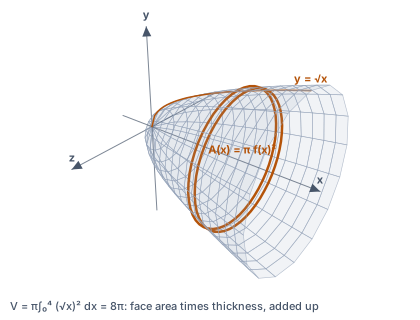
The curve $y = \sqrt{x}$ from $x = 0$ to $x = 4$, turned about the $x$-axis, sweeps out the solid in the figure. One slice at $x = 2.5$ is picked out: a disc of radius $f(2.5) = \sqrt{2.5}$ and face area $A(2.5) = \pi \cdot 2.5$. Every slice is a disc because the region touches the axis all the way along. Adding the faces times their thickness gives $$V = \pi\int_0^4 (\sqrt{x})^2\,dx = \pi\int_0^4 x\,dx = 8\pi.$$ Turn the figure to look along the axis: each slice is a circle, and the square inside the integral is the square in the area of a circle.
Discs and washers are usually presented as two formulas with a rule for choosing between them, and learners accordingly try to memorise which is which and when. That produces a third formula for revolving about a horizontal line, a fourth for a vertical one, and a fifth for cross-sections that are squares — a growing list, none of which helps with the sixth case.
There is one formula, $V = \int A$, and it is not really a formula at all: it says that a solid is the sum of its slices. Everything else is the geometry of a single plate, done freshly each time by looking at the picture.
The washer is not a separate case; it is what a plate looks like when a radius drawn from the axis meets empty space before it meets the solid. Revolving about $y = -1$ is not a new formula; it is the observation that a radius is measured from the axis you are spinning about. Square cross-sections are not an exception; they are a plate whose face happens to be a square.
So the question to ask, every time and before any algebra, is: what does one plate look like, and what is the area of its face? A learner who asks that will handle a case they have never seen; a learner reaching for the matching formula will not.
Revolve the region between $y = x$ and $y = x^2$ on $[0,1]$ about the line $y = -1$.
Mark the axis first; it is not a coordinate axis.
Radii are measured from $y = -1$: the outer radius is $x - (-1) = x + 1$ (the line is further from the axis) and the inner is $x^2 + 1$.
Each radius is the height above the axis of revolution.
$V = \pi\displaystyle\int_0^1\left((x+1)^2 - (x^2+1)^2\right)dx = \pi\int_0^1\left(x^2 + 2x - x^4 - 2x^2\right)dx = \dfrac{7\pi}{15}$.
Difference of squares, expanded and integrated.
Revolve the quarter-disc under $y = \sqrt{r^2 - x^2}$ on $[0, r]$ about the $x$-axis. Each plate is a full disc of radius $\sqrt{r^2 - x^2}$.
The region touches the axis, so no hole.
$A(x) = \pi\left(r^2 - x^2\right)$ — the square root and the square cancel, which is why this integral is elementary although the curve is not.
Squaring the radius removes the radical.
$V = \pi\displaystyle\int_0^{r}\left(r^2 - x^2\right)dx = \pi\left(r^3 - \dfrac{r^3}{3}\right) = \dfrac{2\pi r^3}{3}$: a hemisphere, and twice it is the sphere formula.
The classical result, out of the method.
Does the region touch the $x$-axis? Its lowest boundary is $y = x^2$, which is $0$ only at one point, so for the rest of the interval there is a hole: washers.
Ask the disc-or-washer question first.
Outer radius $4$ (the line, further from the axis), inner radius $x^2$: $A(x) = \pi\left(16 - x^{4}\right)$.
Subtract the squares, not the radii.
$V = \pi\displaystyle\int_0^{2}\left(16 - x^{4}\right)dx = \pi\left(32 - \dfrac{32}{5}\right) = \dfrac{128\pi}{5}$.
The region under $y = 2x$ from $x = 0$ to $x = 2$ is revolved about the $x$-axis. The volume is $k\pi$. Find $k$.
Answer:
The region between $y = 5$ and $y = 9$, for $0 \le x \le 4$, is revolved about the $x$-axis. What is the face of one plate?
Match each solid to the face of one plate cut perpendicular to the $x$-axis.
| $\pi f(x)^{2}$ | $\pi\left(f(x)^{2} - g(x)^{2}\right)$ | $f(x)^{2}$ | $\dfrac{\sqrt{3}}{4}f(x)^{2}$ | |
|---|---|---|---|---|
| The region under $y = f(x)$, revolved about the $x$-axis | ||||
| The region between $y = f(x)$ and $y = g(x)$, both above the axis, revolved about the $x$-axis | ||||
| A solid with square cross-sections of side $f(x)$ | ||||
| A solid with equilateral triangular cross-sections of side $f(x)$ |
The region between $y = 5$ and $y = 7$ is revolved about the $x$-axis. Fill in the plate's numbers.
| Value | |
|---|---|
| Outer radius | 7 |
| Inner radius | 5 |
| Outer radius squared | |
| Inner radius squared | |
| The face area, divided by $\pi$ |
Put the steps of finding the volume of the solid formed by revolving the region under $y = 6x$ about the $x$-axis into the order you do them.
Number the steps in order (write the number in the box):
A solid has base the interval $0 \le x \le 3$ and cross-sections perpendicular to the $x$-axis that are squares of side $4x$. Find its volume.
Answer:
Lesson test: one question per skill, one attempt each, no hints. Your answers are checked when you submit.
The region under $y = 5x$ from $x = 0$ to $x = 3$ is revolved about the $x$-axis. The volume is $k\pi$. Find $k$.
Answer:
You can find the volume of a solid by describing one plate and integrating its face. Say in your own words why $\pi\int f^2$ and $\pi(\int f)^2$ are different, and which is the volume. Next: cutting the same solids the other way, into shells.
11. Your turn: revolve the region between $y = x^{2}$ and $y = 4$ about the $x$-axis, for $0 \le x \le 2$, step 3