Back to the on-screen lesson ·
Surfaces read one slice at a time: cylinders from a missing variable, the six standard quadrics, and the procedure — count the squares, count the minus signs, read the constant — that names a surface without memorising a table.
Paper packet. Every task here also exists on screen, where it is checked automatically; answers written on paper are not assessed by Nydus. When you are back at a device, enter your answers there.
By the end of this lesson you will be able to find the traces of a surface in the coordinate planes, recognise a cylinder from a missing variable, and name the standard quadric surfaces from their equations by counting squared terms and minus signs and reading the constant. You will also be able to say what changes when that constant moves from positive through zero to negative.
The conic sections from Precalculus — ellipse, parabola, hyperbola — and planes from the last lesson. A quadric surface is what happens when a second-degree equation is allowed a third variable, and every one of them is built out of conics stacked up.
A trace is the curve a surface makes when one variable is held fixed; the traces in $x = 0$, $y = 0$ and $z = 0$ are the coordinate traces. A cylinder is the surface swept when a plane curve is repeated at every value of the missing variable. A quadric surface is the graph of a second-degree equation in three variables, and the standard ones are the ellipsoid, the elliptic and hyperbolic paraboloids, the cone, and the hyperboloids of one and two sheets.
A surface in space is hard to picture whole and easy to picture one slice at a time. Hold one variable fixed, look at the curve left in the other two, and then let the fixed value change and watch the curve move. That single method — traces — identifies every surface in this lesson.
Cylinders. If a variable is missing from the equation, it is free. $x^2 + y^2 = 9$ in space is not a circle but a circular cylinder: the circle of radius $3$ repeated at every height. A missing variable is the easiest thing to spot and the easiest to overlook.
The standard quadrics. With positive $a, b, c$:
| Equation | Surface | Horizontal traces |
|---|---|---|
| $\frac{x^2}{a^2} + \frac{y^2}{b^2} + \frac{z^2}{c^2} = 1$ | ellipsoid | ellipses, empty past $\pm c$ |
| $z = \frac{x^2}{a^2} + \frac{y^2}{b^2}$ | elliptic paraboloid | ellipses, empty below $0$ |
| $z = \frac{x^2}{a^2} - \frac{y^2}{b^2}$ | hyperbolic paraboloid | hyperbolas |
| $\frac{x^2}{a^2} + \frac{y^2}{b^2} = \frac{z^2}{c^2}$ | cone | ellipses, a point at $0$ |
| $\frac{x^2}{a^2} + \frac{y^2}{b^2} - \frac{z^2}{c^2} = 1$ | hyperboloid of one sheet | ellipses, never empty |
| $\frac{x^2}{a^2} + \frac{y^2}{b^2} - \frac{z^2}{c^2} = -1$ | hyperboloid of two sheets | ellipses, empty near $0$ |
How to read one. Three questions settle it every time:
The axis of a surface is the variable that behaves differently from the other two: the one with the odd sign, or the one appearing to the first power.
Another way: picture
Think of a loaf of bread and a bread knife. Cut horizontally and look at the face you expose; slide the knife up and watch the face grow, shrink, split in two or vanish. An ellipsoid's faces shrink to nothing at the top; a hyperboloid of one sheet's shrink to a waist and then grow again; a hyperboloid of two sheets' vanish entirely in the middle, which is what makes it two pieces.
Another way: steps
To identify a quadric from its equation:
Compare three equations that differ only in one number:
$$x^2 + y^2 - z^2 = 1, \qquad x^2 + y^2 - z^2 = 0, \qquad x^2 + y^2 - z^2 = -1.$$
Slice each at height $z = h$. The first leaves $x^2 + y^2 = 1 + h^2$, a circle for every $h$, never empty: the surface is one connected piece with a waist of radius $1$. The second leaves $x^2 + y^2 = h^2$, a circle that shrinks to a single point at $h = 0$: the two halves touch at the origin, and the surface is a cone. The third leaves $x^2 + y^2 = h^2 - 1$, which has no solutions at all when $|h| < 1$: the middle of the surface is missing and what remains is two separate caps.
One number, three genuinely different objects — connected, pinched, and disconnected. This is the clearest case in the course of a small change in an equation making a large change in a picture, and it is why identifying a quadric means reading the constant as carefully as the signs.
The cone is the borderline in both directions, and that is not a coincidence: both hyperboloids approach it far from the origin, because the constant becomes negligible beside the squares.
Forgetting that a missing variable means a cylinder. In two variables $x^2 + y^2 = 9$ is a circle; in three it is an infinite tube. Which one is meant depends entirely on how many variables the problem is set in, and that must be stated.
Reading a denominator as a semi-axis. In $\frac{x^2}{9} + \frac{y^2}{4} + z^2 = 1$ the semi-axes are $3$, $2$ and $1$, not $9$, $4$ and $1$. The denominators are the squares.
Assuming a surface is a graph. An ellipsoid is not the graph of a function of $x$ and $y$: most vertical lines meet it twice. Solving for $z$ produces two half-surfaces, and dropping one of them silently loses half the object.
Naming a surface without checking a trace. The names are worth little unless they predict something; take one slice and confirm it. A third coordinate is not a third term bolted onto a two-dimensional formula. The cross product exists only in space, a plane is fixed by a direction rather than by a slope, and a curve in space can bend without ever leaving a surface. Checking a new formula against the plane is worth doing; assuming the plane's formula still governs is how most of the errors in this course begin.
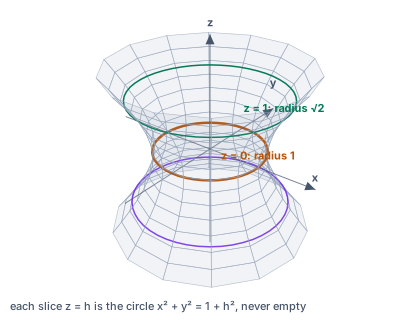
This is the first surface of the comparison above, $x^2 + y^2 - z^2 = 1$, with three of its horizontal traces picked out. At $z = 0$ the slice is $x^2 + y^2 = 1$, the circle of radius $1$ at the waist. At $z = \pm 1$ it is $x^2 + y^2 = 2$, the circle of radius $\sqrt{2}$. No height gives an empty slice, which is why the surface is one connected sheet. Turn the figure to look along the $z$-axis and every trace is a circle about it; turn it side on and the outline is the hyperbola $x^2 - z^2 = 1$, the vertical trace at $y = 0$. Reading a quadric is exactly this: two families of slices, each an ordinary curve.
Six equations with six names invites memorisation, and memorisation fails the moment an equation arrives rotated, shifted, or with the axis along $y$ instead of $z$ — which is most of the time. Nothing in the table survives a change of variable; the method does.
So the thing worth keeping is the procedure: a missing variable is a cylinder, a first-power variable is a paraboloid, and otherwise the minus signs and the constant decide. Applied to $y = x^2 + z^2$ it says elliptic paraboloid about the $y$ axis without needing a seventh row in any table, and applied to $(x-1)^2 + (y+2)^2 - z^2 = 1$ it says hyperboloid of one sheet, shifted. A name you can rebuild is worth more than six you have to recall.
Take $4x^2 - y^2 + 4z^2 = 4$, which tidies to $x^2 - \frac{y^2}{4} + z^2 = 1$.
Standard shape: squares left, constant right.
Slice at $y = h$: $x^2 + z^2 = 1 + h^2/4$, a circle for every $h$, never empty.
The odd sign is on $y$, so $y$ is the axis.
Slice at $z = 0$: $x^2 - y^2/4 = 1$, a hyperbola. Circles across, hyperbolas along, never empty: a hyperboloid of one sheet with axis the $y$ axis. Two slices were enough, and neither needed a picture.
Two traces in different directions identify it.
Take $z = x^2 - y^2$. Along the $x$ axis, $y = 0$ gives $z = x^2$: a parabola opening upwards.
One vertical trace rises.
Along the $y$ axis, $x = 0$ gives $z = -y^2$: a parabola opening downwards.
The other vertical trace falls.
So the origin is the lowest point of one trace and the highest of another — a saddle. Horizontal traces $x^2 - y^2 = h$ are hyperbolas, and at $h = 0$ the pair of lines $y = \pm x$. This surface returns in unit 3 as the standard example of a critical point that is neither a maximum nor a minimum.
Rising one way and falling another is what a saddle means.
Rearranging, $x^2 + y^2 = 4 - z$: one variable, $z$, appears only to the first power.
A first-power variable means a paraboloid.
Slicing at $z = h$ gives $x^2 + y^2 = 4 - h$, a circle of radius $\sqrt{4-h}$ while $h < 4$, a point at $h = 4$, and nothing above.
So it is an elliptic paraboloid — circular, in fact — opening downwards from the point $(0, 0, 4)$. The minus signs in front of the squares turned the bowl upside down without changing which family it belongs to, and the $4$ only moved it up.
The ellipsoid is $\dfrac{x^2}{16} + \dfrac{y^2}{64} + \dfrac{z^2}{49} = 1$. Plot where its trace in the plane $z = 0$ meets the positive $x$ axis and the positive $y$ axis.
Plot your answer on the grid:
Match each equation to the surface it describes.
| An ellipsoid | An elliptic paraboloid | A hyperbolic paraboloid, a saddle | An elliptic cylinder | |
|---|---|---|---|---|
| $\dfrac{x^2}{8} + \dfrac{y^2}{7} + z^2 = 1$ | ||||
| $z = \dfrac{x^2}{8} + \dfrac{y^2}{7}$ | ||||
| $z = \dfrac{x^2}{8} - \dfrac{y^2}{7}$ | ||||
| $\dfrac{x^2}{8} + \dfrac{y^2}{7} = 1$ |
The paraboloid is $z = x^2 + y^2$. Its trace in the plane $z = 16$ is a circle. What is the radius of that circle?
Answer:
What surface is $x^2 + y^2 - z^2 = 4$?
The ellipsoid is $\dfrac{x^2}{49} + \dfrac{y^2}{16} + \dfrac{z^2}{25} = 1$. Plot where its trace in the plane $z = 0$ meets the positive $x$ axis and the positive $y$ axis.
Plot your answer on the grid:
A cooling tower is built in the shape $x^2 + y^2 - \dfrac{z^2}{3} = 1$, with $z$ measured upwards. What shape is a horizontal cut at height $z = h$?
Lesson test: one question per skill, one attempt each, no hints. Your answers are checked when you submit.
Match each equation to the surface it describes.
| An ellipsoid | An elliptic paraboloid | A hyperbolic paraboloid, a saddle | An elliptic cylinder | |
|---|---|---|---|---|
| $\dfrac{x^2}{3} + \dfrac{y^2}{2} + z^2 = 1$ | ||||
| $z = \dfrac{x^2}{3} + \dfrac{y^2}{2}$ | ||||
| $z = \dfrac{x^2}{3} - \dfrac{y^2}{2}$ | ||||
| $\dfrac{x^2}{3} + \dfrac{y^2}{2} = 1$ |
You can slice a surface, read its traces, and name it from its equation rather than from memory. Next: a curve in space described by a single vector that moves, which brings calculus back into the course.
11. Your turn: identify $z = 4 - x^2 - y^2$, step 3