Back to the on-screen lesson ·
Polar coordinates with a height attached, and a system built around distance from the origin: the two volume elements, where their factors come from, and how the bounding surfaces of a solid decide which one to use.
Paper packet. Every task here also exists on screen, where it is checked automatically; answers written on paper are not assessed by Nydus. When you are back at a device, enter your answers there.
By the end of this lesson you will be able to convert between rectangular, cylindrical and spherical coordinates, write the volume element for each, choose the system that turns a solid's bounding surfaces into constant limits, and evaluate volumes and masses in both new systems. You will also be able to say where the factor of $r$ and the factor of $\rho^{2}\sin\phi$ come from geometrically.
Polar coordinates in the plane, with their extra factor of $r$, and triple integrals set up from surfaces and a shadow. Cylindrical coordinates are polar coordinates with the height carried along unchanged; spherical coordinates are the genuinely new one, and their volume element is the thing to get right.
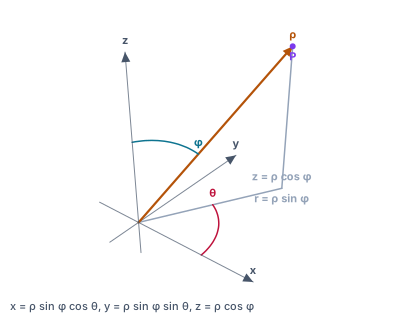
Cylindrical coordinates $(r, \theta, z)$ use the polar coordinates of the shadow together with the height. Spherical coordinates $(\rho, \phi, \theta)$ use the distance $\rho$ from the origin, the polar angle $\phi$ measured down from the positive $z$ axis, and the same azimuthal angle $\theta$ around it. The volume element is the small piece of volume the system's grid cuts out, and it is what carries the conversion factor.
Cylindrical.
$$x = r\cos\theta, \quad y = r\sin\theta, \quad z = z, \qquad dV = r\,dz\,dr\,d\theta.$$
This is the plane's polar system with $z$ untouched, so the volume element is the polar area element with $dz$ attached. Surfaces of constant $r$ are cylinders about the $z$ axis; surfaces of constant $\theta$ are half planes through it.
Spherical.
$$x = \rho\sin\phi\cos\theta, \quad y = \rho\sin\phi\sin\theta, \quad z = \rho\cos\phi,$$
with $0 \le \rho$, $0 \le \phi \le \pi$ and $0 \le \theta \le 2\pi$, and
$$dV = \rho^{2}\sin\phi\;d\rho\,d\phi\,d\theta.$$
Surfaces of constant $\rho$ are spheres about the origin; surfaces of constant $\phi$ are cones about the $z$ axis. Note that $x^2 + y^2 + z^2 = \rho^2$, which is why any integrand built from distance to the origin collapses.
Where $\rho^2 \sin\phi$ comes from. A small cell has one side $d\rho$ along the radius, one side $\rho\,d\phi$ along a line of longitude, and one side $\rho\sin\phi\,d\theta$ along a line of latitude — the circle of latitude at angle $\phi$ has radius $\rho\sin\phi$, not $\rho$. Multiplying the three sides gives $\rho^{2}\sin\phi\,d\rho\,d\phi\,d\theta$. The factor is geometry, not convention: near the poles the cells really are narrow, and $\sin\phi$ is exactly how narrow.
How to choose. Look at the bounding surfaces, not at the solid's symmetry. Cylinders, and solids between two surfaces $z = f(r)$, suit cylindrical coordinates. Spheres, cones through the origin and the regions between them suit spherical coordinates. A solid bounded by a sphere and a plane not through the origin suits neither cleanly, and you choose the lesser evil.
Another way: picture
Cylindrical coordinates slice space like a wedding cake: circular layers, each cut into wedges. Spherical coordinates slice it like an onion wrapped in a globe's grid: shells at fixed distance, cut by lines of latitude and longitude. The cells of the onion shrink towards the poles, where the lines of longitude crowd together — and $\sin\phi$ is the bookkeeping for that crowding.
Another way: steps
To evaluate a triple integral in a new system:
Take the solid cone of base radius $1$ and height $1$ with its point at the origin, opening upwards.
In cylindrical coordinates the cone's surface is $z = r$ and the cap is $z = 1$, so the solid is $0 \le \theta \le 2\pi$, $0 \le r \le 1$, $r \le z \le 1$. Its volume is
$$\int_0^{2\pi}\!\!\int_0^1\!\!\int_r^1 r\,dz\,dr\,d\theta = 2\pi\int_0^1 r(1-r)\,dr = 2\pi\left(\tfrac12 - \tfrac13\right) = \tfrac{\pi}{3}.$$
In spherical coordinates the cone is $\phi = \pi/4$ and the flat cap is $\rho\cos\phi = 1$, so $\rho$ runs from $0$ to $\sec\phi$ — a limit that is not constant. The spherical set-up is possible and messier, because only one of the two boundaries is a spherical surface.
That is the lesson in miniature. The solid has an axis of symmetry and looks cone-shaped, which are both arguments people use to reach for spherical coordinates; the boundaries say cylindrical, and the boundaries are right. Reverse the problem — cap the cone with a sphere instead of a plane — and spherical coordinates win outright, for exactly the same reason.
Using $\rho^2$ without $\sin\phi$. The single commonest error here. It makes the volume of a ball come out as $\tfrac23$ of the truth.
Swapping $\phi$ and $\theta$. Many physics texts use the opposite names. Within this course $\phi$ is measured down from the $z$ axis and runs from $0$ to $\pi$; $\theta$ goes around and runs to $2\pi$. Taking $\phi$ to $2\pi$ covers the ball twice.
Letting $\rho$ or $r$ be negative. Both are distances and both start at $0$.
Converting $x^2 + y^2$ to $\rho^2$. In spherical coordinates it is $\rho^2\sin^2\phi$; only $x^2+y^2+z^2$ is $\rho^2$.
Choosing by symmetry rather than by boundary. A solid can have an axis of symmetry and still be bounded by spheres and cones, in which case spherical coordinates are right.
The point $P$ is at $\rho = 2$, $\phi = \pi/4$, $\theta = \pi/3$. The angle $\phi$ opens down from the positive $z$-axis to the arrow $OP$; the angle $\theta$ opens in the floor from the positive $x$-axis to $P$'s shadow. The shadow's distance from the $z$-axis is the cylindrical $r = \rho \sin\phi = \sqrt{2}$, and the height of $P$ above the floor is $z = \rho\cos\phi = \sqrt{2}$. That right triangle — $\rho$ as the slant, $r$ across, $z$ up — is the whole link between the two systems, and it is why $x = \rho\sin\phi\cos\theta$: first go out $r$, then split $r$ between $x$ and $y$ by $\theta$.
Both new elements can be read straight off a picture, and doing so is more reliable than remembering them. In cylindrical coordinates a cell has sides $dr$, $r\,d\theta$ and $dz$, because the arc swept by an angle at distance $r$ is $r\,d\theta$. In spherical coordinates the sides are $d\rho$, $\rho\,d\phi$ and $\rho\sin\phi\,d\theta$, because the circle of latitude at angle $\phi$ has radius $\rho\sin\phi$.
Anyone who can draw that picture can recover either element in ten seconds and will never write $\rho^2$ without $\sin\phi$. Anyone relying on memory will, sooner or later, and the resulting answer is wrong by a factor that no dimensional check will catch — because it is a pure number.
Find the mass of the ball of radius $2$ with density $\rho$. The integrand is already the spherical coordinate, so the integral is $\int_0^{2\pi}\!\int_0^{\pi}\!\int_0^2 \rho \cdot \rho^2\sin\phi\,d\rho\,d\phi\,d\theta$.
Density times volume element, nothing else.
All six limits are constants and the integrand factors, so the three integrals separate: $\left(\int_0^2 \rho^3\,d\rho\right)\left(\int_0^{\pi}\sin\phi\,d\phi\right)\left(\int_0^{2\pi} d\theta\right)$.
A spherical box behaves like a rectangle.
That is $4 \times 2 \times 2\pi = 16\pi$. A uniform ball of density $2$ — the peak value — would weigh $\tfrac43\pi\cdot 8 \cdot 2 = \tfrac{64\pi}{3} \approx 21.3\pi$, so the answer is sensibly less.
A bound on the answer confirms it.
Find the volume between the cylinders $r = 1$ and $r = 3$, for $0 \le z \le 5$. Both boundaries are surfaces of constant $r$, so cylindrical coordinates make every limit a constant.
The boundaries choose the system.
The volume is $\int_0^{2\pi}\!\int_1^3\!\int_0^5 r\,dz\,dr\,d\theta = 2\pi \times 5 \times \left[\tfrac{r^2}{2}\right]_1^3$.
Three separate constant-limit integrals.
That is $2\pi \times 5 \times 4 = 40\pi$, which is $\pi(3^2 - 1^2) \times 5$: the area of the ring times the height, as a pipe's volume should be.
The answer reduces to a formula anyone would trust.
The ball is $0 \le \rho \le 3$; the top half is $0 \le \phi \le \pi/2$, since $\phi$ is measured down from the north pole.
Half the range of $\phi$, not half the range of $\theta$.
So the volume is $\left(\int_0^3 \rho^2\,d\rho\right)\left(\int_0^{\pi/2}\sin\phi\,d\phi\right)\left(\int_0^{2\pi}d\theta\right) = 9 \times 1 \times 2\pi$.
That is $18\pi$, exactly half of $\tfrac43\pi \cdot 27 = 36\pi$. Note that halving the $\theta$ range instead would also have given $18\pi$ — but it would have been the volume of a different half, sliced vertically, and for a non-symmetric integrand the two answers would part company.
Match each coordinate to what it measures, for a point $5$ units from the origin.
| The distance from the $z$ axis | The distance from the origin | The angle down from the positive $z$ axis | The angle around the $z$ axis from the positive $x$ axis | |
|---|---|---|---|---|
| $r$ in cylindrical coordinates | ||||
| $\rho$ in spherical coordinates | ||||
| $\phi$ in spherical coordinates | ||||
| $\theta$ in either system |
Put the stages of evaluating a triple integral over the ball of radius $9$ in spherical coordinates into order.
Number the steps in order (write the number in the box):
The volume of the ball of radius $2$ is a multiple of $\pi$. What is the multiplier?
Answer:
A cylinder has radius $3$ and height $3$. Its volume is a multiple of $\pi$. What is the multiplier?
Answer:
Match each coordinate to what it measures, for a point $3$ units from the origin.
| The distance from the $z$ axis | The distance from the origin | The angle down from the positive $z$ axis | The angle around the $z$ axis from the positive $x$ axis | |
|---|---|---|---|---|
| $r$ in cylindrical coordinates | ||||
| $\rho$ in spherical coordinates | ||||
| $\phi$ in spherical coordinates | ||||
| $\theta$ in either system |
A solid is the part of the ball of radius $6$ lying inside the cone that makes a fixed angle with the positive $z$ axis. Which system suits it best, and why?
Lesson test: one question per skill, one attempt each, no hints. Your answers are checked when you submit.
Put the stages of evaluating a triple integral over the ball of radius $9$ in spherical coordinates into order.
Number the steps in order (write the number in the box):
You can convert a solid and an integrand into cylindrical or spherical coordinates, write the right volume element, and let the bounding surfaces choose the system. Next: the general rule that both of these are special cases of.
11. Your turn: the volume of the top half of the ball of radius $3$, step 3