Back to the on-screen lesson ·
A point and a forbidden direction: the normal vector, the scalar equation whose coefficients are that normal, the plane through three points, distances, dihedral angles, and the line where two planes meet.
Paper packet. Every task here also exists on screen, where it is checked automatically; answers written on paper are not assessed by Nydus. When you are back at a device, enter your answers there.
By the end of this lesson you will be able to write the equation of a plane from a point and a normal or from three points, read a normal straight off a plane equation, find the distance from a point to a plane and the angle between two planes, and find the direction of the line where two planes meet. You will also be able to say why the constant term carries no geometry until it is divided by the length of the normal.
The dot product's orthogonality test and the cross product's ability to produce a vector perpendicular to two others. A plane is the first object in this course that both are needed for: the cross product builds the normal and the dot product writes the equation.
A normal vector to a plane is perpendicular to every vector lying in it. The scalar equation is the familiar $ax + by + cz = d$, whose coefficients are the normal's components. Two planes are parallel when their normals are multiples of each other, and the dihedral angle between two planes is the angle between their normals. A plane and a line are parallel when the line's direction is orthogonal to the plane's normal.
A line was fixed by a direction to move along. A plane is fixed by a direction you may not move along: pick a point $\mathbf{r}_0$ and a non-zero normal $\mathbf{n}$, and the plane is every point whose displacement from $\mathbf{r}_0$ is orthogonal to $\mathbf{n}$:
$$\mathbf{n} \cdot (\mathbf{r} - \mathbf{r}_0) = 0.$$
Scalar form. Writing $\mathbf{n} = \langle a, b, c \rangle$ and expanding, with $d = \mathbf{n} \cdot \mathbf{r}_0$:
$$ax + by + cz = d.$$
So the coefficients of a plane equation are a normal vector. That single sentence turns every plane equation you will ever meet into geometry at a glance: $2x - y + 3z = 7$ is the plane perpendicular to $\langle 2, -1, 3 \rangle$, and the $7$ only says how far along that direction it sits.
Three points. Given $A$, $B$, $C$ not in a line, take $\mathbf{n} = \overrightarrow{AB} \times \overrightarrow{AC}$ and use any of the three as $\mathbf{r}_0$.
Distance from a point. For a point $Q$,
$$d(Q) = \frac{|\mathbf{n} \cdot \overrightarrow{Q_0Q}|}{|\mathbf{n}|} = \frac{|ax_Q + by_Q + cz_Q - d|}{\sqrt{a^2 + b^2 + c^2}}.$$
Substitute, subtract the constant, take the size, divide by the normal's length.
Angles and intersections. The angle between two planes is the angle between their normals, from the usual dot product formula. Two planes with non-parallel normals meet in a line, and that line's direction is $\mathbf{n}_1 \times \mathbf{n}_2$ — perpendicular to both normals, so lying in both planes.
Another way: picture
Hold a pencil upright and let a sheet of card rest against its tip, at right angles. The pencil is the normal; the card is the plane. Sliding the card up and down the pencil gives every plane with that normal, and the constant $d$ is the reading on the pencil that says which one you have. Tilting the pencil changes the plane's direction entirely.
Another way: steps
To write the plane through three points:
Take two points $P$ and $Q$ both satisfying $ax + by + cz = d$. Subtracting the two equations gives
$$a(x_Q - x_P) + b(y_Q - y_P) + c(z_Q - z_P) = 0,$$
which says $\langle a, b, c \rangle \cdot \overrightarrow{PQ} = 0$. So the coefficient vector is orthogonal to every displacement inside the plane, which is exactly what being normal to it means. Nothing was assumed beyond the two points lying on the plane, so the statement holds for every plane equation.
Two payoffs follow immediately. First, two planes are parallel exactly when their coefficient triples are proportional — a comparison you can do by eye, without solving anything. Second, the distance formula is not a new result but a projection: $\mathbf{n} \cdot \overrightarrow{Q_0Q}$ measures the displacement from the plane to the point along the normal, in units of $|\mathbf{n}|$, and dividing by $|\mathbf{n}|$ converts it to ordinary length.
The same reading explains the sign. Without the absolute value, $ax_Q + by_Q + cz_Q - d$ is positive on the side the normal points towards and negative on the other, which is how graphics and collision code decide which side of a wall something is on.
Crossing the points instead of the edges. Three points are positions, not displacements. Subtract one from the other two first, or the cross product answers a question about the origin that nobody asked.
Forgetting to divide by the length of the normal. $|ax + by + cz - d|$ is a distance measured in units of $|\mathbf{n}|$, and scaling the equation by $10$ would multiply it by $10$ without moving the plane an inch.
Taking the angle between planes from the wrong pair. It is the angle between the normals; the supplementary angle is equally available, so say which one you mean, and the acute one is the usual convention.
Assuming a plane and a line must meet. A line whose direction is orthogonal to the normal is parallel to the plane and either misses it entirely or lies inside it. A third coordinate is not a third term bolted onto a two-dimensional formula. The cross product exists only in space, a plane is fixed by a direction rather than by a slope, and a curve in space can bend without ever leaving a surface. Checking a new formula against the plane is worth doing; assuming the plane's formula still governs is how most of the errors in this course begin.
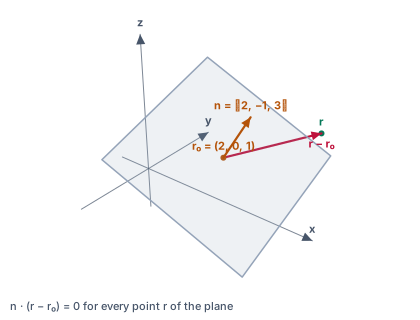
The plane $2x - y + 3z = 7$ passes through $\mathbf{r}_0 = (2, 0, 1)$, since $4 - 0 + 3 = 7$. Its coefficients give the normal $\mathbf{n} = \langle 2, -1, 3 \rangle$, drawn standing out of the plane at $\mathbf{r}_0$. The point $\mathbf{r} = (3, 2, 1)$ is also on the plane ($6 - 2 + 3 = 7$), and the arrow $\mathbf{r} - \mathbf{r}_0 = \langle 1, 2, 0 \rangle$ joining them lies flat in it: $\mathbf{n} \cdot \langle 1, 2, 0 \rangle = 2 - 2 + 0 = 0$. Turn the figure until the plane is edge on and it becomes a line with the normal square to it; that view is the equation $\mathbf{n} \cdot (\mathbf{r} - \mathbf{r}_0) = 0$ seen directly.
It is tempting to read $ax + by + cz = d$ the way $y = mx + b$ was read, with $d$ playing the part of an intercept. It does not. Multiplying the whole equation by any non-zero number gives the same plane with a different $d$, so $d$ on its own means nothing at all; only the ratio $d / |\mathbf{n}|$ is geometry, and that is the plane's distance from the origin.
Nor is a plane the graph of a function of two variables, even though many planes can be rearranged into $z = f(x, y)$. A vertical plane such as $x = 3$ cannot be, and treating planes as graphs would make that one disappear. The scalar equation describes every plane evenhandedly, which is exactly why this course uses it rather than the solved-for-$z$ form the next unit will need.
Through $A = (1,0,0)$, $B = (0,2,0)$, $C = (0,0,4)$: edges $\overrightarrow{AB} = \langle -1, 2, 0 \rangle$ and $\overrightarrow{AC} = \langle -1, 0, 4 \rangle$.
Subtract the shared corner from the other two points.
Their cross product is $\langle 8, 4, 2 \rangle$, so the plane is $8x + 4y + 2z = d$ with $d = 8(1) + 0 + 0 = 8$.
The coefficients are the normal; the constant comes from one point.
Check $B$: $0 + 8 + 0 = 8$, and $C$: $0 + 0 + 8 = 8$. Dividing throughout by $2$ gives $4x + 2y + z = 4$, the same plane with a shorter normal — both answers are right, and comparing them by coefficients alone would suggest otherwise.
Every point must give the same constant.
Take $2x + 3y + 6z = 5$ and $2x + 3y + 6z = 19$. Same coefficients, so same normal, so parallel.
Proportional coefficients mean parallel planes.
Pick any point on the first, say $(0, 0, 5/6)$, and put it into the second: $5 - 19 = -14$.
The gap in the constants, measured at a point.
The normal $\langle 2, 3, 6 \rangle$ has length $7$, so the distance is $14/7 = 2$. Note that the difference of the constants, $14$, was not the answer — it became one only after the division, which is precisely the step the formula exists to remind you of.
Divide the constant gap by the length of the normal.
The normals are $\mathbf{n}_1 = \langle 1, 1, 1 \rangle$ and $\mathbf{n}_2 = \langle 1, -1, 0 \rangle$, and they are not multiples, so the planes do meet.
Non-parallel normals guarantee a line of intersection.
The line lies in both planes, so its direction is orthogonal to both normals: take $\mathbf{n}_1 \times \mathbf{n}_2 = \langle 1, 1, -2 \rangle$.
Check it: dotting with $\mathbf{n}_1$ gives $1 + 1 - 2 = 0$ and with $\mathbf{n}_2$ gives $1 - 1 + 0 = 0$. Both zero, so the direction really does lie in both planes — and a point on the line would still be needed before the line itself could be written down.
Write a normal vector, as a row, to the plane through $A = (1, -2, 3)$, $B = (4, -1, 3)$ and $C = (1, -1, 7)$.
This task has no paper form; do it on a device.
Match each description to what it describes.
| A plane parallel to the horizontal coordinate plane | A plane running parallel to the vertical axis | The plane through a fixed point with a given normal | Two different parallel planes | |
|---|---|---|---|---|
| $z = 3$ | ||||
| $6x + 5y = 3$ | ||||
| $\mathbf{n} \cdot (\mathbf{r} - \mathbf{r}_0) = 0$ | ||||
| $6x + 5y + 3z = 3$ together with $12x + 10y + 6z = 3$ |
How far is $(2, -4, 2)$ from the plane $2x + 3y + 6z = -31$?
Answer:
The plane through $(5, 2, 6)$ with normal $\langle 2, -3, 5 \rangle$ is written $2x - 3y + 5z = d$. What is $d$?
Answer:
Write a normal vector, as a row, to the plane through $A = (0, -2, -2)$, $B = (2, 1, -2)$ and $C = (0, -1, 2)$.
This task has no paper form; do it on a device.
A cutting routine evaluates $\mathbf{n} \cdot \mathbf{r} - d$ at two points of a beam and gets $+9$ at one end and $-9$ at the other. What follows?
Lesson test: one question per skill, one attempt each, no hints. Your answers are checked when you submit.
Match each description to what it describes.
| A plane parallel to the horizontal coordinate plane | A plane running parallel to the vertical axis | The plane through a fixed point with a given normal | Two different parallel planes | |
|---|---|---|---|---|
| $z = 5$ | ||||
| $4x + 2y = 5$ | ||||
| $\mathbf{n} \cdot (\mathbf{r} - \mathbf{r}_0) = 0$ | ||||
| $4x + 2y + 4z = 5$ together with $8x + 4y + 8z = 5$ |
You can build a plane from a point and a normal or from three points, and you can read distance, angle and side straight from its equation. Next: the curved surfaces whose flat slices are the conic sections you already know.
11. Your turn: the direction of the line where $x + y + z = 1$ meets $x - y = 0$, step 3