Back to the on-screen lesson ·
Two vectors in and a perpendicular vector out: the component formula, the length as the area of a parallelogram, the right-hand rule, and the algebra that does not behave like multiplication.
Paper packet. Every task here also exists on screen, where it is checked automatically; answers written on paper are not assessed by Nydus. When you are back at a device, enter your answers there.
By the end of this lesson you will be able to compute a cross product from components, use its length as the area of a parallelogram or triangle, say which way the right-hand rule sends it, and test two vectors for being parallel by crossing them. You will also be able to say which rules of ordinary multiplication it breaks, and what goes wrong physically when the factors are written in the wrong order.
The dot product from the last lesson: two vectors in, one number out, zero exactly when they are perpendicular. The cross product is the other way round in every respect — two vectors in, a vector out, zero exactly when they are parallel — and unlike the dot product it exists only in three dimensions.
Two vectors span a parallelogram when they are drawn from the same corner; its area is what the length of the cross product reports. Two vectors are parallel when one is a multiple of the other, which includes pointing oppositely. The right-hand rule fixes which of the two perpendicular directions the answer takes. A quantity that reverses when the coordinate frame is reflected — torque, angular momentum, a magnetic field — is sometimes called a pseudovector, and every one of them is built from a cross product.
For $\mathbf{u} = \langle u_1, u_2, u_3 \rangle$ and $\mathbf{v} = \langle v_1, v_2, v_3 \rangle$,
$$\mathbf{u} \times \mathbf{v} = \langle u_2v_3 - u_3v_2,\; u_3v_1 - u_1v_3,\; u_1v_2 - u_2v_1 \rangle.$$
Each component covers up its own coordinate and crosses the two that are left; the middle one comes out with the factors in the other order, which is the minus sign everybody remembers as a special case and which is really just the pattern continuing.
What it is, geometrically. Three statements, and together they determine it:
The algebra that follows.
$$\mathbf{v} \times \mathbf{u} = -(\mathbf{u} \times \mathbf{v}), \qquad \mathbf{u} \times \mathbf{u} = \mathbf{0}, \qquad \mathbf{u} \cdot (\mathbf{u} \times \mathbf{v}) = 0.$$
It is not commutative and not associative, so the order and the bracketing both matter. It is zero exactly when the two vectors are parallel — which is the test this course will use for collinear points, for a line lying in a plane, and for two planes being the same plane.
The determinant mnemonic. Writing
$$\mathbf{u} \times \mathbf{v} = \begin{vmatrix} \mathbf{i} & \mathbf{j} & \mathbf{k} \\ u_1 & u_2 & u_3 \\ v_1 & v_2 & v_3 \end{vmatrix}$$
and expanding along the top row reproduces the formula, minus sign included. It is a memory aid rather than a determinant — the top row holds vectors, not numbers — but it is the one most people keep.
Another way: picture
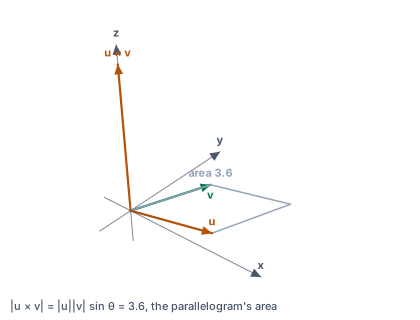
Lay $\mathbf{u}$ and $\mathbf{v}$ flat on a table from the same corner. They outline a parallelogram. The cross product stands straight up out of the table, and how far up it reaches is how much floor the parallelogram covers: a long thin sliver gives a short vector, and two perpendicular vectors of the same lengths give the longest one possible.
Another way: steps
To cross two vectors by hand:
Take the parallelogram spanned by $\mathbf{u}$ and $\mathbf{v}$. Its base is $|\mathbf{u}|$ and its height is the part of $\mathbf{v}$ perpendicular to $\mathbf{u}$, which is $|\mathbf{v}|\sin\theta$. Base times height gives $|\mathbf{u}||\mathbf{v}|\sin\theta$, and that is exactly $|\mathbf{u} \times \mathbf{v}|$.
So the two products divide the work between them. The dot product keeps the part of one vector along the other and reports $|\mathbf{u}||\mathbf{v}|\cos\theta$; the cross product keeps the part across it and reports $|\mathbf{u}||\mathbf{v}|\sin\theta$. Each is zero exactly where the other is largest, which is why the pair of them answers almost every angle question in this unit.
A triangle with two edges $\mathbf{u}$ and $\mathbf{v}$ from one corner is half that parallelogram, so its area is $\tfrac12|\mathbf{u} \times \mathbf{v}|$. In the plane this is the familiar shoelace formula; in space there is no other elementary way to get it, and this is the formula the next lesson's volume rests on.
Writing the factors in either order. $\mathbf{v} \times \mathbf{u}$ is the negative of $\mathbf{u} \times \mathbf{v}$, and in an application — torque, angular momentum, the normal to an oriented surface — the sign is the physics.
Forgetting the middle minus sign. It is the commonest arithmetic slip here, and the dot-product check catches it instantly.
Treating the product as associative. $(\mathbf{u} \times \mathbf{v}) \times \mathbf{w}$ and $\mathbf{u} \times (\mathbf{v} \times \mathbf{w})$ are usually different vectors, so brackets are never optional.
Crossing two vectors in the plane. There is no cross product in two dimensions; what a plane problem means by it is the third component of the cross product of the two vectors lifted into space, and saying so out loud avoids a genuinely confusing half-hour later. An orientation, an order of integration and an order of factors are part of the answer, not part of the handwriting. Reversing a curve flips the sign of the work along it, swapping the factors of a cross product flips the vector, and exchanging the two limits of an inner integral changes what region was integrated over. Say which one you chose, every time.
Here $\mathbf{u} = \langle 2, 0.5, 0 \rangle$ and $\mathbf{v} = \langle 0.8, 2, 0 \rangle$ lie flat in the $xy$-plane and outline a parallelogram. Their cross product is $\langle 0, 0, 2 \cdot 2 - 0.5 \cdot 0.8 \rangle = \langle 0, 0, 3.6 \rangle$: it has no $x$ or $y$ part at all, so it stands straight up out of the plane, at right angles to both. Its length $3.6$ is the area of the parallelogram. Point the fingers of your right hand along $\mathbf{u}$ and curl them towards $\mathbf{v}$: your thumb points up the drawn arrow. Swap the order and the thumb points down, which is $\mathbf{v} \times \mathbf{u} = -\mathbf{u} \times \mathbf{v}$.
It is written with a multiplication sign and it obeys almost none of the rules multiplication obeys. It does not commute; it does not associate; a product can be zero when neither factor is; and it takes two vectors to a vector of a different kind, one that flips when the coordinate frame is reflected in a mirror while an ordinary displacement does not.
What survives is distribution over addition and compatibility with scalars: $\mathbf{u} \times (\mathbf{v} + \mathbf{w}) = \mathbf{u} \times \mathbf{v} + \mathbf{u} \times \mathbf{w}$ and $(c\mathbf{u}) \times \mathbf{v} = c(\mathbf{u} \times \mathbf{v})$. Those two are enough to expand brackets, and expanding brackets while silently reordering factors is how a correct-looking page of algebra ends up with the wrong sign throughout.
The triangle with corners $A = (1,0,0)$, $B = (0,2,0)$ and $C = (0,0,3)$ has edge vectors $\overrightarrow{AB} = \langle -1, 2, 0 \rangle$ and $\overrightarrow{AC} = \langle -1, 0, 3 \rangle$.
Two edges from the same corner.
Crossing them: $\langle 2\cdot3 - 0\cdot0,\; 0\cdot(-1) - (-1)\cdot3,\; (-1)\cdot0 - 2\cdot(-1) \rangle = \langle 6, 3, 2 \rangle$.
Cover each column in turn, and negate the middle one.
Its length is $\sqrt{36 + 9 + 4} = 7$, so the parallelogram has area $7$ and the triangle has area $\tfrac72$. And $\langle 6,3,2 \rangle \cdot \langle -1,2,0 \rangle = -6 + 6 + 0 = 0$, so the answer really is perpendicular to the first edge.
One cross product gave a normal, an area and its own check.
Are $(1,1,1)$, $(3,4,5)$ and $(7,10,13)$ on one line? Form $\mathbf{u} = \langle 2,3,4 \rangle$ and $\mathbf{v} = \langle 6,9,12 \rangle$ from the first point.
Two displacements from a common point.
$\mathbf{u} \times \mathbf{v} = \langle 3\cdot12 - 4\cdot9,\; 4\cdot6 - 2\cdot12,\; 2\cdot9 - 3\cdot6 \rangle = \langle 0,0,0 \rangle$.
The two displacements span no area.
A zero cross product means the two vectors are parallel, so the three points are collinear. Comparing ratios component by component would have said the same thing, and would have needed a special case for a zero component; this test needs none.
Zero area is the collinearity test.
Two edges from the origin are $\mathbf{u} = \langle 2,2,1 \rangle$ and $\mathbf{v} = \langle 1,-2,2 \rangle$.
The corner at the origin makes the edge vectors the points themselves.
Crossing: $\langle 2\cdot2 - 1\cdot(-2),\; 1\cdot1 - 2\cdot2,\; 2\cdot(-2) - 2\cdot1 \rangle = \langle 6, -3, -6 \rangle$.
Its length is $\sqrt{36 + 9 + 36} = 9$, so the triangle's area is $\tfrac92$. Both original vectors had length $3$, and $9 = 3 \times 3$ — which says $\sin\theta = 1$, so these two edges are perpendicular, a fact the arithmetic handed over for free.
Write $\mathbf{u} \times \mathbf{v}$ as a row, for $\mathbf{u} = \langle 0, -2, 4 \rangle$ and $\mathbf{v} = \langle 4, 0, 3 \rangle$.
This task has no paper form; do it on a device.
Match each expression to what it is, for vectors $\mathbf{u}$ and $\mathbf{v}$ of length $2$.
| A vector at right angles to both | The area of the parallelogram they span | The zero vector | The number zero | |
|---|---|---|---|---|
| $\mathbf{u} \times \mathbf{v}$ | ||||
| $|\mathbf{u} \times \mathbf{v}|$ | ||||
| $\mathbf{u} \times \mathbf{u}$ | ||||
| $\mathbf{u} \cdot (\mathbf{u} \times \mathbf{v})$ |
A triangle has two edges $\langle 5, 0, 0 \rangle$ and $\langle 0, 6, 0 \rangle$ from the same corner. What is its area?
Answer:
For $\mathbf{u} = \langle -6, -6, 2 \rangle$ and $\mathbf{v} = \langle 3, -6, 5 \rangle$, what is the third component of $\mathbf{u} \times \mathbf{v}$?
Answer:
Write $\mathbf{u} \times \mathbf{v}$ as a row, for $\mathbf{u} = \langle -3, -2, 2 \rangle$ and $\mathbf{v} = \langle 2, -3, 4 \rangle$.
This task has no paper form; do it on a device.
Torque is $\mathbf{r} \times \mathbf{F}$. An engineer computes $\mathbf{F} \times \mathbf{r}$ instead for a spanner of length $2$ centimetres. What has changed?
Lesson test: one question per skill, one attempt each, no hints. Your answers are checked when you submit.
Match each expression to what it is, for vectors $\mathbf{u}$ and $\mathbf{v}$ of length $3$.
| A vector at right angles to both | The area of the parallelogram they span | The zero vector | The number zero | |
|---|---|---|---|---|
| $\mathbf{u} \times \mathbf{v}$ | ||||
| $|\mathbf{u} \times \mathbf{v}|$ | ||||
| $\mathbf{u} \times \mathbf{u}$ | ||||
| $\mathbf{u} \cdot (\mathbf{u} \times \mathbf{v})$ |
You can cross two vectors, read the length as an area and the direction from the right-hand rule, and check your answer by dotting it back against both factors. Next: three vectors at once, and the volume they enclose.
11. Your turn: the area of the triangle with corners at the origin, $(2,2,1)$ and $(1,-2,2)$, step 3