Back to the on-screen lesson ·
One function whose output is a vector: the curve it traces, limits and continuity taken one component at a time, the tangent vector $\mathbf{r}'(t)$, and the product rules for scalar, dot and cross products.
Paper packet. Every task here also exists on screen, where it is checked automatically; answers written on paper are not assessed by Nydus. When you are back at a device, enter your answers there.
By the end of this lesson you will be able to read a vector function as a curve together with a schedule for tracing it, take limits and test continuity one component at a time, differentiate a vector function to get a tangent vector, and apply the product rules for a scalar multiple, a dot product and a cross product. You will also be able to show that a vector of constant length is perpendicular to its own derivative.
Parametric curves from Calculus II, where a point moved in the plane as $t$ ran over an interval, and the derivative of an ordinary function. This lesson keeps both and adds a third component. What is new is not the calculus — every rule below is a rule you already have — but the object: one function whose output is a vector rather than a number.
A vector function $\mathbf{r}(t)$ takes a number and returns a vector. Its component functions are the three ordinary functions inside it. The set of points it visits is a space curve, and $\mathbf{r}$ is a parametrisation of that curve — one of many, since the same road can be driven at many speeds. $\mathbf{r}'(t)$ is the tangent vector, and dividing it by its own length gives the unit tangent $\mathbf{T}$.
A vector function is written
$$\mathbf{r}(t) = \langle f(t),\, g(t),\, h(t) \rangle = f(t)\mathbf{i} + g(t)\mathbf{j} + h(t)\mathbf{k},$$
and as $t$ runs over an interval the head of $\mathbf{r}(t)$ traces a space curve. The function carries more information than the curve does: it says when each point is visited, and two different functions can trace the same curve at different speeds or in opposite directions.
Limits and continuity, one component at a time.
$$\lim_{t \to a} \mathbf{r}(t) = \left\langle \lim_{t \to a} f(t),\; \lim_{t \to a} g(t),\; \lim_{t \to a} h(t) \right\rangle,$$
provided all three exist; if one fails, the vector limit fails. $\mathbf{r}$ is continuous at $a$ when that limit is $\mathbf{r}(a)$, which happens exactly when all three components are continuous there.
The derivative. The definition is the one you expect,
$$\mathbf{r}'(t) = \lim_{s \to 0} \frac{\mathbf{r}(t + s) - \mathbf{r}(t)}{s} = \langle f'(t),\, g'(t),\, h'(t) \rangle,$$
because subtraction and division by a scalar are already componentwise. The numerator is a secant vector joining two points of the curve; dividing by $s$ and letting $s$ shrink turns it into a vector tangent to the curve, pointing in the direction of increasing $t$.
The rules. With $c$ a constant, $f$ a scalar function and $\mathbf{u}, \mathbf{v}$ vector functions:
$$(\mathbf{u} + \mathbf{v})' = \mathbf{u}' + \mathbf{v}', \qquad (c\mathbf{u})' = c\mathbf{u}', \qquad (f\mathbf{u})' = f'\mathbf{u} + f\mathbf{u}',$$ $$(\mathbf{u} \cdot \mathbf{v})' = \mathbf{u}' \cdot \mathbf{v} + \mathbf{u} \cdot \mathbf{v}', \qquad (\mathbf{u} \times \mathbf{v})' = \mathbf{u}' \times \mathbf{v} + \mathbf{u} \times \mathbf{v}', \qquad \big(\mathbf{u}(f(t))\big)' = f'(t)\,\mathbf{u}'(f(t)).$$
Every one of these has the shape of the scalar rule it is named after. The cross product rule has one extra condition attached: the factors may not be swapped, so $\mathbf{u}$ stays on the left in both terms.
Another way: picture
Think of $t$ as time and $\mathbf{r}(t)$ as where a fly is. The curve is the track the fly leaves in the air; the vector function is the whole flight, timings included. Two flies can leave the same track — one dawdling, one hurrying, one flying it backwards — and the derivative is what tells them apart, because it is an arrow along the track whose length is how fast that fly is going.
Another way: steps
To differentiate a vector function:
Suppose $|\mathbf{r}(t)| = c$ for every $t$. Squaring, $\mathbf{r} \cdot \mathbf{r} = c^{2}$, and the right-hand side is a constant, so differentiating gives
$$\mathbf{r}' \cdot \mathbf{r} + \mathbf{r} \cdot \mathbf{r}' = 0, \qquad \text{so} \qquad \mathbf{r} \cdot \mathbf{r}' = 0.$$
A vector function of constant length is always perpendicular to its own derivative. The picture is immediate once you have it: if the arrow cannot get longer or shorter, the only thing left for it to do is turn, and turning moves its head sideways.
This one line is worth more than it looks. It is why a particle confined to a sphere has velocity tangent to the sphere; it is why the unit tangent $\mathbf{T}$ is perpendicular to $\mathbf{T}'$, which is what makes the normal vector of the next lessons well defined; and it is the first place in this course where differentiating an equation rather than a formula does the work.
Swapping the factors in a cross-product derivative. $(\mathbf{u} \times \mathbf{v})' = \mathbf{u}' \times \mathbf{v} + \mathbf{u} \times \mathbf{v}'$, and writing either term the other way round negates it. The dot product forgives this; the cross product does not.
Substituting before differentiating. Putting $t = 2$ into $\mathbf{r}(t)$ and then differentiating gives the zero vector, because a constant has no derivative left. Differentiate first, substitute second, every time.
Treating the curve and the parametrisation as the same thing. They are not. $\mathbf{r}(t)$ and $\mathbf{r}(2t)$ trace the same curve and have different derivatives at corresponding points, and lesson 10 turns that difference into a genuine question.
Reading a zero derivative as a stationary point of the curve. $\mathbf{r}'(t) = \mathbf{0}$ means the parametrisation has paused; the curve may still have a perfectly good corner or cusp there, and the tangent direction is simply undefined by this parametrisation.
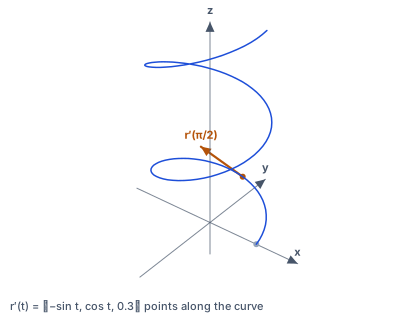
The helix $\mathbf{r}(t) = \langle \cos t, \sin t, 0.3t \rangle$ is two ordinary motions at once: round the unit circle in $x$ and $y$, and steadily up in $z$. The marker that moves along it is placed at equal steps of $t$, so it shows the function's timing and not only its track. At $t = \pi/2$ the derivative $\mathbf{r}'(t) = \langle -\sin t, \cos t, 0.3 \rangle = \langle -1, 0, 0.3 \rangle$ is drawn from the point it belongs to; it runs along the curve, mostly round and a little up. Its length $\sqrt{1 + 0.09}$ is the same at every $t$, which is why the marker moves at a constant speed.
A space curve is a set of points; a vector function is a schedule for visiting them. Everything in the next four lessons turns on keeping the two apart. Arc length belongs to the curve, and so does curvature; velocity, speed and acceleration belong to the function, and change when the schedule changes.
The commonest symptom is a learner who computes $\mathbf{r}'(t)$, gets a long vector, and concludes that the curve is steep or stretched there. It is not: the length of $\mathbf{r}'$ is how fast the parameter is being spent, and a curve traced by a hurrying parametrisation has exactly the same shape as one traced by a dawdling one. Ask is this a fact about the road or about the driver before trusting any quantity computed from $\mathbf{r}'$.
Let $\mathbf{r}(t) = \langle t,\, t^{2},\, t^{3} \rangle$. Differentiating componentwise, $\mathbf{r}'(t) = \langle 1,\, 2t,\, 3t^{2} \rangle$.
Three ordinary derivatives, reassembled.
At $t = 2$ the point is $(2, 4, 8)$ and the tangent vector is $\langle 1, 4, 12 \rangle$.
Differentiate first, substitute second.
Its length is $\sqrt{1 + 16 + 144} = \sqrt{161}$, so the unit tangent is $\langle 1, 4, 12 \rangle / \sqrt{161}$. The ugly root is normal here and is the reason the next lessons work with the square of the speed wherever they can.
Direction and speed come out of the same vector.
$\mathbf{r}(t) = \langle \cos t, \sin t, 0 \rangle$ and $\mathbf{q}(t) = \langle \cos 2t, \sin 2t, 0 \rangle$ both trace the unit circle in the plane $z = 0$.
The same curve, two functions.
$\mathbf{r}'(t) = \langle -\sin t, \cos t, 0 \rangle$ has length $1$; $\mathbf{q}'(t) = \langle -2\sin 2t, 2\cos 2t, 0 \rangle$ has length $2$.
The second traversal is twice as fast.
Both derivatives are perpendicular to their own position vector, as constant length requires. The curve cannot tell the two apart; the vector function can, and that extra information is exactly what velocity is.
The parametrisation carries the timing.
With $\mathbf{u}(t) = \langle t, 0, 1 \rangle$ and $\mathbf{v}(t) = \langle 0, t, 1 \rangle$, first find $\mathbf{u}' = \langle 1, 0, 0 \rangle$ and $\mathbf{v}' = \langle 0, 1, 0 \rangle$.
The pieces the rule needs.
Then $\mathbf{u}' \times \mathbf{v} = \langle 1,0,0 \rangle \times \langle 0,t,1 \rangle = \langle 0, -1, t \rangle$ and $\mathbf{u} \times \mathbf{v}' = \langle t,0,1 \rangle \times \langle 0,1,0 \rangle = \langle -1, 0, t \rangle$.
Adding gives $\langle -1, -1, 2t \rangle$. Expanding the cross product first gives $\mathbf{u} \times \mathbf{v} = \langle -t, -t, t^{2} \rangle$, whose derivative is the same vector — which is the check worth doing once, so that the rule can be trusted every time after.
For $\mathbf{r}(t) = \langle 3t^{2},\; 3t^{3},\; -6t \rangle$, give the three components of $\mathbf{r}'(1)$.
| Value | |
|---|---|
| The first component | |
| The second component | |
| The third component |
Match each derivative to its rule. Here $\mathbf{u}$ and $\mathbf{v}$ are differentiable vector functions and $f$ is a scalar function with $f(0) = 8$.
| $\mathbf{u}' \cdot \mathbf{v} + \mathbf{u} \cdot \mathbf{v}'$ | $\mathbf{u}' \times \mathbf{v} + \mathbf{u} \times \mathbf{v}'$, with the order kept | $f'\mathbf{u} + f\,\mathbf{u}'$ | $f'(t)\,\mathbf{u}'(f(t))$ | |
|---|---|---|---|---|
| The derivative of a dot product | ||||
| The derivative of a cross product | ||||
| The derivative of a scalar function times a vector function | ||||
| The derivative of a vector function of a scalar function |
Find the first component of $\displaystyle\lim_{t \to 0} \left\langle \frac{\sin(3t)}{t},\; \frac{4t^{2} + 5}{t + 1},\; e^{t} \right\rangle$.
Answer:
Let $\mathbf{u}(1) = \langle 0, 4, 0 \rangle$, $\mathbf{u}'(1) = \langle 3, -1, 0 \rangle$, $\mathbf{v}(1) = \langle -4, -3, 0 \rangle$ and $\mathbf{v}'(1) = \langle -3, 1, 0 \rangle$. What is the derivative of $\mathbf{u} \cdot \mathbf{v}$ at $t = 1$?
Answer:
For $\mathbf{r}(t) = \langle 2t^{2},\; 3t^{3},\; -t \rangle$, give the three components of $\mathbf{r}'(2)$.
| Value | |
|---|---|
| The first component | |
| The second component | |
| The third component |
A probe stays exactly $7$ thousand kilometres from a planet's centre, which is the origin. What must be true of its position and velocity vectors?
Lesson test: one question per skill, one attempt each, no hints. Your answers are checked when you submit.
Match each derivative to its rule. Here $\mathbf{u}$ and $\mathbf{v}$ are differentiable vector functions and $f$ is a scalar function with $f(0) = 9$.
| $\mathbf{u}' \cdot \mathbf{v} + \mathbf{u} \cdot \mathbf{v}'$ | $\mathbf{u}' \times \mathbf{v} + \mathbf{u} \times \mathbf{v}'$, with the order kept | $f'\mathbf{u} + f\,\mathbf{u}'$ | $f'(t)\,\mathbf{u}'(f(t))$ | |
|---|---|---|---|---|
| The derivative of a dot product | ||||
| The derivative of a cross product | ||||
| The derivative of a scalar function times a vector function | ||||
| The derivative of a vector function of a scalar function |
You can differentiate a vector function componentwise, read the result as a tangent vector, and say which product rule a given expression needs. Next: the same derivative read as velocity, and the second one read as acceleration.
11. Your turn: differentiate a cross product without expanding it, step 3