Back to the on-screen lesson ·
Coordinates in three dimensions, the vector between two points, component arithmetic, length, and the unit vector that carries direction alone.
Paper packet. Every task here also exists on screen, where it is checked automatically; answers written on paper are not assessed by Nydus. When you are back at a device, enter your answers there.
By the end of this lesson you will be able to write the vector between two points in space, add and scale vectors component by component, find the length of a vector and the distance between two points, and divide a vector by its length to get the unit vector in its direction. You will also be able to say why a displacement survives a change of origin when a position vector does not.
Vectors in the plane from Precalculus: components, addition, scaling, length. Everything in this lesson is that, with a third number carried along. What is genuinely new is the geometry a third axis makes possible, and it starts here with the difference between a point and the arrow that reaches it.
A point is a place; a vector is a displacement, with a length and a direction and no location of its own. The position vector of a point is the displacement from the origin to it — the one vector that is tied to a point, and the reason the two ideas are so easily confused. A unit vector has length one and carries direction only. Components are the three numbers $\langle v_1, v_2, v_3 \rangle$ a vector is written with, and the standard basis vectors $\mathbf{i}, \mathbf{j}, \mathbf{k}$ are the unit vectors along the three axes.
Three coordinates locate a point in space: $P = (x, y, z)$, with the axes in right-handed order — curl the fingers of your right hand from the positive $x$ axis to the positive $y$ axis and your thumb points along positive $z$. Every orientation convention in this course, up to and including Stokes' theorem, descends from that one choice.
The vector between two points. For $P = (p_1, p_2, p_3)$ and $Q = (q_1, q_2, q_3)$,
$$\overrightarrow{PQ} = \langle q_1 - p_1,\; q_2 - p_2,\; q_3 - p_3 \rangle.$$
Head minus tail, one axis at a time. Reversing the subtraction gives $\overrightarrow{QP}$, which is the same arrow pointing the other way.
Arithmetic, component by component. Addition, subtraction and scaling all work one axis at a time:
$$\mathbf{u} + \mathbf{v} = \langle u_1 + v_1, u_2 + v_2, u_3 + v_3 \rangle, \qquad c\,\mathbf{v} = \langle cv_1, cv_2, cv_3 \rangle.$$
So a vector problem in space is three one-dimensional problems carried together, and that is why it is no harder than the plane.
Length. The Pythagorean theorem applied twice — once in the $xy$ plane, once to raise that result to height $z$ — gives
$$|\mathbf{v}| = \sqrt{v_1^2 + v_2^2 + v_3^2}.$$
Scaling by $c$ multiplies the length by $|c|$, so dividing a non-zero vector by its own length leaves the unit vector $\mathbf{v}/|\mathbf{v}|$: the direction with the size removed. Writing a vector as length times direction is the single most useful re-reading in the whole unit.
The standard basis. With $\mathbf{i} = \langle 1,0,0 \rangle$, $\mathbf{j} = \langle 0,1,0 \rangle$ and $\mathbf{k} = \langle 0,0,1 \rangle$, every vector is $v_1\mathbf{i} + v_2\mathbf{j} + v_3\mathbf{k}$. The two notations say the same thing; textbooks and this course use both.
Another way: picture
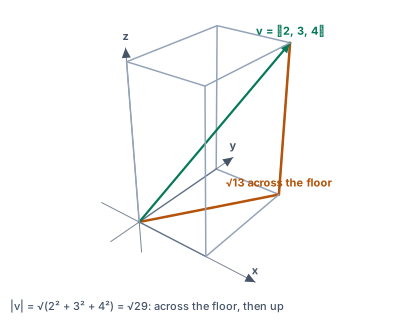
Draw the box whose opposite corners are the origin and the head of $\mathbf{v}$, with edges along the axes of lengths $|v_1|$, $|v_2|$ and $|v_3|$. The vector is the long diagonal of that box, and the length formula is the diagonal of a box computed the only way it can be: across the floor first, then up.
Another way: steps
To turn two points into a direction:
The arrow from $(1,1,1)$ to $(3,4,5)$ and the arrow from $(0,0,0)$ to $(2,3,4)$ are the same vector. Both are $\langle 2,3,4 \rangle$; both say go two east, three north, four up. A vector records a displacement, and a displacement does not remember where it started.
That is worth insisting on because it is what makes vector algebra useful. A force on a beam, a velocity of an aircraft and the offset between two survey markers are all displacements in this sense, and adding two of them is meaningful no matter where in space each was measured. Adding two points, by contrast, is meaningless: the answer would change if somebody moved the origin, and no real quantity behaves that way.
The one place a vector does get pinned down is the position vector $\overrightarrow{OP}$, whose tail is deliberately fixed at the origin. It is a useful bookkeeping device — and it is the reason a point and a vector are so often written with the same three numbers.
Subtracting the wrong way round. $\overrightarrow{PQ}$ is $Q - P$. The letters read left to right in the direction of travel, and the subtraction reads the other way, which is exactly why it is worth saying head minus tail out loud each time.
Adding components to get a length. $\langle 3,4,12 \rangle$ has length $13$, not $19$. Squares first, always.
Normalising a vector that might be zero. $\mathbf{v}/|\mathbf{v}|$ needs $\mathbf{v} \ne \mathbf{0}$. The zero vector has no direction, and that is not a technicality to be waved past: it is the case that breaks a program.
Assuming the plane's formulas carry over unchanged. Most do. The next two lessons contain one that does not exist in the plane at all.
The figure draws $\mathbf{v} = \langle 2, 3, 4 \rangle$ from the origin as the long diagonal of a box whose edges lie along the axes, $2$ along $x$, $3$ along $y$ and $4$ up. The dashed line across the floor of the box has length $\sqrt{2^2 + 3^2} = \sqrt{13}$, and climbing $4$ from its end reaches the head of $\mathbf{v}$, so $|\mathbf{v}| = \sqrt{13 + 16} = \sqrt{29}$. That is the length formula, read off the box: across the floor, then up. Turn the figure until the floor is face on and the vertical edge disappears behind the diagonal; turn it side on and the floor shrinks to a line. The box is the same from every side, and so is the length.
They are written with the same three numbers, and almost every early mistake in this course comes from that coincidence. A point is somewhere; a vector is a move. You may add two vectors, and the answer is a vector. You may add a vector to a point, and the answer is a point. You may subtract two points, and the answer is a vector. You may not add two points — the result would depend on where somebody put the origin, and nothing measurable does.
The test that settles it every time: ask what happens if the origin moves. A quantity that changes was a point or a position vector; a quantity that survives was a genuine displacement. A third coordinate is not a third term bolted onto a two-dimensional formula. The cross product exists only in space, a plane is fixed by a direction rather than by a slope, and a curve in space can bend without ever leaving a surface. Checking a new formula against the plane is worth doing; assuming the plane's formula still governs is how most of the errors in this course begin.
Let $P = (1, -2, 4)$ and $Q = (4, 2, 16)$. Then $\overrightarrow{PQ} = \langle 3, 4, 12 \rangle$.
Head minus tail, one axis at a time.
Its length is $\sqrt{9 + 16 + 144} = \sqrt{169} = 13$, so $P$ and $Q$ are $13$ apart.
The distance between two points is the length of the vector joining them.
The unit vector from $P$ towards $Q$ is $\left\langle \tfrac{3}{13}, \tfrac{4}{13}, \tfrac{12}{13} \right\rangle$, and the point five units along that road from $P$ is $P + 5\left\langle \tfrac{3}{13}, \tfrac{4}{13}, \tfrac{12}{13} \right\rangle$.
Direction times distance is how you travel a stated distance.
Two markers sit at $A = (10, 3, 0)$ and $B = (16, 11, 0)$, so $\overrightarrow{AB} = \langle 6, 8, 0 \rangle$, of length $10$.
The offset between the markers is a vector.
A second team puts the origin $100$ metres east: the markers become $(-90, 3, 0)$ and $(-84, 11, 0)$.
Every coordinate has changed.
But $\overrightarrow{AB} = \langle 6, 8, 0 \rangle$ still, and the distance is still $10$. The two teams disagree about every number they wrote down and agree about every measurement either could make.
The displacement is origin-free; the coordinates are not.
For $A = (2, 6, -4)$ and $B = (8, -2, 6)$, first write $\overrightarrow{AB} = \langle 6, -8, 10 \rangle$.
Head minus tail.
Half of it is $\langle 3, -4, 5 \rangle$, and travelling that far from $A$ lands at $(2 + 3,\; 6 - 4,\; -4 + 5) = (5, 2, 1)$.
Which is the average of the two points coordinate by coordinate — as it must be, since $A + \tfrac12(B - A) = \tfrac12(A + B)$. The algebra and the picture agree, and each is a check on the other.
For $P = (5, 1, 0)$ and $Q = (-2, -6, 3)$, give the three components of $\overrightarrow{PQ}$.
| Value | |
|---|---|
| The first component | |
| The second component | |
| The third component |
Match each expression to what it describes. Here $A$ and $B$ are points and $\mathbf{v}$ is a vector of length $6$.
| The displacement from one point to the other | The position vector, measured from the origin | A direction of length one | The reversed vector, scaled longer | |
|---|---|---|---|---|
| $B - A$ | ||||
| $A$, read as a vector | ||||
| $\mathbf{v} / 6$ | ||||
| $-2\,\mathbf{v}$ |
Find the length of $\langle 9, 12, 36 \rangle$.
Answer:
Let $\mathbf{u}$ have second component $-7$ and $\mathbf{v}$ have second component $-6$. What is the second component of $2\mathbf{u} - 5\mathbf{v}$?
Answer:
For $P = (-5, 0, 6)$ and $Q = (-4, 4, 4)$, give the three components of $\overrightarrow{PQ}$.
| Value | |
|---|---|
| The first component | |
| The second component | |
| The third component |
A survey team re-labels every point by shifting the origin $8$ metres east. Which quantity is unchanged?
Lesson test: one question per skill, one attempt each, no hints. Your answers are checked when you submit.
Match each expression to what it describes. Here $A$ and $B$ are points and $\mathbf{v}$ is a vector of length $4$.
| The displacement from one point to the other | The position vector, measured from the origin | A direction of length one | The reversed vector, scaled longer | |
|---|---|---|---|---|
| $B - A$ | ||||
| $A$, read as a vector | ||||
| $\mathbf{v} / 4$ | ||||
| $-3\,\mathbf{v}$ |
You can turn two points into a displacement, a length and a direction, and you can say which of those depends on where the origin is. Next: the dot product, which turns two vectors into the one number that measures the angle between them.
11. Your turn: the midpoint of a segment in space, step 3