Back to the on-screen lesson ·
Saddles, nodes, spirals and centres in the phase plane, and how the trace and determinant of the coefficient matrix decide between them without the eigenvalues ever being computed.
Paper packet. Every task here also exists on screen, where it is checked automatically; answers written on paper are not assessed by Nydus. When you are back at a device, enter your answers there.
By the end of this lesson you will be able to compute the trace, determinant and discriminant of a two-by-two coefficient matrix, name which of the six kinds of equilibrium a linear system has from those numbers alone, place a system as a point on the trace-determinant plane and read its classification off where it lands, and say why a centre is the one case that no amount of care makes robust.
You can write a two-dimensional system as $\mathbf{x}' = A\mathbf{x}$ and build its solutions from the eigenvalues and eigenvectors of $A$. This lesson stops producing formulas and starts producing pictures: the same eigenvalues, read for what they say about the shape of every trajectory at once.
| Term | What it means |
|---|---|
| Phase plane | The $xy$ plane in which solutions live; time is a parameter along each curve, not an axis. |
| Trajectory | One solution curve in the phase plane, with an arrow for the direction of time. |
| Equilibrium | A point where both right-hand sides vanish, so a solution starting there never moves. |
| Node | Trajectories approach or leave along straight directions. |
| Spiral | Trajectories turn while approaching or leaving. |
| Saddle | Trajectories approach along one direction and leave along another. |
| Centre | Trajectories loop for ever without approaching anything. |
For $\mathbf{x}' = A\mathbf{x}$ the origin is always an equilibrium, and the eigenvalues of $A$ decide what happens near it. There are six pictures:
| Eigenvalues | Picture |
|---|---|
| real, opposite signs | saddle |
| real, both negative | stable node |
| real, both positive | unstable node |
| complex, negative real part | stable spiral |
| complex, positive real part | unstable spiral |
| purely imaginary | centre |
The eigenvalues need not be computed to choose between them. Write $t$ for the trace $a + d$ and $m$ for the determinant $ad - bc$; the characteristic equation is $\lambda^{2} - t\lambda + m = 0$, so the eigenvalues sum to $t$ and multiply to $m$. Three readings follow immediately.
If $m < 0$, the product is negative, so the eigenvalues are real with opposite signs: a saddle, always.
If $t^{2} < 4m$, the discriminant is negative and the eigenvalues are a complex conjugate pair: the trajectories turn.
The sign of $t$ is the sign of the real part in every case where both eigenvalues share one, so it decides stable from unstable.
Plotting $(t, m)$ on a plane therefore classifies the system by where the point lands, and the whole of this lesson fits on that one picture.
Another way: picture
Water on a surface. A stable node is a plughole: everything drains straight in. A stable spiral is the same plughole with the water already swirling. A saddle is a mountain pass — water arrives along the ridge and leaves down both valleys. A centre is a perfectly level roundabout where the water goes round and never in, which is why the smallest imperfection destroys it.
Another way: steps
To classify an equilibrium of a linear system:
Draw the determinant up and the trace across, and mark the parabola $t^{2} = 4m$. Four regions and two curves carry the whole classification.
Below the horizontal axis ($m < 0$): saddles, the entire half-plane, whatever the trace does.
Above the axis and below the parabola: real eigenvalues of the same sign, so nodes — stable on the left where $t < 0$, unstable on the right.
Above the parabola: complex eigenvalues, so spirals — again stable on the left and unstable on the right.
The positive vertical axis itself ($t = 0$, $m > 0$): centres. It is a line, with no thickness, which is the geometric statement of how fragile a centre is — nudging any entry of the matrix moves the point off the axis and turns the loops into a slow spiral one way or the other.
The parabola is the boundary case of a repeated eigenvalue, where the node degenerates and the two straight-line directions collapse into one.
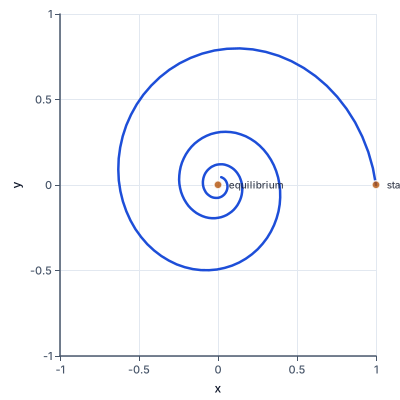
The chart traces one trajectory of a stable spiral, a point with negative trace above the parabola: it circles the origin and closes in on every turn.
Deciding stability from the determinant. The determinant separates saddles from everything else; it says nothing about stability on its own. A stable node and an unstable node can share a determinant exactly.
Forgetting the off-diagonal product. $ad$ alone is the determinant only for an uncoupled system. The coupling is precisely what makes trajectories turn, so dropping $bc$ deletes every spiral from the picture.
Calling a spiral a centre. A spiral with a very small real part looks closed over one loop. The test is algebraic, not visual: the trace is either exactly zero or it is not.
Reading the arrows off the eigenvalues' size. The magnitudes set the speed; the signs set the direction, and only the signs are part of the classification.
Classifying and sketching the phase portrait of $\mathbf{x}' = A\mathbf{x}$ follows one routine.
Why the trace and determinant are enough. The eigenvalues are the roots of $\lambda^{2} - t\lambda + m = 0$, so $\lambda_1 + \lambda_2 = t$ and $\lambda_1\lambda_2 = m$. A negative product forces opposite signs. When the discriminant is negative the eigenvalues are $\frac{t}{2} \pm \beta i$, so the real part is $\frac{t}{2}$ and its sign is the sign of $t$. When they are real with a positive product they share a sign, and their sum shows which.
Polar coordinates for a spiral. When the matrix has the form $\begin{pmatrix} \alpha & -\beta \\ \beta & \alpha \end{pmatrix}$, the equations $rr' = xx' + yy'$ and $r^{2}\theta' = xy' - yx'$ separate the motion into $r' = \alpha r$ and $\theta' = \beta$: the distance grows or shrinks exponentially while the angle turns at a steady rate.
How to check the answer. The eigenvalues must add to $t$ and multiply to $m$. A sketch must agree with the velocity at a test point: at $(1, 0)$ the arrow is the first column of $A$, and at $(0, 1)$ the second. If the sketch shows a spiral turning one way and the test arrow points the other, the sketch is wrong.
A control engineer designing a feedback loop, the autopilot that holds an aircraft's pitch or the regulator that holds a motor's speed, often ends up with a closed-loop system $x' = y$, $y' = -kx - cy$, where $k$ and $c$ are gains they can set. Its matrix $\begin{pmatrix} 0 & 1 \\ -k & -c \end{pmatrix}$ has trace $t = -c$ and determinant $m = k$, so choosing the gains is choosing a point on the trace-determinant map.
With $k = 4$ and $c = 2$: $t = -2$, $m = 4$ and $t^{2} - 4m = 4 - 16 = -12 < 0$, a stable spiral with eigenvalues $-1 \pm \sqrt{3}\,i$. The system settles, but overshoots and oscillates about $\sqrt{3}$ radians a second on the way. Raising the damping gain to $c = 4$ gives $t^{2} - 4m = 0$: the point sits on the parabola, the repeated eigenvalue $-2$, the fastest response without overshoot. Raising it further, to $c = 6$, gives a stable node with eigenvalues $-3 \pm \sqrt{5}$, roughly $-0.76$ and $-5.24$: no overshoot, but the slow mode now takes about $\frac{1}{0.76} \approx 1.3$ time units to settle by a factor of $e$. More damping is not always faster. Engineers tune gains exactly by moving this point, aiming just inside the spiral region for a quick response with a small, acceptable overshoot.
In 1935 Lewis Fry Richardson modelled two rival nations' military spending, $x$ and $y$, by supposing each increases its spending in proportion to the other's and decreases it in proportion to its own cost: $x' = -ax + ky$, $y' = kx - ay$, with $a$ the restraint and $k$ the reaction to the rival. The matrix has trace $-2a$ and determinant $a^{2} - k^{2}$.
If restraint outweighs reaction, $a > k$, the determinant is positive and the trace negative: a stable node, and spending on both sides settles. If reaction outweighs restraint, $a < k$, the determinant is negative and the origin is a saddle: almost every start runs away, one side's increase feeding the other's, which Richardson read as an arms race escalating towards war. One sign, the determinant's, separates the two histories.
The model is crude, but it shows what the trace-determinant map is for: turning a question about the long run of a system, which would otherwise need its solution, into two numbers computed from its coefficients.
Physiologists model a nerve or heart cell with two variables, its voltage and a slower recovery variable, and draw the cell's state in the phase plane. The resting state is an equilibrium, and its classification by trace and determinant says whether a small disturbance dies away (a stable node or spiral: the cell rests) or grows into a large excursion that returns (the firing of an impulse). Drugs that change the cell's rates move that point on the trace-determinant map, and a change from stable spiral to unstable spiral is the mathematical moment a resting cell starts to fire rhythmically.
It is natural to treat the six names as one list to be memorised, and then to reach for a single number to pick from it. Nothing works that way here, because two independent questions are being answered at once. The first is do the trajectories turn — settled entirely by the discriminant $t^{2} - 4m$, which decides whether the eigenvalues are real or complex. The second is do they go in or out — settled entirely by the sign of the trace. A saddle is the case where the second question has no single answer, because the two directions disagree, and that is why the determinant is checked first and separately. Learners who try to read stability off the determinant get a consistent-looking rule that is wrong about half the plane.
Take $x' = x + 2y$, $y' = 2x + y$. Compute the trace and determinant.
$t = 1 + 1 = 2, \qquad m = 1 \cdot 1 - 2 \cdot 2 = 1 - 4 = -3$
Two multiplications and a subtraction.
Read the type from the determinant.
$m = -3 < 0 \quad\Rightarrow\quad \text{real eigenvalues of opposite sign: a saddle}$
A negative determinant ends the question; no characteristic equation was solved.
Confirm by solving the characteristic equation.
$\lambda^{2} - 2\lambda - 3 = (\lambda - 3)(\lambda + 1) = 0 \;\Rightarrow\; \lambda = 3,\ -1$
The equation is $\lambda^{2} - t\lambda + m = 0$. Opposite signs, as the determinant said.
Find the two straight-line directions.
$\lambda = 3: \ \begin{pmatrix} -2 & 2 \\ 2 & -2 \end{pmatrix}\mathbf{v} = \mathbf{0} \Rightarrow (1, 1); \qquad \lambda = -1: \ \begin{pmatrix} 2 & 2 \\ 2 & 2 \end{pmatrix}\mathbf{v} = \mathbf{0} \Rightarrow (1, -1)$
Each eigenvector is a line of trajectories that stay straight.
Sketch the saddle from those directions.
$\text{in along } (1, -1) \ (\lambda = -1), \qquad \text{out along } (1, 1) \ (\lambda = 3)$
Every other trajectory comes in near the $(1, -1)$ line and leaves near the $(1, 1)$ line, like water through a mountain pass.
Take $x' = -x - 2y$, $y' = 2x - y$. Compute the trace and determinant.
$t = -1 + (-1) = -2, \qquad m = (-1)(-1) - (-2)(2) = 1 + 4 = 5$
Mind the signs in the second product.
Compare $t^{2}$ with $4m$ to decide whether the eigenvalues are real.
$t^{2} - 4m = 4 - 20 = -16 < 0 \quad\Rightarrow\quad \lambda = \dfrac{-2 \pm 4i}{2} = -1 \pm 2i$
A negative discriminant means complex eigenvalues: the trajectories turn.
Read stability from the trace.
$t = -2 < 0 \quad\Rightarrow\quad \text{stable spiral}$
The real part of each eigenvalue is $\frac{t}{2} = -1$, so the turning trajectories are drawn inward.
Find the direction of rotation from the velocity at one point.
$(x, y) = (1, 0): \quad (x', y') = (-1, 2)$
At a point on the positive $x$ axis the motion is upward, so the spiral turns anticlockwise.
Change both diagonal entries to $0$ and recompute.
$t = 0, \qquad m = 0 - (-2)(2) = 4 \;\Rightarrow\; \lambda = \pm 2i: \text{a centre}$
One number moved and the trajectories went from settling to circling for ever.
Take $x' = -3x + y$, $y' = x - 3y$. Compute the trace and determinant.
$t = -3 + (-3) = -6, \qquad m = (-3)(-3) - (1)(1) = 9 - 1 = 8$
$m > 0$, so not a saddle.
Compare $t^{2}$ with $4m$ to decide whether the eigenvalues are real.
$t^{2} - 4m = 36 - 32 = 4 > 0$
A positive discriminant means real eigenvalues, so a node rather than a spiral.
Read stability from the trace.
$t = -6 < 0 \quad\Rightarrow\quad \text{stable node}$
Both eigenvalues are real, multiply to $8 > 0$ and add to $-6 < 0$, so both are negative.
Find the eigenvalues.
$\lambda = \dfrac{-6 \pm \sqrt{4}}{2} = \dfrac{-6 \pm 2}{2} \quad\Rightarrow\quad \lambda = -2, \ -4$
Check: $-2 + (-4) = -6$ and $(-2)(-4) = 8$.
Find the eigenvector for the slower eigenvalue, $-2$.
$(A + 2I)\mathbf{v} = \begin{pmatrix} -1 & 1 \\ 1 & -1 \end{pmatrix}\mathbf{v} = \mathbf{0} \quad\Rightarrow\quad \mathbf{v} = (1, 1)$
Both rows say $v_1 = v_2$.
Find the eigenvector for the faster eigenvalue, $-4$.
$(A + 4I)\mathbf{v} = \begin{pmatrix} 1 & 1 \\ 1 & 1 \end{pmatrix}\mathbf{v} = \mathbf{0} \quad\Rightarrow\quad \mathbf{v} = (1, -1)$
Both rows say $v_1 = -v_2$.
Describe how trajectories arrive.
$\mathbf{x} = c_1e^{-2t}(1, 1) + c_2e^{-4t}(1, -1) \approx c_1e^{-2t}(1, 1) \text{ for large } t$
The $e^{-4t}$ term dies first, so almost every trajectory enters the origin tangent to the slow direction $(1, 1)$.
Compute the trace and determinant.
$t = -3 + (-1) = -4, \qquad m = (-3)(-1) - (1)(-2) = 3 + 2 = 5$
Mind both signs in the second product.
The determinant is positive; compare $t^{2}$ with $4m$.
Let the trace decide the direction.
Each of these four systems has its only equilibrium at the origin. Sort them by what kind of equilibrium that is.
| An unstable node | A stable node | A saddle | A centre | |
|---|---|---|---|---|
| $x' = 2x$, $\ y' = 3y$ | ||||
| $x' = -2x$, $\ y' = -3y$ | ||||
| $x' = 2x$, $\ y' = -3y$ | ||||
| $x' = -2y$, $\ y' = 3x$ |
Complete the worked solution: classify the origin for $x' = -x - 4y$, $y' = 4x - y$.
Write the coefficient matrix.
$A = \begin{pmatrix} -1 & -4 \\ 4 & -1 \end{pmatrix}$
One row per equation, one column per unknown.
Add the diagonal entries for the trace.
$t = (-1) + (-1) =$ t
The trace is the sum of the diagonal.
Cross-multiply for the determinant.
$m = (-1)(-1) - (-4)(4) = 1 + 16 =$ m
$\det = ad - bc$; subtracting a negative product adds it.
Compute the discriminant $t^{2} - 4m$.
$t^{2} - 4m = 4 \cdot 1 - 4\left(1 + 16\right) =$ d
The $p$ terms cancel, leaving minus four times the square of the off-diagonal entry.
Read the classification from the three numbers.
$m > 0, \quad t^{2} - 4m < 0, \quad t < 0 \quad\Rightarrow\quad \text{stable spiral}$
Positive determinant rules out a saddle, a negative discriminant means complex eigenvalues, and a negative trace draws inward.
The system $x' = -2x, \quad y' = -5y$ has trace $-7$ and determinant $10$. What kind of equilibrium is the origin?
For each system, fill in the trace, the determinant and the discriminant $t^{2} - 4m$ of its coefficient matrix.
| Trace | Determinant | Discriminant | |
|---|---|---|---|
| $x' = 4x$, $\ y' = -3y$ | |||
| $x' = -4y$, $\ y' = 3x$ | |||
| $x' = -4x - 3y$, $\ y' = 3x - 4y$ |
What is the determinant of the coefficient matrix of $x' = -2x, \quad y' = -5y$?
Answer:
A float dropped into a draining whirlpool circles the centre while it is drawn in; its position $(x, y)$ in metres after $t$ seconds obeys the system below. Solve $x' = -2x - 4y$, $y' = 4x - 2y$ with $x(0) = 5$ and $y(0) = 0$. Write $x(t)$ as a formula in $t$ (type e^(...) and cos(...)).
Answer:
Plot the system $x' = x - 3y, \quad y' = 3x + y$ as a single point on the trace-determinant plane, with the trace across and the determinant up.
Plot your answer on the grid:
Lesson test: one question per skill, one attempt each, no hints. Your answers are checked when you submit.
A float dropped into a draining whirlpool circles the centre while it is drawn in; its position $(x, y)$ in metres after $t$ seconds obeys the system below. Solve $x' = -x - 4y$, $y' = 4x - y$ with $x(0) = 4$ and $y(0) = 0$. Write $x(t)$ as a formula in $t$ (type e^(...) and cos(...)).
Answer:
You can classify the origin of a linear system from its trace and determinant, and you can place that system on the trace-determinant map. Say in your own words why a negative determinant settles the question on its own.
15. Your turn: classify the origin for $x' = -3x + y$, $y' = -2x - y$, step 2
$t^{2} - 4m = 16 - 20 = -4 < 0$
Not a saddle, and the eigenvalues are complex.
15. Your turn: classify the origin for $x' = -3x + y$, $y' = -2x - y$, step 3
$t = -4 < 0 \quad\Rightarrow\quad \text{stable spiral}$
The point $(-4, 5)$ sits just above the parabola, so the turning is slow compared with the inward drift.