Back to the on-screen lesson ·
What a differential equation asserts about gradients, how order and linearity are decided, and how to read $y' = f(x, y)$ before solving it.
Paper packet. Every task here also exists on screen, where it is checked automatically; answers written on paper are not assessed by Nydus. When you are back at a device, enter your answers there.
By the end of this lesson you will be able to say the order of a differential equation and whether it is linear, check whether a proposed function is a solution by substituting it, read a slope directly off a first-order equation at any point, and find the isocline on which the slope takes a chosen value.
You can differentiate and integrate, and you know that a derivative is a rate of change with a geometric meaning: the gradient of a graph. That second reading is the whole of this lesson. A differential equation is a sentence about gradients, and before any technique is learned it can simply be read.
| Term | What it means |
|---|---|
| Ordinary differential equation | An equation relating an unknown function of one variable to its derivatives. |
| Order | The highest derivative that appears in the equation. |
| Linear | The unknown and its derivatives occur only to the first power and are never multiplied by each other; the coefficients may be any functions of the independent variable. |
| Solution | A function that satisfies the equation at every point of an interval. |
| General solution | The whole family of solutions, carrying as many arbitrary constants as the order. |
| Initial condition | A value such as $y(x_0) = y_0$ that fixes the arbitrary constants. |
| Particular solution | The one member of the family that an initial condition picks out. |
| Slope field (direction field) | The picture of the equation: a short line of the right gradient drawn at each point. |
| Isocline | A curve along which the slope field has one fixed gradient $m$, found by solving $f(x, y) = m$. |
A first-order equation $y' = f(x, y)$ says something completely explicit: at the point $(x, y)$, any solution passing through has gradient $f(x, y)$. That is a rule you can apply without solving anything. Draw a short segment of that gradient at each point of a grid and you have the slope field; a solution is any curve that stays tangent to it everywhere.
This is why an initial condition matters so much. The field fills the plane, so there is a curve through every point; naming one point picks one curve out of the family.
Order is the highest derivative present. Linearity is a statement about the unknown only:
| Equation | Order | Linear? |
|---|---|---|
| $y' + 3y = \sin x$ | 1 | yes |
| $x^{2}y' + xy = e^{x}$ | 1 | yes, however wild the coefficients |
| $y' = y^{2}$ | 1 | no — the unknown is squared |
| $yy'' + y' = 0$ | 2 | no — the unknown multiplies its own derivative |
Checking that a candidate is a solution needs no theory at all: substitute it and see whether both sides agree. That check is available at the end of every method in this course, and it is the only one that never lies.
Another way: picture
Imagine a field of tiny weather vanes, one at every point of the plane, each locked at the angle the equation dictates there. A solution is the path of a boat that always points the way the vane at its position points. Different starting harbours give different paths; the field is the same for all of them.
Another way: steps
To read an equation before solving it:
Evaluating the right-hand side point by point works and is slow. The quick way is to ask the opposite question: where is the slope equal to $m$? That is the single equation $f(x, y) = m$, and for the equations in this unit it is usually a line or a simple curve — an isocline.
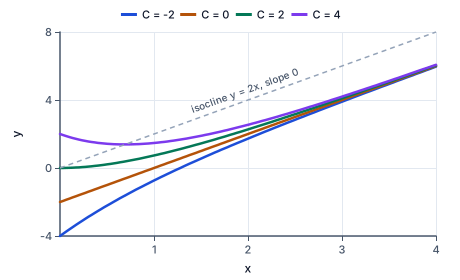
For $y' = 2x - y$, the slope is $m$ exactly on $y = 2x - m$. Draw that line, then hatch it with little segments all at gradient $m$. Three or four values of $m$ give a readable field in a minute.
The isocline for $m = 0$ is worth naming separately: it is where solutions have a horizontal tangent, so every maximum and minimum of every solution curve lies on it. Sketching that one curve tells you where the turning points of an entire family are before a single one has been computed.
The chart draws four members of the family for y' = 2x - y with the zero-slope isocline y = 2x; the one curve that turns does so on that line.
Reading the isocline as a solution. An isocline joins points of equal slope; a solution curve follows the slope. They coincide only by accident, and the field is the fastest way to see that the two families cross.
Deciding linearity from the right-hand side. $y' = x^{5} + \cos x$ is linear. What $x$ does is irrelevant; only the appearance of $y$ counts.
Expecting one solution. Without an initial condition the answer is a family, and an answer written without its arbitrary constant is not the general solution of anything.
Reaching for a method first. Every method in this course answers one shape of equation and no other. So the first question is never how do I solve this but what is this — the order, whether it is linear, and which of the standard shapes it already is. An integrating factor applied to a nonlinear equation produces confident nonsense.
A differential equation almost never has one solution. It has a family, and the family is labelled by arbitrary constants: one for a first-order equation, two for a second-order one, and in general as many as the order. The reason is that solving an equation of order $n$ undoes $n$ derivatives, and each undone derivative leaves a constant behind. So $y = Ce^{2x}$ is the general solution of $y' = 2y$, and $y = A\cos x + B\sin x$ is the general solution of $y'' = -y$.
An initial condition is what picks one member out. For a first-order equation one number is enough, the value $y(x_0)$; for a second-order equation you need two, usually $y(x_0)$ and $y'(x_0)$, because two constants have to be fixed. Counting the conditions against the order is a quick test of whether a problem is well posed.
A solution also lives on an interval. The formula $y = \frac{1}{1 - x}$ satisfies $y' = y^{2}$, but it breaks at $x = 1$, and the solution through $y(0) = 1$ is that formula on $x < 1$ only. The other branch, on $x > 1$, is a different solution: nothing in the equation joins the two across the gap. When a formula has a division by zero, a logarithm or a square root in it, say where it holds.
How to check a candidate, step by step.
This check is worth its time at the end of every method in the course. A method can be misremembered; substitution cannot. It also answers questions that look harder than they are: to ask whether a straight line solves an equation, suppose $y = mx + c$, substitute, and ask what $m$ and $c$ must be for the two sides to agree for every $x$. Matching the coefficient of $x$ and the constant term gives two small equations, and that is the whole solution.
Most differential equations met outside a classroom are read long before they are solved, and often they are never solved at all. A pharmacologist writing $C' = D - kC$ for the concentration $C$ of a drug in the blood, delivered at a steady rate $D$ and cleared at a rate proportional to what is there, can answer the first clinical question from the right-hand side alone: the slope is zero when $C = \frac{D}{k}$, below that level the slope is positive, above it negative, so every patient's level drifts towards $\frac{D}{k}$. With $D = 12$ milligrams an hour and $k = 0.3$ per hour the steady level is $\frac{12}{0.3} = 40$ milligrams.
A probe in an oven. An oven's air warms steadily, so that $x$ minutes after it is switched on the air is $3x$ degrees above its starting temperature. A probe inside warms at a rate equal to the gap between the air and itself, so its temperature $y$ above the start obeys
$$y' = 3x - y.$$
Read it as a slope field. The isocline of slope $3$ is $3x - y = 3$, that is $y = 3x - 3$, and along that line the field points along the line itself. So $y = 3x - 3$ is a solution: the probe rises at the air's own rate, $3$ degrees a minute, and trails exactly $3$ degrees behind it. Above the line $3x - y < 3$ and curves rise more slowly than the line; below it they rise faster, so every probe is funnelled onto the lagging line, and the lag, $3$ degrees, is the correction to add to its reading.
A weather model, a spacecraft's trajectory and a circuit simulator all solve differential equations the way this lesson reads them: they stand at a point, ask the equation for the slope there, take a short step in that direction and ask again. That is Euler's method, met properly in unit 6, and it is nothing more than following the arrows of a slope field. The field is therefore not a drawing aid but the object the software works with: a funnel or an escape visible in it is something the computation will meet.
Ecologists use the same reading on a single line. A fish stock $P$ in thousands, growing logistically and harvested at $H$ thousand a year, obeys $P' = 0.5P\left(1 - \frac{P}{100}\right) - H$. The right-hand side is a downward parabola in $P$ with its highest value, $12.5$, at $P = 50$. If $H < 12.5$ the slope is zero at two stock levels and the upper one is where the fishery settles; if $H > 12.5$ the slope is negative for every $P$ and the stock collapses whatever its size. The largest sustainable catch, $12.5$ thousand a year, is read off the equation, and it is the number a fisheries regulator is actually asked for.
The word invites the idea that a linear equation has straight-line solutions, and almost none of them do: $y' + y = 0$ is as linear as an equation gets and its solutions are exponentials. Linear means the unknown enters the equation the way a variable enters a linear expression — first power, no products with itself — and what that buys is not a shape but a property: any combination of solutions of a linear homogeneous equation is another solution. The whole of unit 2 is built on that property, and it fails the instant $y$ is squared.
Is $y = 3e^{2x}$ a solution of $y' - 2y = 0$? Differentiate the candidate first.
$y = 3e^{2x} \quad\Rightarrow\quad y' = 3 \cdot 2e^{2x} = 6e^{2x}$
The chain rule brings down the $2$ from the exponent.
Substitute $y$ and $y'$ into the left-hand side.
$y' - 2y = 6e^{2x} - 2 \cdot 3e^{2x} = 6e^{2x} - 6e^{2x} = 0$
Substitution is the whole test: the candidate is a solution exactly when the equation holds.
It holds for every $x$, so $y = 3e^{2x}$ is a solution on the whole real line.
$0 = 0 \quad \text{for all } x \in \mathbb{R}$
Both sides agree everywhere, so the interval is all of it.
Now test a plausible wrong answer, $y = 3e^{2x} + 1$.
$y' - 2y = 6e^{2x} - 2\left(3e^{2x} + 1\right) = 6e^{2x} - 6e^{2x} - 2 = -2 \ne 0$
Adding a constant to a solution of a linear homogeneous equation does not in general give another one, and the check catches it at once.
Test the whole family $y = Ce^{2x}$ at once, with $C$ left as a letter.
$y' - 2y = 2Ce^{2x} - 2Ce^{2x} = 0$
The check works for every $C$, so $y = Ce^{2x}$ is a one-parameter family of solutions: one constant, because the equation is first order.
For $y' = y(3 - y)$ the slope depends only on $y$. Find where it is zero.
$y(3 - y) = 0 \quad\Rightarrow\quad y = 0 \ \text{or}\ y = 3$
A product is zero exactly when one of its factors is. Along a horizontal line where the slope is zero, the line itself is a solution.
Find the sign of the slope between the two lines, at a test value such as $y = 1$.
$0 < y < 3: \quad y > 0,\ 3 - y > 0 \quad\Rightarrow\quad y' > 0 \qquad (y = 1:\ 1 \cdot 2 = 2)$
The sign of a product is decided by the signs of its factors, and a test value confirms it.
Find the sign above $y = 3$, at a test value such as $y = 4$.
$y > 3: \quad y > 0,\ 3 - y < 0 \quad\Rightarrow\quad y' < 0 \qquad (y = 4:\ 4 \cdot (-1) = -4)$
One factor has changed sign, so the product has.
Find the sign below $y = 0$, at a test value such as $y = -1$.
$y < 0: \quad y < 0,\ 3 - y > 0 \quad\Rightarrow\quad y' < 0 \qquad (y = -1:\ -1 \cdot 4 = -4)$
Now the other factor carries the minus sign, and the slope is negative again.
Read the behaviour of solutions from those signs.
$y(0) = 1 \;\nearrow\; 3, \qquad y(0) = 5 \;\searrow\; 3, \qquad y(0) = -1 \;\searrow\; -\infty$
The sign of the slope is the direction of travel. A solution cannot cross an equilibrium line, so it approaches $y = 3$ from its own side, and one below $0$ falls away.
Name the two equilibria by what nearby solutions do.
$y = 3: \ \text{both sides move towards it (stable)}; \qquad y = 0: \ \text{both sides move away (unstable)}$
No formula was produced, and the long-run question was answered from signs alone.
Sketch the field of $y' = x + y$ with isoclines. Set the right-hand side equal to a slope $m$.
$x + y = m$
An isocline is where the slope takes one fixed value, and the right-hand side is the slope.
Solve for $y$ by subtracting $x$ from both sides.
$y = -x + m$
Every isocline is a line of gradient $-1$; only its height changes with $m$.
Take $m = 0$: solutions have a horizontal tangent along this line.
$m = 0: \quad y = -x$
Every maximum and minimum of every solution lies on the $m = 0$ isocline.
Take $m = -1$: the segments drawn on this isocline have gradient $-1$, the same as the line itself.
$m = -1: \quad y = -x - 1, \qquad \text{gradient of the line} = -1 = m$
When the slope field points along its own isocline, a curve that follows the field can run along the line.
Check that the line is a solution by substituting it.
$y = -x - 1: \quad y' = -1, \qquad x + y = x + (-x - 1) = -1$
Both sides equal $-1$ for every $x$, so $y = -x - 1$ is a solution. It is the one case in which an isocline and a solution coincide.
Read the field on either side of that line.
$y > -x - 1 \Rightarrow x + y > -1, \qquad y < -x - 1 \Rightarrow x + y < -1$
Above the line the slope is steeper than the line's, so solutions climb away from it; below, they fall away. The straight solution separates two different long-run behaviours.
Find the order and test linearity.
$y'' \Rightarrow \text{second order}; \quad xy'',\ y',\ xy \text{ are functions of } x \text{ times } y^{(k)} \Rightarrow \text{linear}$
Order first, then linearity: every term is a coefficient in $x$ times $y$, $y'$ or $y''$.
A horizontal tangent needs $y' = 0$. Put that into the equation.
$xy'' + 0 + xy = 0 \quad\Rightarrow\quad x\left(y'' + y\right) = 0$
A condition on the solution becomes an equation once it is substituted.
For $x \ne 0$, divide by $x$ and read the shape.
Sort these four equations by order and by whether they are linear.
| First order, linear | First order, nonlinear | Second order, linear | Second order, nonlinear | |
|---|---|---|---|---|
| $y' + 2y = \sin x$ | ||||
| $y' = 2y^{2}$ | ||||
| $y'' + 7y' + 4y = 0$ | ||||
| $yy'' + 7y' = 0$ |
Complete the worked solution: the slopes the equation $y' = 2x - y$ gives at three points.
The right-hand side is the slope of the solution through any point $(x, y)$.
$y' = 2x - y$
An equation $y' = f(x, y)$ is a rule that hands out a slope at every point.
At $(2, 6)$: substitute $x = 2$ and $y = 6$, multiply, then subtract.
$y' = 2 \times 2 - 6 =$ p
Order of operations: the product $2x$ before the subtraction.
At $(3, 1)$: substitute $x = 3$ and $y = 1$.
$y' = 2 \times 3 - 1 =$ q
The same rule at a different point gives a different slope.
At $(0, 6)$: substitute $x = 0$ and $y = 6$.
$y' = 2 \times 0 - 6 =$ r
The $-y$ term alone decides the slope where $x = 0$, so it is negative here.
Draw each slope mark from its sign and size.
$y' > 0 \Rightarrow \text{rising}, \qquad y' < 0 \Rightarrow \text{falling}$
No integration was needed: the equation gives slopes wherever you ask.
Classify $yy'' + y' = 0$ by order and by linearity.
For $y' = 4x - y$, fill in the slope the equation gives at each point.
| x | y | Slope there | |
|---|---|---|---|
| The origin | 0 | 0 | |
| One step right | 1 | 0 | |
| Straight above the origin | 0 | 3 | |
| Two right and up | 2 | 3 |
A solution of $y' = 3x + y$ passes through $(4, 6)$. What is its slope at that point?
Answer:
An oven's air warms steadily: $x$ minutes after it is switched on it is $4x$ degrees above its starting temperature. A probe inside warms at a rate equal to the gap between the air and itself, so its temperature $y$ above the start obeys $y' = 4x - y$. After a while every probe rises in the same straight line $y = mx + c$. Find that line, and write $y$ as a formula in $x$.
Answer:
In the slope field of $y' = 2x - y$, the points where the slope is exactly $6$ lie on a straight line. Give that line's gradient and its intercept.
Gradient of the isocline:
Where it crosses the y axis:
Lesson test: one question per skill, one attempt each, no hints. Your answers are checked when you submit.
An oven's air warms steadily: $x$ minutes after it is switched on it is $6x$ degrees above its starting temperature. A probe inside warms at a rate equal to the gap between the air and itself, so its temperature $y$ above the start obeys $y' = 6x - y$. After a while every probe rises in the same straight line $y = mx + c$. Find that line, and write $y$ as a formula in $x$.
Answer:
You can classify an equation by order and linearity, test a candidate solution by substitution, and read the slope field off the equation. Say in your own words why an isocline is not a solution curve.
14. Your turn: classify $x y'' + y' + xy = 0$ and find where its solutions have a horizontal tangent, step 3
$y'' = -y$
Where $y > 0$ the curve is concave down, so a turning point above the axis is a maximum, and one below it is a minimum. The equation described its solutions without producing one.