Back to the on-screen lesson ·
A zero discriminant gives $(c_1 + c_2x)e^{rx}$ and a negative one gives a decaying oscillation; both come from the same substitution.
Paper packet. Every task here also exists on screen, where it is checked automatically; answers written on paper are not assessed by Nydus. When you are back at a device, enter your answers there.
By the end of this lesson you will be able to use the discriminant to decide which of the three cases a constant-coefficient equation is in, write the general solution for a repeated root and say why it carries a factor of $x$, complete the square to read the real and imaginary parts of a complex pair, and fit initial conditions to either shape.
You can write the characteristic quadratic of a constant-coefficient equation and read the general solution off two distinct real roots. A quadratic has three possible fates, and you have only used one of them. This lesson does the other two, and the machinery — substitute an exponential, solve a quadratic — does not change at all.
| Term | What it means |
|---|---|
| Discriminant | $b^{2} - 4ac$, which decides which of the three cases applies. |
| Repeated root | The single (double) root a zero discriminant gives; the solutions are $e^{rx}$ and $xe^{rx}$. |
| Complex conjugate pair | The roots $\alpha \pm i\beta$ a negative discriminant gives. |
| Real part, imaginary part | $\alpha$ and $\beta$; in the solution $\beta$ becomes the angular frequency. |
| Envelope | The factor $e^{\alpha x}$ that grows or shrinks the oscillation. |
| Overdamped, critically damped, underdamped | The three cases seen physically: two real roots, a repeated root, a complex pair. |
A repeated root. If $ar^{2} + br + c$ is a perfect square with root $r$, the substitution gives only one solution, $e^{rx}$, where two independent ones are needed. The missing one is
$$y_2 = xe^{rx},$$
and it is not a guess. Substituting $y = v(x)e^{rx}$ into the equation and using $b = -2ar$ and $c = ar^{2}$ leaves $av'' = 0$, so $v$ is any linear function, and the new piece is the $x$. The general solution is
$$y = (c_1 + c_2x)e^{rx}.$$
A complex pair. If the discriminant is negative the roots are $\alpha \pm i\beta$ with $\beta \ne 0$. Euler's formula $e^{i\theta} = \cos\theta + i\sin\theta$ turns the two complex exponentials into real functions, and the general real solution is
$$y = e^{\alpha x}\left(c_1\cos\beta x + c_2\sin\beta x\right).$$
Nothing complex survives into the answer. The imaginary numbers appear in the middle of the calculation and cancel, and what they leave behind is an oscillation.
| Discriminant | Roots | General solution |
|---|---|---|
| positive | $r_1 \ne r_2$ real | $c_1e^{r_1x} + c_2e^{r_2x}$ |
| zero | $r$ twice | $(c_1 + c_2x)e^{rx}$ |
| negative | $\alpha \pm i\beta$ | $e^{\alpha x}(c_1\cos\beta x + c_2\sin\beta x)$ |
Another way: picture
A mass hanging on a spring in a tub of oil. Thick oil and the mass creeps back to rest without ever passing it — two negative real roots, overdamped. Thin the oil until the mass just barely fails to overshoot and you are at the repeated root, critically damped: the fastest return to rest there is, which is why door closers and instrument needles are built to sit there. Thin it further and the mass swings past, again and again, inside a shrinking envelope — the complex case.
Another way: steps
It is tempting to treat $xe^{rx}$ as a rule to memorise. It is a consequence, and the derivation is short enough to be worth carrying.
Suppose $r$ is a double root of $ar^{2} + br + c$. Then $b = -2ar$ and $c = ar^{2}$. Look for a second solution of the form $y = v(x)e^{rx}$. Differentiating twice and substituting, every term without a derivative of $v$ carries the factor $ar^{2} + br + c = 0$ and disappears; the terms with $v'$ carry $2ar + b = 0$ and disappear too. What survives is $av''e^{rx} = 0$, so $v'' = 0$ and $v = c_1 + c_2x$.
Two coefficients vanished, not one, and that is the signature of a double root. The same argument run on a triple root of a third-order equation leaves $v''' = 0$ and produces $x^{2}e^{rx}$ as well, which is the general pattern: one extra power of $x$ per repetition.
Completing the square is faster than the quadratic formula here and gives both numbers directly. For $y'' + 6y' + 13y = 0$:
$$r^{2} + 6r + 13 = (r + 3)^{2} + 4,$$
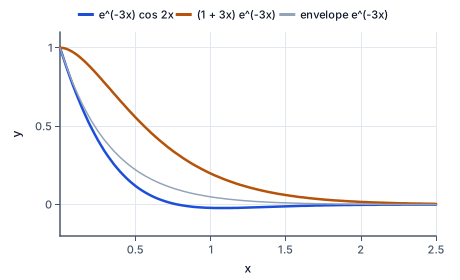
so $(r + 3)^{2} = -4$ and $r = -3 \pm 2i$. The solution is $e^{-3x}(c_1\cos 2x + c_2\sin 2x)$, read straight off.
The two numbers mean different things and are worth keeping apart. $\alpha = -3$ is the decay rate: the envelope $e^{-3x}$ falls by a factor of $e$ every $\tfrac{1}{3}$ of a unit. $\beta = 2$ is the angular frequency: the period is $2\pi/\beta = \pi$, independent of how fast the envelope shrinks. Damping a system changes how long it rings for; it barely changes the note.
The chart sets that solution inside its envelope beside the double-root case, which decays without ever crossing zero.
Every equation $ay'' + by' + cy = 0$ with constant coefficients is handled by one procedure with a single fork in it.
| $\Delta$ | Roots | General solution |
|---|---|---|
| $> 0$ | $r_1 \ne r_2$, real | $c_1e^{r_1x} + c_2e^{r_2x}$ |
| $= 0$ | $r$ twice | $(c_1 + c_2x)e^{rx}$ |
| $< 0$ | $\alpha \pm \beta i$ | $e^{\alpha x}(c_1\cos\beta x + c_2\sin\beta x)$ |
Why the complex case has cosines and sines. The complex exponentials $e^{(\alpha \pm \beta i)x}$ solve the equation, and Euler's formula $e^{i\theta} = \cos\theta + i\sin\theta$ turns them into $e^{\alpha x}(\cos\beta x \pm i\sin\beta x)$. Adding and subtracting the two gives the real solutions $e^{\alpha x}\cos\beta x$ and $e^{\alpha x}\sin\beta x$, and a real problem needs only real solutions.
How to check the answer. Put $x = 0$ into your $y$ and your $y'$ and confirm the two conditions. Then check the shape against the coefficients: when $a$, $b$ and $c$ are all positive every solution must decay, so an answer that grows has a sign error, usually in the real part $\alpha = -\frac{b}{2a}$. In the complex case the angular frequency must satisfy $\alpha^{2} + \beta^{2} = \frac{c}{a}$, the product of the two roots, which is a one-line check on the completed square.
Each wheel of a car hangs on a spring and a shock absorber, and after a bump the body's height $y$ above its resting level obeys $my'' + cy' + ky = 0$, with $m$ the mass the wheel carries, $k$ the spring stiffness and $c$ the damping of the shock absorber.
Take a quarter of a small car, $m = 250$ kilograms, with $k = 16\,000$ newtons per metre and $c = 2000$ newton-seconds per metre. Dividing by $m$, $y'' + 8y' + 64y = 0$. Completing the square, $r^{2} + 8r + 64 = (r + 4)^{2} + 48$, so $r = -4 \pm \sqrt{48}\,i \approx -4 \pm 6.93i$. The body bounces with angular frequency $6.93$ per second, a period of $\frac{2\pi}{6.93} \approx 0.91$ seconds, inside an envelope $e^{-4t}$ that halves every $\frac{\ln 2}{4} \approx 0.17$ seconds. After one period the bounce is $e^{-4 \times 0.91} \approx 0.03$ of what it was: the car settles in about one bounce, which is what a comfortable suspension does.
The repeated root is the boundary: $c^{2} = 4mk$, here $c = 2\sqrt{250 \times 16\,000} = 4000$. This critical damping returns the car fastest without any overshoot, and a worn shock absorber, whose $c$ has fallen well below it, is felt as a car that keeps bouncing after every bump.
A circuit with an inductor $L$, a resistor $R$ and a capacitor $C$ in series holds a charge $q$ that obeys $Lq'' + Rq' + \frac{q}{C} = 0$, the same equation as the car with inductance for mass, resistance for damping and $\frac{1}{C}$ for stiffness.
With $L = 0.1$ henry, $R = 20$ ohms and $C = 100$ microfarads, dividing by $L$ gives $q'' + 200q' + 100\,000q = 0$. Completing the square, $(r + 100)^{2} + 90\,000 = 0$, so $r = -100 \pm 300i$. The charge oscillates at $300$ radians per second, about $48$ hertz, and dies away with time constant $\frac{1}{100}$ of a second: the circuit rings for a few hundredths of a second when it is disturbed.
Radio tuners use this deliberately: a circuit with small $R$ rings at $\frac{1}{\sqrt{LC}}$ and so responds strongly to a signal at that frequency and weakly to others. The imaginary part of the root is the station it picks out, and the real part says how sharply. Raising $R$ to $2\sqrt{L/C} \approx 63$ ohms would make the root repeated and stop the ringing altogether, which is what the designer of a circuit that must not ring chooses.
Skyscrapers sway in the wind at a low natural frequency, and many carry a tuned mass damper: a heavy block near the top on springs and dampers of its own. Taipei 101 hangs a steel ball of about $660$ tonnes. Without it the tower's sway is lightly damped, with roots like $-0.01 \pm 0.9i$: it oscillates with a period of about $\frac{2\pi}{0.9} \approx 7$ seconds, and the envelope $e^{-0.01t}$ takes $\frac{\ln 2}{0.01} \approx 69$ seconds to halve the motion, so a gust sets the top swaying for minutes. The damper moves out of step with the tower and draws energy out of it, which in the language of this lesson makes the real part of the roots more negative while leaving the frequency almost unchanged. Raising the real part from $-0.01$ to $-0.05$ cuts the halving time to $14$ seconds. Occupants care about exactly those two numbers: how fast the building sways (the imaginary part, felt as motion sickness) and how long it keeps swaying (the real part).
The sentence "the equation has no real roots" is true and is regularly mistranslated into "the differential equation has no real solutions", which is false and would be alarming if it were not. Every equation in this lesson has a two-parameter family of perfectly real solutions; what the complex roots change is their shape, from exponentials to oscillations. The complex numbers are scaffolding — they appear when the quadratic is solved and are gone by the time Euler's formula has been applied. A related slip is reading $\alpha \pm i\beta$ as two independent behaviours to be chosen between; they are one pair, and both roots together produce the single real solution $e^{\alpha x}(c_1\cos\beta x + c_2\sin\beta x)$, which already has its two constants and needs nothing added.
Solve $y'' + 4y' + 4y = 0$ with $y(0) = 1$, $y'(0) = 1$. Check the discriminant first.
$\Delta = 16 - 16 = 0 \quad\Rightarrow\quad (r + 2)^{2} = 0, \quad r = -2 \text{ twice}$
Zero discriminant is the repeated case.
Write the general solution for a repeated root.
$y = (c_1 + c_2x)e^{-2x}$
The second solution is the first multiplied by $x$.
Differentiate with the product rule.
$y' = c_2e^{-2x} - 2(c_1 + c_2x)e^{-2x}$
The product rule is where this case goes wrong most often: both the bracket and the exponential change.
Apply both conditions at $x = 0$.
$y(0) = c_1 = 1, \qquad y'(0) = c_2 - 2c_1 = 1 \;\Rightarrow\; c_2 = 3, \qquad y = (1 + 3x)e^{-2x}$
At $x = 0$ the exponential is $1$ and the $x$ terms vanish.
Read the behaviour.
$1 + 3x > 0 \text{ for } x > -\tfrac{1}{3} \quad\Rightarrow\quad \text{rises briefly, then decays to } 0$
The $3x$ beats the exponential at first; a critically damped system can overshoot at most once.
Solve $y'' + 2y' + 5y = 0$ with $y(0) = 0$, $y'(0) = 4$. Complete the square.
$r^{2} + 2r + 5 = (r + 1)^{2} + 4 = 0 \quad\Rightarrow\quad r = -1 \pm 2i$
Both numbers come out of one completed square.
Write the real form of the solution.
$y = e^{-x}\left(c_1\cos 2x + c_2\sin 2x\right)$
Real part $-1$ in the exponential, imaginary part $2$ inside the trigonometric functions.
Apply $y(0) = 0$ before differentiating.
$y(0) = c_1 = 0 \quad\Rightarrow\quad y = c_2e^{-x}\sin 2x$
Using the first condition early makes the derivative much simpler.
Differentiate and apply $y'(0) = 4$.
$y' = c_2e^{-x}(2\cos 2x - \sin 2x), \quad y'(0) = 2c_2 = 4 \;\Rightarrow\; c_2 = 2, \qquad y = 2e^{-x}\sin 2x$
Product rule on $e^{-x}$ and $\sin 2x$.
Read the oscillation and the decay separately.
$\text{zeros at } x = \tfrac{n\pi}{2}; \qquad \text{each swing shrinks by } e^{-\pi/2}$
Oscillation and decay are two independent readings of one formula.
Solve $y'' + 9y = 0$ with $y(0) = 3$, $y'(0) = 12$. Write the characteristic equation and solve it.
$r^{2} + 9 = 0 \quad\Rightarrow\quad r^{2} = -9 \quad\Rightarrow\quad r = \pm 3i$
There is no $y'$ term, so the real part is $0$: no damping at all.
Write the real form of the general solution.
$y = e^{0x}\left(c_1\cos 3x + c_2\sin 3x\right) = c_1\cos 3x + c_2\sin 3x$
With real part $0$ the envelope $e^{0x}$ is $1$, so the oscillation never shrinks.
Put $x = 0$ and use $y(0) = 3$.
$y(0) = c_1 \cdot 1 + c_2 \cdot 0 = c_1 = 3$
$\cos 0 = 1$ and $\sin 0 = 0$.
Differentiate, put $x = 0$ and use $y'(0) = 12$.
$y' = -3c_1\sin 3x + 3c_2\cos 3x, \qquad y'(0) = 3c_2 = 12 \quad\Rightarrow\quad c_2 = 4$
The chain rule brings down the $3$ from each argument; divide both sides by $3$.
Write the solution and find its amplitude.
$y = 3\cos 3x + 4\sin 3x, \qquad R = \sqrt{3^{2} + 4^{2}} = \sqrt{25} = 5$
A sum $A\cos\omega x + B\sin\omega x$ is a single wave of amplitude $\sqrt{A^{2} + B^{2}}$.
Find the phase angle $\varphi$ from the two coefficients.
$\cos\varphi = \dfrac{3}{5}, \quad \sin\varphi = \dfrac{4}{5} \quad\Rightarrow\quad \varphi = \arctan\dfrac{4}{3} \approx 0.927$
Matching $R\cos(3x - \varphi) = R\cos\varphi\cos 3x + R\sin\varphi\sin 3x$ against $3\cos 3x + 4\sin 3x$ gives both equations.
Write the single-wave form and read the period.
$y = 5\cos(3x - 0.927), \qquad T = \dfrac{2\pi}{3}$
The solution swings between $-5$ and $5$ forever, once every $\frac{2\pi}{3}$. Check: $5\cos(-0.927) = 5 \times 0.6 = 3 = y(0)$.
Check the discriminant and find the root.
$\Delta = 36 - 36 = 0 \quad\Rightarrow\quad (r - 3)^{2} = 0, \quad r = 3 \text{ twice}$
Check the discriminant before choosing the shape of the solution.
Write the solution and differentiate it.
Apply the conditions.
Match each equation to the shape of its general solution.
| $(c_1 + c_2x)e^{5x}$ | $e^{-5x}\left(c_1\cos 4x + c_2\sin 4x\right)$ | $c_1\cos 4x + c_2\sin 4x$ | $c_1e^{5x} + c_2e^{-5x}$ | |
|---|---|---|---|---|
| $y'' - 10y' + 25y = 0$ | ||||
| $y'' + 10y' + 41y = 0$ | ||||
| $y'' + 16y = 0$ | ||||
| $y'' - 25y = 0$ |
Complete the worked solution: the roots of $r^{2} + 8r + 41 = 0$ and the shape of the solution.
Halve the coefficient of $r$.
$\dfrac{8}{2} =$ h
Completing the square uses half the middle coefficient.
Write the square and subtract what it adds.
$r^{2} + 8r + 41 = \left(r + \tfrac{8}{2}\right)^{2} - \left(\tfrac{8}{2}\right)^{2} + 41$
Expanding the square gives back $r^{2} + 8r$ plus the extra square, which is taken off again.
Combine the constants.
$41 - \left(\tfrac{8}{2}\right)^{2} =$ m
What is left over after completing the square.
Set the completed square to zero and take the square root of the leftover.
$\left(r + \tfrac{8}{2}\right)^{2} = -(\text{leftover}) \quad\Rightarrow\quad \text{imaginary part} = \sqrt{\text{leftover}} =$ w
A negative number's square root is imaginary.
Write the real form of the solution.
$y = e^{-\frac{8}{2}x}\left(c_1\cos\omega x + c_2\sin\omega x\right)$
The real part is the decay; the imaginary part is the angular frequency $\omega$.
What kind of roots does $y'' + 2y' + 10y = 0$ have?
For each equation, give the discriminant of its characteristic quadratic and how many distinct real roots it has.
| Discriminant | Distinct real roots | |
|---|---|---|
| $y'' + 10y' + 25y = 0$ | ||
| $y'' + 10y' + 29y = 0$ | ||
| $y'' + 10y' + 21y = 0$ | ||
| $y'' + 5y' = 0$ |
The solutions of $y'' + 10y' + 34y = 0$ oscillate inside a decaying envelope. What is the angular frequency of that oscillation?
Answer:
A mass on a spring, with a damper, is displaced $1$ centimetres and given a push; its displacement $y$ after $x$ seconds obeys $y'' + 4y' + 20y = 0$. Solve $y'' + 4y' + 20y = 0$ with $y(0) = 1$ and $y'(0) = 6$. Write $y$ as a formula in $x$ (type e^(...), cos(...) and sin(...)).
Answer:
The roots of the characteristic equation of $y'' + 4y' + 5y = 0$ form a conjugate pair. Give the real part and the size of the imaginary part.
Real part of the roots:
Size of the imaginary part:
Lesson test: one question per skill, one attempt each, no hints. Your answers are checked when you submit.
A mass on a spring, with a damper, is displaced $3$ centimetres and given a push; its displacement $y$ after $x$ seconds obeys $y'' + 6y' + 25y = 0$. Solve $y'' + 6y' + 25y = 0$ with $y(0) = 3$ and $y'(0) = -1$. Write $y$ as a formula in $x$ (type e^(...), cos(...) and sin(...)).
Answer:
You can choose the case from the discriminant, write the general solution for a repeated root or a complex pair, and say what the real and imaginary parts each control. Say in your own words why a factor of $x$ appears only when the roots coincide.
15. Your turn: solve $y'' - 6y' + 9y = 0$ with $y(0) = 2$, $y'(0) = 0$, step 2
$y = (c_1 + c_2x)e^{3x}, \qquad y' = c_2e^{3x} + 3(c_1 + c_2x)e^{3x}$
Product rule on the whole bracket.
15. Your turn: solve $y'' - 6y' + 9y = 0$ with $y(0) = 2$, $y'(0) = 0$, step 3
$c_1 = 2, \quad c_2 + 3c_1 = 0 \;\Rightarrow\; c_2 = -6, \qquad y = (2 - 6x)e^{3x}$
The root is positive, so this grows without limit; critical damping needs a negative repeated root.