Back to the on-screen lesson ·
C = max over inputs of I(X; Y); noiseless and useless channels; units of bits per use.
Paper packet. Every task here also exists on screen, where it is checked automatically; answers written on paper are not assessed by Nydus. When you are back at a device, enter your answers there.
By the end of this lesson you will be able to describe a discrete memoryless channel by its transition matrix, compute output distributions and noise entropies for a given input, explain what memorylessness means for blocks of uses, and recognise the binary symmetric, binary erasure and Z channels. You will define channel capacity as the maximum mutual information over input distributions, compute it for noiseless, useless and binary symmetric channels, explain why the uniform input is optimal when the noise entropy is fixed, and state the bounds that any capacity must satisfy, ready for the coding theorem that gives the definition its operational meaning.
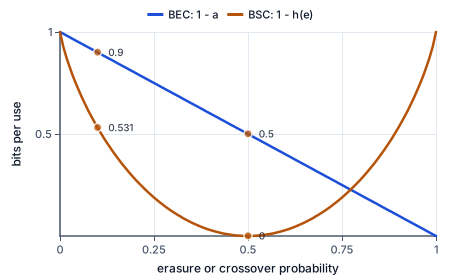
The capacity of a DMC is $$C = \max_{p(x)} I(X; Y)$$ bits per channel use: the most information any input distribution can push through one use. It depends on the channel only, satisfies $0 \le C \le \min(\log_2 |\mathcal{X}|, \log_2 |\mathcal{Y}|)$, and the maximum exists because $I$ is a continuous concave function of $p(x)$ on a compact set. A noiseless channel with $m$ inputs has $C = \log_2 m$; a channel whose output ignores the input has $C = 0$. For the BSC, $I = H(Y) - h(\varepsilon)$ with the noise term fixed, so the uniform input, which makes $H(Y) = 1$, is optimal and $C = 1 - h(\varepsilon)$; at $\varepsilon = 0$ this is $1$, at $\varepsilon = \tfrac{1}{2}$ it is $0$, and at $\varepsilon = 1$ it is $1$ again, since a channel that always flips is perfectly informative. The definition earns its name in the channel coding theorem: $C$ is exactly the largest rate at which arbitrarily reliable communication is possible.
Another way: picture
The graph of $1 - h(\varepsilon)$ on $[0, 1]$: a valley touching $0$ at $\varepsilon = \tfrac{1}{2}$ and rising to $1$ at both ends. A channel that always lies is as good as one that never does; a channel that lies half the time is useless.
Another way: steps
Capacity is $C = \max_{p(x)} I(X; Y)$: the channel is given, the input distribution is yours to choose, and $C$ is the best you can do per use. The maximum exists because $I$ is continuous and concave in $p(x)$ over a compact set, and it obeys $$0 \le C \le \min\big(\log_2 |\mathcal{X}|, \log_2 |\mathcal{Y}|\big)$$ because $I \le H(X)$ and $I \le H(Y)$. The recipe that solves most channels in one line: if $H(Y \mid X)$ does not depend on the input — every row of the matrix has the same entropy — then maximising $I = H(Y) - H(Y \mid X)$ means maximising $H(Y)$ alone, and a uniform input usually makes the output uniform.
| channel | capacity | best input | why |
|---|---|---|---|
| noiseless with $m$ inputs | $\log_2 m$ | uniform | $I = H(X)$ |
| BSC($\varepsilon$) | $1 - h(\varepsilon)$ | uniform | noise term is fixed, so maximise $H(Y)$ |
| BEC($\alpha$) | $1 - \alpha$ | uniform | $I = (1 - \alpha) H(X)$ |
| output ignores the input | $0$ | any | $I = 0$ |
| crossover $p$ | $h(p)$ | $1 - h(p)$ |
|---|---|---|
| $0.05$ | $0.286$ | $0.714$ |
| $0.1$ | $0.469$ | $0.531$ |
| $0.15$ | $0.610$ | $0.390$ |
| $0.2$ | $0.722$ | $0.278$ |
| $0.25$ | $0.811$ | $0.189$ |
| $0.3$ | $0.881$ | $0.119$ |
| $0.35$ | $0.934$ | $0.066$ |
| $0.4$ | $0.971$ | $0.029$ |
| $0.45$ | $0.993$ | $0.007$ |
| $0.5$ | $1$ | $0$ |
Common mistakes
$I(X; Y) = H(Y) - H(Y \mid X) = H(Y) - h(\varepsilon)$, and $H(Y) \le 1$ with equality when $Y$ is uniform, which the uniform input achieves.
Noise term fixed, output entropy maximised.
$C = 1 - h(\varepsilon)$: $0.531$ at $\varepsilon = 0.1$, $0.278$ at $\varepsilon = 0.2$, $0$ at $\varepsilon = 0.5$.
$I(X; Y) \le H(X) \le \log_2 |\mathcal{X}|$ and $I(X; Y) \le H(Y) \le \log_2 |\mathcal{Y}|$.
Mutual information never exceeds either entropy.
So a channel with $4$ inputs and $8$ outputs has $C \le 2$ bits per use, however the outputs are arranged.
A channel has $8$ inputs and $4$ outputs.
$I \le H(X) \le \log_2 8 = 3$ and $I \le H(Y) \le \log_2 4 = 2$.
$C \le 2$ bits per use, however clean the channel: you cannot learn more than the output can express.
$I(X; Y) = H(Y) - H(Y \mid X) = H(Y) - h(\varepsilon)$ for every input distribution.
The subtracted term is a constant of the channel.
$Y$ is binary, so $H(Y) \le 1$, with equality when $P(Y = 1) = \tfrac{1}{2}$.
A uniform input gives $P(Y = 1) = \tfrac{1}{2}(1 - \varepsilon) + \tfrac{1}{2}\varepsilon = \tfrac{1}{2}$, so $C = 1 - h(\varepsilon)$.
$C = 1 - h(0.9) = 1 - h(0.1)$ by symmetry of $h$.
$0.531$ bits: the receiver simply flips every bit back.
A noiseless channel delivers each of its $16$ input symbols exactly. What is its capacity in bits per use?
Computed value: answer
A binary symmetric channel has crossover probability $0.35$. Compute $I(X; Y)$ for the uniform input, in bits to three decimal places; this is the channel's capacity.
Computed value: answer
A channel with $4$ inputs and $8$ outputs produces its output uniformly at random, independently of the input. What is its capacity?
Computed value: answer
A noiseless channel delivers each of its $8$ input symbols exactly. What is its capacity in bits per use?
Computed value: answer
Which is the definition of the capacity of a discrete memoryless channel?
Lesson test: one question per skill, one attempt each, no hints. Your answers are checked when you submit.
A binary symmetric channel has crossover probability $0.4$. Compute $I(X; Y)$ for the uniform input, in bits to three decimal places; this is the channel's capacity.
Computed value: answer
You can model a noisy channel and compute how much information one use can carry at best. Next: the two workhorse channels, binary symmetric and binary erasure, in detail.
9. Your turn: capacity of a BSC with $\varepsilon = 0.9$, step 2