Back to the on-screen lesson ·
C = W log2(1 + SNR) bits per second; the power-bandwidth trade-off.
Paper packet. Every task here also exists on screen, where it is checked automatically; answers written on paper are not assessed by Nydus. When you are back at a device, enter your answers there.
By the end of this lesson you will be able to explain why the Gaussian channel needs a power constraint, derive its capacity $\tfrac{1}{2} \log_2 (1 + P/N)$ from the maximum-entropy property of the Gaussian distribution, convert signal-to-noise ratios between decibels and ratios, and picture the sphere-packing argument behind the coding theorem for it. You will apply the Shannon-Hartley law $C = W \log_2 (1 + \text{SNR})$ to size real links, solve it for the bandwidth or the SNR a target rate demands, and explain the trade-off between power and bandwidth, including the finite capacity that remains when bandwidth is unlimited.
A continuous-time channel of bandwidth $W$ hertz can be sampled at $2W$ samples per second without loss (Nyquist), so it is $2W$ Gaussian channel uses per second. With white noise of spectral density $N_0/2$ the noise per sample has variance $N_0 W$... more simply, with signal power $P$ and noise power $N = N_0 W$ in the band, $$C = W \log_2 \left(1 + \frac{P}{N_0 W}\right) \text{ bits per second,}$$ the Shannon-Hartley law: $2W$ uses per second times $\tfrac{1}{2} \log_2 (1 + \text{SNR})$ bits per use. Capacity is linear in bandwidth but only logarithmic in power: doubling $W$ doubles $C$ (at fixed SNR), doubling $P$ adds one bit per use only when the SNR was already $1$ and less when it was high. As $W \to \infty$ with fixed $P$ the SNR per hertz vanishes and $C \to (P/N_0) \log_2 e$, a finite ceiling: power is the ultimate constraint. A telephone line with $W = 3$ kHz and $30$ dB SNR has $C \approx 3000 \cdot \log_2 1001 \approx 30$ kbit/s, which is why modems stopped near that speed.
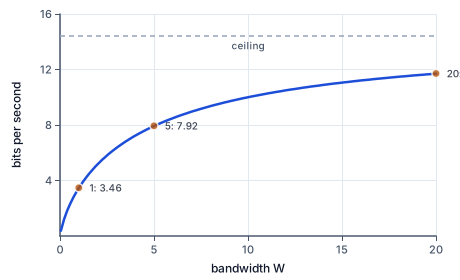
Another way: picture
Capacity plotted against bandwidth for fixed power: a curve that rises steeply at first, then bends over and flattens toward the ceiling $(P/N_0) \log_2 e$. Plotted against power at fixed bandwidth: a logarithm, ever rising but ever slower.
Another way: steps
A continuous-time channel of bandwidth $W$ hertz can be sampled at $2W$ samples per second without losing anything (Nyquist), so it is $2W$ Gaussian channel uses per second. With signal power $P$ and noise power $N = N_0 W$ in the band, each use is worth $\tfrac{1}{2} \log_2 (1 + P/N)$ bits, and multiplying the two gives the Shannon-Hartley law $$C = W \log_2 \left(1 + \frac{P}{N_0 W}\right) \text{ bits per second.}$$
The shape of that curve is the practical lesson: capacity is linear in bandwidth but only logarithmic in power. Doubling $W$ at a fixed signal-to-noise ratio doubles $C$; doubling $P$ adds only $\tfrac{1}{2} \log_2 \frac{1 + 2\,\text{SNR}}{1 + \text{SNR}}$ bits per use, which at high SNR is half a bit and at low SNR almost nothing. Bandwidth is the cheap axis, which is why every generation of radio reaches for more of it.
But bandwidth is not free either. As $W$ grows, the noise power $N_0 W$ grows with it and the SNR falls, so the curve bends over: writing $x = P/(N_0 W) \to 0$ and $\log_2 (1 + x) \approx x \log_2 e$, $$C \to \frac{P}{N_0} \log_2 e \approx 1.44 \frac{P}{N_0},$$ the infinite-bandwidth limit. Unlimited spectrum does not buy unlimited rate; only power does.
Common mistakes
$W = 3000$ Hz, SNR $= 30$ dB $= 1000$.
$C = 3000 \log_2 1001 \approx 3000 \cdot 9.97 \approx 29.9$ kbit/s: the ceiling that $28.8$ and $33.6$ kbit/s modems approached.
Theory met practice.
$C = W \log_2 (1 + P/(N_0 W))$; write $x = P/(N_0 W) \to 0$ and use $\log_2 (1 + x) \approx x \log_2 e$.
$C \to W \cdot \dfrac{P}{N_0 W} \log_2 e = \dfrac{P}{N_0} \log_2 e \approx 1.44 \, P/N_0$ bits per second: more bandwidth stops helping.
$W = 3000$ Hz and SNR $= 30$ dB $= 1000$.
$\log_2 1001 \approx 9.97$ bits per hertz of bandwidth.
$C \approx 3000 \cdot 9.97 \approx 29\,900$ bit/s — the ceiling that $28.8$ kbit/s modems were built to touch.
A link must carry $12$ Mbit/s with SNR $= 15$, so $\log_2 16 = 4$ bits per hertz.
$W = 12 / 4 = 3$ MHz.
Rate divided by bits per hertz.
Doubling the rate by bandwidth alone needs $6$ MHz; doubling it by power alone needs SNR $255$, seventeen times the power.
$\log_2 (1 + 15) = \log_2 16 = 4$.
$C = 20 \cdot 4 = 80$ Mbit/s.
A band-limited Gaussian channel has bandwidth $W = 5$ kHz and signal-to-noise ratio $255$. What is its capacity in kilobits per second?
Computed value: answer
A link must carry $45$ Mbit/s over a Gaussian channel with signal-to-noise ratio $31$. What bandwidth, in MHz, does the Shannon-Hartley law require at least?
Computed value: answer
A channel with bandwidth $3$ MHz and SNR $31$ has capacity $15$ Mbit/s. To double the capacity by adding bandwidth alone, to how many MHz must $W$ rise? And by raising power alone, the SNR must become $1023$: how many times the original power is that, approximately, for large SNR? Enter the required bandwidth in MHz.
Computed value: answer
A band-limited Gaussian channel has bandwidth $W = 6$ kHz and signal-to-noise ratio $7$. What is its capacity in kilobits per second?
Computed value: answer
With noise spectral density $N_0$ and power $P$, the capacity is $C = W \log_2 \left(1 + \dfrac{P}{N_0 W}\right)$. What happens as the bandwidth $W \to \infty$?
Lesson test: one question per skill, one attempt each, no hints. Your answers are checked when you submit.
A link must carry $72$ Mbit/s over a Gaussian channel with signal-to-noise ratio $255$. What bandwidth, in MHz, does the Shannon-Hartley law require at least?
Computed value: answer
You can compute the capacity of a Gaussian link from its power, noise and bandwidth. This closes the channel unit; the last unit builds the codes that approach these limits.
9. Your turn: $W = 20$ MHz and SNR $= 15$, step 2