Back to the on-screen lesson ·
Rows and columns that are permutations of each other; C = log|Y| − H(row) at the uniform input.
Paper packet. Every task here also exists on screen, where it is checked automatically; answers written on paper are not assessed by Nydus. When you are back at a device, enter your answers there.
By the end of this lesson you will be able to recognise symmetric and weakly symmetric channels from their transition matrices, prove that the uniform input is optimal for them and compute their capacity as $\log_2 |\mathcal{Y}|$ minus a row entropy, and explain through the noisy typewriter how non-overlapping output sets give error-free communication at capacity. You will combine capacities correctly for channels used in parallel, in cascade and over time, using data processing to bound cascades and independence to add parallel channels, and you will reduce two symmetric channels in series to a single equivalent channel.
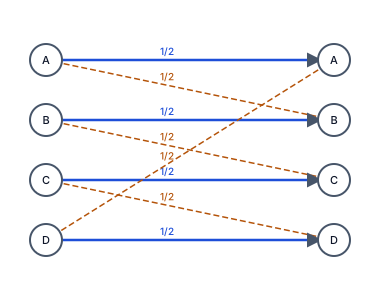
A channel is symmetric when every row of its transition matrix is a permutation of every other row and every column is a permutation of every other column; it is weakly symmetric when the rows are permutations of one another and the column sums are all equal. In either case every row has the same entropy $H(\text{row})$, so $H(Y \mid X) = H(\text{row})$ whatever the input, and the uniform input makes the output uniform, so $$C = \log_2 |\mathcal{Y}| - H(\text{row}),$$ attained at the uniform input. The BSC is the case $|\mathcal{Y}| = 2$, row $(1 - \varepsilon, \varepsilon)$. The noisy typewriter with $m$ keys, each printing itself or its neighbour with probability $\tfrac{1}{2}$, has $C = \log_2 m - 1$, and shows the idea behind all channel coding: use only inputs whose output sets do not overlap (every other key), and zero-error communication at capacity follows. For a channel that is not symmetric, such as the Z-channel, the noise entropy depends on the input and the maximisation must be done in earnest.
Another way: picture
The noisy typewriter with keys $A$ to $H$ drawn in a ring: each key's arrows go to itself and its clockwise neighbour. Highlight $A, C, E, G$: their output sets $\{A, B\}, \{C, D\}, \{E, F\}, \{G, H\}$ do not overlap, so four messages, two bits, pass with no error.
Another way: steps
A channel is symmetric when the rows of its transition matrix are permutations of one another and so are the columns; weakly symmetric when the rows are permutations of one another and all the column sums are equal. Either condition gives the same two facts, and those two facts give the capacity in one line. First, every row has the same entropy, so $H(Y \mid X) = H(\text{row})$ whatever the input. Second, a uniform input makes the output uniform (that is what the column condition buys), so $H(Y) = \log_2 |\mathcal{Y}|$ is attainable. Hence $$C = \log_2 |\mathcal{Y}| - H(\text{row}),$$ at the uniform input.
| rows of $p(y \mid x)$ | rows permutations? | columns permutations? | kind | capacity |
|---|---|---|---|---|
| $(0.8, 0.1, 0.1)$, $(0.1, 0.8, 0.1)$, $(0.1, 0.1, 0.8)$ | yes | yes | symmetric | $\log_2 3 - 0.922 = 0.663$ |
| $(\tfrac{1}{3}, \tfrac{1}{6}, \tfrac{1}{2})$, $(\tfrac{1}{3}, \tfrac{1}{2}, \tfrac{1}{6})$ | yes | no, but the column sums are equal | weakly symmetric | $\log_2 3 - 1.459 = 0.126$ |
| $(1 - \varepsilon, \varepsilon)$, $(\varepsilon, 1 - \varepsilon)$ | yes | yes | symmetric (the BSC) | $1 - h(\varepsilon)$ |
| $(1, 0)$, $(0.1, 0.9)$ | no | no | neither (the Z-channel) | needs optimisation |
The noisy typewriter is the picture worth keeping. With $m$ keys, each printing itself or the next with probability $\tfrac{1}{2}$, every row is a permutation of $(\tfrac{1}{2}, \tfrac{1}{2}, 0, \ldots)$, so $H(\text{row}) = 1$ and $C = \log_2 m - 1 = \log_2 (m/2)$.
And here the capacity has a constructive meaning that the general theorem does not: use only every other key. With $m = 4$, sending only $A$ and $C$ gives outputs $\{A, B\}$ and $\{C, D\}$, disjoint sets, so the receiver never confuses them — $\log_2 (4/2) = 1$ bit per use, with no coding, no block length and no probability of error at all. That is unusual; for most channels capacity is only reached in the limit of long blocks.
Common mistakes
Rows $(0.8, 0.1, 0.1)$ and its rotations: symmetric, with $H(\text{row}) = 0.8 \cdot 0.322 + 2 \cdot 0.1 \cdot 3.322 = 0.922$ bits.
Row entropy.
$C = \log_2 3 - 0.922 = 1.585 - 0.922 = 0.663$ bits per use at the uniform input.
Rows $(\tfrac{1}{3}, \tfrac{1}{6}, \tfrac{1}{2})$ and $(\tfrac{1}{3}, \tfrac{1}{2}, \tfrac{1}{6})$: permutations of each other; column sums $\tfrac{2}{3}, \tfrac{2}{3}, \tfrac{2}{3}$, all equal.
Columns are not permutations, but their sums agree.
The uniform input still gives a uniform output, so $C = \log_2 3 - H(\tfrac{1}{3}, \tfrac{1}{6}, \tfrac{1}{2}) = 1.585 - 1.459 = 0.126$ bits.
$16$ inputs, $16$ outputs, each input received as one of $4$ equally likely outputs.
Each row is uniform on $4$ values, so $H(\text{row}) = \log_2 4 = 2$ bits.
$C = \log_2 16 - 2 = 4 - 2 = 2$ bits per use: the noise costs exactly the two bits it scrambles.
Rows $(0.8, 0.1, 0.1)$ and its two rotations.
$H(\text{row}) = 0.8 \cdot 0.322 + 2 \cdot 0.1 \cdot 3.322 = 0.258 + 0.664 = 0.922$ bits.
Every row has this entropy; the order of the entries does not matter.
$C = \log_2 3 - 0.922 = 1.585 - 0.922 = 0.663$ bits per use at the uniform input.
$H(\text{row}) = \log_2 4 = 2$; $\log_2 |\mathcal{Y}| = 4$.
$C = 4 - 2 = 2$ bits per use.
A channel has $8$ inputs and $8$ outputs. Each input is received as one of $2$ equally likely outputs, and the channel is symmetric. What is its capacity in bits per use?
Computed value: answer
A noisy typewriter has $64$ keys; each key prints itself or the next key (cyclically), each with probability $\tfrac{1}{2}$. What is the capacity in bits per use?
Computed value: answer
A channel has $32$ inputs and $32$ outputs. Each input is received as one of $4$ equally likely outputs, and the channel is symmetric. What is its capacity in bits per use?
Computed value: answer
A noisy typewriter has $4$ keys; each key prints itself or the next key (cyclically), each with probability $\tfrac{1}{2}$. What is the capacity in bits per use?
Computed value: answer
A channel has transition matrix with rows $(0.7, 0.2, 0.1)$, $(0.1, 0.7, 0.2)$, $(0.2, 0.1, 0.7)$. Which is true?
Lesson test: one question per skill, one attempt each, no hints. Your answers are checked when you submit.
A channel has $32$ inputs and $32$ outputs. Each input is received as one of $2$ equally likely outputs, and the channel is symmetric. What is its capacity in bits per use?
Computed value: answer
You can compute the capacity of any symmetric channel and of combinations of channels. Next: the theorem that makes capacity the true speed limit of reliable communication.
9. Your turn: $16$ inputs, each received as one of $4$ equally likely outputs, symmetric, step 2