Back to the on-screen lesson ·
Eigenvectors as the null space of $A - \lambda I$, the eigenspace and its dimension, independence across distinct eigenvalues, and the gap between geometric and algebraic multiplicity.
Paper packet. Every task here also exists on screen, where it is checked automatically; answers written on paper are not assessed by Nydus. When you are back at a device, enter your answers there.
By the end of this lesson you will be able to find the eigenvectors for a given eigenvalue by row-reducing $A - \lambda I$ and reading off its null space, describe the eigenspace as a subspace rather than a single vector and scale a representative of it as a question demands, use the row of zeros that must appear as a check on the eigenvalue, compute the geometric multiplicity and compare it with the algebraic one, explain why eigenvectors for distinct eigenvalues are independent, and recognise a defective matrix such as a shear.
The eigenvalues of $A$ are the roots of $\det(A - tI)$, and finding them is a question about one polynomial. That question is now answered, and a second one opens: for a given eigenvalue $\lambda$, which vectors does $A$ merely scale by it? That is a homogeneous system, and you already know how to describe the whole solution set of one — row-reduce, identify the free variables, and read off a basis of the null space.
For an eigenvalue $\lambda$ of $A$, the eigenspace $E_\lambda$ is the null space of $A - \lambda I$: every $v$ with $Av = \lambda v$, the zero vector included. Its dimension is the geometric multiplicity of $\lambda$. The number of times $\lambda$ repeats as a root of the characteristic polynomial is its algebraic multiplicity. When the geometric falls short of the algebraic, $\lambda$ is called defective, and so is the matrix.
$\lambda$ is an eigenvalue exactly when $A - \lambda I$ is singular, and singular means its null space contains more than the zero vector. So the eigenvectors for $\lambda$ are precisely the non-zero members of
$$E_\lambda = \operatorname{null}(A - \lambda I),$$
and finding them is not a new technique. Substitute the number $\lambda$, row-reduce the matrix of numbers that results, and read off a basis of the null space exactly as in the first unit.
Two consequences follow immediately from $E_\lambda$ being a subspace rather than a list of vectors. First, an eigenvector is never unique: every non-zero multiple of one is another, so an answer is only pinned down once the question says how to scale it. Second, a row of zeros must appear when $A - \lambda I$ is reduced. If it does not, the null space is trivial, and $\lambda$ was not an eigenvalue after all — which makes the reduction a free check on the previous lesson's arithmetic.
The interesting quantity is the dimension of $E_\lambda$, and it is not determined by the characteristic polynomial. What is always true is the inequality
$$1 \le \dim E_\lambda \le (\text{algebraic multiplicity of } \lambda).$$
The lower bound holds because $\lambda$ being a root makes $A - \lambda I$ singular, so there is at least one direction. The upper bound is a genuine theorem, and the gap it allows is where matrices go wrong: a repeated root whose eigenspace is too small.
Another way: picture
Apply $A$ to every unit vector and draw where each one lands. Almost all of them swing round as well as change length. The eigenvector directions are the ones whose image points along the original line — forwards if $\lambda > 0$, backwards if $\lambda < 0$, and collapsed to the origin if $\lambda = 0$. A shear, $\begin{pmatrix} 1 & 1 \\ 0 & 1 \end{pmatrix}$, slides the plane sideways: only the arrows already lying along the horizontal axis stay put, so its one eigenvalue has only one direction to show for itself, no matter that its root is a double one.
Another way: steps
Eigenvectors belonging to distinct eigenvalues are linearly independent. The proof of the two-eigenvalue case shows why. Suppose $Av_1 = \lambda_1 v_1$, $Av_2 = \lambda_2 v_2$ with $\lambda_1 \ne \lambda_2$, and suppose $c_1v_1 + c_2v_2 = 0$. Apply $A$ to that relation: $c_1\lambda_1 v_1 + c_2\lambda_2 v_2 = 0$. Now multiply the original relation by $\lambda_1$ and subtract: $c_2(\lambda_2 - \lambda_1)v_2 = 0$. Since $\lambda_2 \ne \lambda_1$ and $v_2 \ne 0$, we get $c_2 = 0$, and then $c_1 = 0$ too.
The same argument, run repeatedly, handles any number of distinct eigenvalues. It has a consequence worth stating on its own: an $n \times n$ matrix with $n$ distinct eigenvalues has $n$ independent eigenvectors, and therefore a basis of them. That is the comfortable case, and it is the common one — a matrix drawn at random has distinct eigenvalues with probability one.
It also bounds the trouble. Independence across different eigenvalues is free; the only way a matrix can fail to have a basis of eigenvectors is for a single repeated eigenvalue to come up short within its own eigenspace.
Compare two matrices with identical characteristic polynomials:
$$S = \begin{pmatrix} 3 & 1 \\ 0 & 3 \end{pmatrix}, \qquad T = \begin{pmatrix} 3 & 0 \\ 0 & 3 \end{pmatrix}.$$
Both give $(3 - t)^{2}$, so both have the single eigenvalue $3$ with algebraic multiplicity $2$.
For $T$, $T - 3I$ is the zero matrix, whose null space is the whole plane: geometric multiplicity $2$. Every vector is an eigenvector, and $T$ is simply the scaling by $3$.
For $S$, $S - 3I = \begin{pmatrix} 0 & 1 \\ 0 & 0 \end{pmatrix}$, which already is reduced and has rank $1$, so its null space is only the line of multiples of $(1, 0)$: geometric multiplicity $1$. Algebraic $2$, geometric $1$ — the gap. $S$ is defective, and there is no basis of $\mathbb{R}^{2}$ made of its eigenvectors.
$S$ is a shear, and the picture is the argument. Sliding the plane sideways leaves exactly one direction fixed. There is no second one to find, whatever the characteristic polynomial suggests — which is the clearest statement of why algebraic and geometric multiplicity are two different measurements and not two names for one.
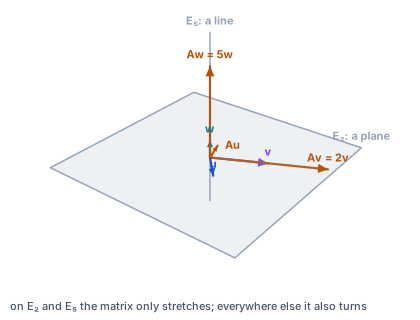
Take $A = \operatorname{diag}(2, 2, 5)$. For $\lambda = 2$, $A - 2I = \operatorname{diag}(0, 0, 3)$, whose null space is the whole $xy$-plane: $E_2$ is a plane, two-dimensional. For $\lambda = 5$, $A - 5I = \operatorname{diag}(-3, -3, 0)$, whose null space is the $z$-axis: $E_5$ is a line. The figure shows what that means. Any $\mathbf{v}$ in the plane goes to $A\mathbf{v} = 2\mathbf{v}$, along its own line; $\mathbf{w}$ on the axis goes to $5\mathbf{w}$. A vector $\mathbf{u}$ in neither has its plane part doubled and its vertical part multiplied by five, so $A\mathbf{u}$ swings off $\mathbf{u}$'s line. Turn the figure: every direction in the plane is an eigenvector, which is what a two-dimensional eigenspace looks like.
Forgetting to subtract $\lambda$. Row-reducing $A$ itself finds the null space of $A$, which is the eigenspace for $\lambda = 0$ and for nothing else.
Treating an eigenvector as unique. $(1, 2)$, $(2, 4)$ and $(-3, -6)$ are the same eigenvector as far as the mathematics is concerned. An answer is only determined once the question fixes the scale, and a check that rejects a correct multiple is checking the wrong thing.
Offering the zero vector. It satisfies $Av = \lambda v$ for every $\lambda$ at once, which would make every number an eigenvalue of every matrix. The definition excludes it for exactly that reason — and note that $\lambda = 0$ is perfectly respectable even though $v = 0$ is not.
Assuming the eigenspace is as big as the root is repeated. It is at least one-dimensional and at most as large as the algebraic multiplicity, and it can be anywhere in between. Nothing short of row-reducing $A - \lambda I$ settles which.
Reading no row of zeros and carrying on. That is not a hard system; it is a wrong eigenvalue. Go back a step.
$A = \begin{pmatrix} 4 & 1 \\ 2 & 3 \end{pmatrix}$ has trace $7$ and determinant $10$, so its eigenvalues are $5$ and $2$.
From the previous lesson.
$A - 5I = \begin{pmatrix} -1 & 1 \\ 2 & -2 \end{pmatrix}$ reduces to $\begin{pmatrix} -1 & 1 \\ 0 & 0 \end{pmatrix}$: the row of zeros confirms $5$, and the surviving row gives $v_1 = v_2$, so $E_5$ is the line through $(1, 1)$.
One free column, one basis vector.
$A - 2I = \begin{pmatrix} 2 & 1 \\ 2 & 1 \end{pmatrix}$ reduces to $\begin{pmatrix} 2 & 1 \\ 0 & 0 \end{pmatrix}$, giving $2v_1 + v_2 = 0$ and $E_2$ the line through $(1, -2)$. Two distinct eigenvalues, two independent directions.
Distinct eigenvalues never interfere.
$B = \begin{pmatrix} 2 & 0 & 0 \\ 0 & 2 & 0 \\ 0 & 0 & 5 \end{pmatrix}$: triangular, so $\chi_B(t) = (2 - t)^{2}(5 - t)$ and $2$ has algebraic multiplicity $2$.
A repeated root is not yet bad news.
$B - 2I$ has only one non-zero row, $(0, 0, 3)$, so its rank is $1$ and its null space has dimension $2$.
Rank plus nullity is three.
Geometric multiplicity $2$ matches algebraic $2$: the eigenspace is the whole $xy$-plane, spanned by $(1, 0, 0)$ and $(0, 1, 0)$. Repetition is only a problem when the eigenspace fails to keep up.
Compare the two numbers, never assume them.
It is triangular, so $\chi(t) = t^{2}$ and the only eigenvalue is $0$, with algebraic multiplicity $2$.
Read the diagonal.
$A - 0I$ is the matrix itself, already reduced, with rank $1$; its null space is where $v_2 = 0$.
Subtracting zero changes nothing — this time.
So $E_0$ is the line of multiples of $(1, 0)$, of dimension $1$ against an algebraic multiplicity of $2$: defective, and for the same reason a shear is.
$A = \begin{pmatrix} 7 & -1 \\ 6 & 2 \end{pmatrix}$ has $\lambda = 4$ among its eigenvalues. Write, as a column, the eigenvector for it whose first entry is $1$.
This task has no paper form; do it on a device.
$A = \begin{pmatrix} 5 & 3 \\ 0 & 2 \end{pmatrix}$ has an eigenvector $(3, k)$ for $\lambda = 2$. What is $k$?
Answer:
Put the steps of finding an eigenvector of $A = \begin{pmatrix} 2 & 7 \\ 6 & 7 \end{pmatrix}$ into the order they have to be carried out in.
Number the steps in order (write the number in the box):
For $A = \begin{pmatrix} 9 & 1 & 0 \\ 0 & 9 & 0 \\ 0 & 0 & 1 \end{pmatrix}$, fill in the algebraic and geometric multiplicity of each eigenvalue.
| Algebraic multiplicity | Geometric multiplicity | |
|---|---|---|
| $\lambda = 9$ | ||
| $\lambda = 1$ |
Which of these is an eigenvector of $A = \begin{pmatrix} -6 & 3 \\ -36 & 15 \end{pmatrix}$ for $\lambda = 3$?
The eigenvectors of $A = \begin{pmatrix} 6 & -1 \\ 6 & 1 \end{pmatrix}$ for $\lambda = 4$ all lie on one line through the origin. Plot the point of that line whose first coordinate is $2$.
Plot your answer on the grid:
Lesson test: one question per skill, one attempt each, no hints. Your answers are checked when you submit.
$A = \begin{pmatrix} 2 & 1 \\ -6 & 7 \end{pmatrix}$ has $\lambda = 5$ among its eigenvalues. Write, as a column, the eigenvector for it whose first entry is $1$.
This task has no paper form; do it on a device.
You can compute an eigenspace, give its dimension, and say whether it matches the algebraic multiplicity. Say in your own words why a row of zeros has to appear when $A - \lambda I$ is reduced. Next: what a full basis of eigenvectors lets you do to the matrix itself.
11. Your turn: the eigenspace of $\begin{pmatrix} 0 & 1 \\ 0 & 0 \end{pmatrix}$ for its only eigenvalue, step 3
Name both numbers, not just one.