Back to the on-screen lesson ·
Turn a stop point into a paced plan: work blocks, rests written in before they are needed, the heaviest part first, and the three Ps.
Paper packet. Every task here also exists on screen, where it is checked automatically; answers written on paper are not assessed by Nydus. When you are back at a device, enter your answers there.
You will build a paced plan from a stop point — blocks, rests, start and end minutes — and sort pacing moves into plan, prioritize and pace.
The last lesson turned a few days of an energy log into a stop point. This one builds a whole task around it. The weekly shape — which day gets the heavy jobs — belongs to the returning-to-routine course; here we work inside one task or one afternoon. The plans are fictional and optional practice, not treatment. If your fatigue changes, or pacing does not seem to help, talk to your own clinician.
| Term | What it means |
|---|---|
| Pacing | Working in planned blocks with rests between them, instead of until you are exhausted. |
| Work block | A stretch of the task that ends at your stop point. |
| Planned rest | A break written into the plan in advance, taken whether or not you feel you need it. |
| Boom and bust | Doing a lot on a good day, then needing a long time to recover. |
| The three Ps | Plan (when things happen), prioritize (what is worth doing), pace (how long at a stretch). |
The aid is an index card that sits with the task. On it: the task, the block length (your stop point), the rest length, and the plan written out — 0–20 work, 20–35 rest, 35–55 work. A kitchen timer or a phone alarm set for the end of each block does the watching for you.
Decide what a rest is before you start: sitting down with a drink, eyes closed for a few minutes, a quiet room. Scrolling a phone or a demanding conversation is not a rest.
The usual way to handle a big job is to push through while the energy lasts, then collapse. It feels productive on the day. The cost comes afterward, sometimes the next day, as a long stretch when little can be done. That pattern is called boom and bust.
Pacing replaces it. Each work block ends at your stop point. A planned rest comes between blocks, written in before the task starts and taken whether or not you feel you need it. The heaviest block goes first, while energy is highest.
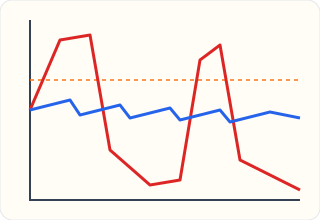
The red line in the picture is boom and bust. The blue line does the same work in smaller pieces and never crosses into the zone where fatigue takes over.
Another way: story
Think of a phone battery. Charging it a little several times a day keeps it working all day. Running it to zero means waiting by the outlet until it has recovered. Pacing is the little-and-often charge.
Another way: steps
Occupational therapists often teach pacing as three Ps. The Royal College of Occupational Therapists' guide to conserving energy names them as pace, plan and prioritize, and notes that people recover faster when they work on a task until they are tired rather than exhausted. Plan is when: the bills at the best time of day. Prioritize is whether: some jobs can be dropped, shortened, or done another way, such as groceries delivered instead of a trip. Pace is how long: blocks and rests.
The American Stroke Association gives the same advice in plain words: plan rest breaks before you feel tired.
Two rules from the last lesson carry over. If an early sign appears in the middle of a block, the sign wins: stop there and rest. If a block ends and you feel fine, the plan wins: rest anyway. A good day is exactly when boom and bust begins.
The ACRM review of rehabilitation evidence (Cicerone and colleagues, 2019) favors strategies that people plan, use and check for themselves. A block plan is checkable: at the end of the task, look at the card. Were the rests taken? Did a sign come early? Write that in the energy log, and adjust the blocks next time.
Holiday cooking is a classic boom-and-bust day. It also has built-in rest time, because the oven does much of the work: the U.S. Department of Agriculture's roasting chart gives about 3 to 3¾ hours at 325°F for an unstuffed 12- to 14-pound turkey.
Picture Dot, a fictional host whose stop point for kitchen work is 20 minutes. The side dishes need about an hour of hands-on work: 60 ÷ 20 = 3 blocks. She writes the card before the turkey goes in: peel 0–20, rest 20–35, chop 35–55, rest 55–70, mix and dish up 70–90. The whole plan takes 90 minutes of the roasting time, so it fits with room to spare. Her daughter carves; that was the prioritize step. Dinner is on time, and the day after is not lost to a crash.
"I'll rest when it's done." By then the rest needed is much longer, and the next day may go with it.
"I don't need the break, I feel fine." Feeling fine at the end of a block is the plan working. Rest anyway.
"A rest means scrolling my phone." A rest is time when attention and body both get a break: sitting quietly, eyes closed, a drink on the porch.
Take the block length from the stop point.
Stop point for sorting: 20 minutes → block: 20.
No block runs past the point where a sign usually comes near.
Divide the work into blocks.
About 60 minutes of work ÷ 20 = 3 blocks.
The same closet; the work is shared out.
Write the rests in, before starting.
0–20 sort coats, 20–35 rest, 35–55 sort shoes, 55–70 rest, 70–90 bag donations.
Written in advance, the rests are not negotiated in the moment.
Put the heaviest block first and set a timer.
Coats first (lifting). Timer: 20 minutes.
The heaviest part gets the most energy, and the timer does the watching.
Write out the boom-and-bust afternoon.
Rake 90 minutes straight → lie down the rest of the day.
The work is done, but the evening and maybe tomorrow are gone.
Apply the three Ps.
Prioritize: front yard only. Plan: after lunch. Pace: 25-minute blocks.
Each P changes a different part of the afternoon.
Write the paced plan.
Rake 0–25, rest 25–40, rake 40–65, rest 65–80, rake 80–105.
Three blocks, two rests, finishing at minute 105.
Check the plan at the end.
Card: rests taken ✓; sign at minute 20 of block 3 → stopped.
The sign won inside block 3, and that goes in the log for next time.
Set the block length.
Block: 15 minutes.
The block ends at her stop point.
Divide the work into blocks.
60 ÷ 15 = 4 blocks.
The cards are shared out across the blocks.
How many rests go in, and where?
A fictional Saturday. Gus needs about an hour of work to clear out his hall closet. His stop point for this kind of task, from his log, is minute 20. Which plan is paced?
A fictional plan. Ivy will repot her houseplants in 3 blocks of 18 minutes, with a 13-minute rest between blocks. Complete her worked plan.
Write down the block length and the number of blocks.
3 blocks of 18 minutes
The block length comes from her stop point for this task.
Count the rests between blocks.
Rests: a
A rest sits between two blocks, so there is one fewer rest than blocks; she finishes on a block.
Add up all the work and all the rests.
Finish: minute f
The plan says when the whole job ends, so the afternoon can be planned around it.
A fictional plan. Work blocks of 15 minutes with a 11-minute rest between them, starting at minute 0. Fill in the start and end minute of the first two blocks.
| Starts at minute | Ends at minute | |
|---|---|---|
| Block 1 | 0 | |
| Block 2 |
A fictional job. Writing thank-you cards will take Mae about 51 minutes of work. Her stop point for writing is minute 17, so each block is 17 minutes. How many blocks does she plan?
Blocks planned: a
Four fictional moves from a pacing plan for a busy afternoon. Write which of the three Ps each one is: **plan**, **prioritize** or **pace**.
| Which P | |
|---|---|
| Bills at 10 a.m., when energy is highest | |
| Skip ironing the dish towels | |
| Recycling in two 15-minute blocks | |
| Order groceries online instead of the trip |
A fictional Thanksgiving morning. While the turkey roasts, you have three blocks of side-dish prep to do: peeling, chopping and mixing. Finish all three blocks without ever starting a block straight after another one.
This task has no paper form; do it on a device.
Lesson test: one question per skill, one attempt each, no hints. Your answers are checked when you submit.
A fictional afternoon. Raking the front yard will take Dot about 54 minutes of work. Her stop point for yard work is minute 18, and she rests 11 minutes between blocks, starting at minute 0. Fill in her paced plan.
| Plan | |
|---|---|
| Block length (minutes) | |
| Blocks | |
| Rests | |
| Finish (minute) |
Pick one task you usually push through. Write a block plan for it on an index card, with the rests in, and set a timer for the first block's end. From memory, say the three Ps. Next: preparing before the clock starts. This is optional practice at home, not treatment and not a test of attention. If anything about your attention, energy or eyesight is new or changing, tell your own clinician. Stopping is always allowed: close the page, and the lesson reopens where you left it.
12. Your turn: Mae has 60 minutes of card-writing and a stop point of 15, step 3
3 rests, one between each pair of blocks.
She finishes on a block, so there is one rest fewer than blocks, written in before she starts.