Back to the on-screen lesson ·
Search a shelf, a page or a drawer along a fixed path from an anchor, left to right and top to bottom, with the far end of every row included.
Paper packet. Every task here also exists on screen, where it is checked automatically; answers written on paper are not assessed by Nydus. When you are back at a device, enter your answers there.
You will search a field along a path — anchor, far end, back to the same edge, top to bottom — and use ticks to find what a search missed.
Everyone has hunted for something that turned out to be in plain view. This lesson is about the way of looking that makes that rarer. It is practice on drawings and invented tasks, not a vision or attention test, and not treatment.
If a therapist has given you a scanning routine of your own — some people are taught always to find the left edge first — use theirs; it was made for you. If anything about your eyesight or your side vision is new or changing, tell your own clinician.
| Term | What it means |
|---|---|
| Field | Everything to be searched: a shelf, a page, a drawer, a room. |
| Search path | An order fixed in advance that visits every part of a field. |
| Anchor | A mark at the edge where each row starts — a finger, a bright strip, a ruler's end — that you return to every time. |
| Far end | The last item of a row, where a hurried search most often turns back. |
| Tick | A mark for each part covered, so the end of a search can be checked. |
The support is physical and cheap. An anchor: before looking, put a mark on the edge where every row begins — a strip of bright tape down the left side of a page, or your hand resting on the left end of a shelf. A finger or a card that moves along the row, so the eyes have something to follow instead of jumping to whatever stands out. A tick or a touch for each row covered, so the end of the search can be checked.
For a big field, say the path aloud as you go — top shelf, left to right; back to the anchor; middle shelf — which keeps your place when attention wobbles.
Left to themselves, eyes go to what is bright, big, central or expected. That is fine for noticing a fire alarm and poor for finding every can on a shelf, because the dull, small and edge items are exactly the ones the eye skips.
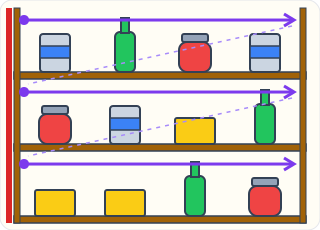
A search path fixes the order in advance, the way a page is read: start at the anchor on one edge, go along the row to its far end, return to the same anchor one row down, and carry on top to bottom until the field is covered. Then check the ticks.
Another way: picture
Picture a lighthouse on a dark coast. Its beam does not flick to whatever looks interesting; it sweeps the whole horizon, end to end, every time. A search path is a slow, deliberate sweep like that.
Another way: steps
The ACRM review of rehabilitation evidence (Cicerone and colleagues, 2019) gives its strongest rating, a practice standard, to visual scanning training for people who miss one side of space after a right-hemisphere stroke. The idea goes back decades. Weinberg and colleagues (1977) put a red line down the left side of the page and taught people to find it before reading each line. Niemeier (1998) asked people to picture themselves as a lighthouse, sweeping their gaze fully from side to side during everyday tasks.
Those studies were done with clinicians, for particular difficulties. This lesson borrows the everyday habit — an anchor, a full sweep, a return — as a way to search a shelf or a page. Completing the items shows the items were done, nothing about anyone's eyes or attention.
The first and last items in a row are where a hurried search most often turns back early, so the path always touches both. The anchor protects the start of each row. The rule to the far end protects the finish.
A search is finished when the field is finished, not when it feels finished. Ticks make the difference visible: a list of 24 lines with 22 ticks has two lines no one looked at, and you can go straight to them.
US supermarkets place products deliberately: manufacturers may pay stores "slotting fees" for shelf space (Federal Trade Commission, 2003), and the eye-level shelves are the ones most people see first. So a search led by the eye stops at eye level, and the store brand on the bottom shelf is often never seen.
Picture Luis, a fictional shopper, looking for a low-sodium chicken soup in a section five shelves high and eight cans wide: 5 × 8 = 40 slots. He rests a hand on the left end of the top shelf as his anchor and reads each shelf to its far end before dropping down. He finds the soup on the bottom shelf, far right: slot 40, the very last on the path, and the one an eye-led glance would have skipped. The path did not make him see better. It made him look everywhere.
"I'll look again, faster." It feels thorough and repeats the same gap. A second, slower pass along a fixed path — especially along the ends of the rows — is the change that finds it.
"It's usually on the second shelf." The missing item is often missing precisely because it is not where it usually is.
"Snaking back along each row saves time." It can, but it leaves the start of every other row without an anchor. Returning to the same edge is the habit that protects the side most easily missed.
Place the anchor before looking.
Anchor: left hand on the far left of the top shelf.
The start is chosen before the eye can be pulled to the brightest item.
Run the top shelf to its far end.
Top: tin, bottle, jar ✓, tin. Found: 1.
The path goes to the last slot even after a jar has been found.
Return to the anchor for the middle shelf.
Middle: jar ✓ (far left), tin, box, bottle. Found: 2.
An end slot — exactly the one a drifting search misses.
Finish the bottom shelf and count.
Bottom: box, box, bottle, jar ✓ (far right). Found: 3 of 3.
The last jar sits in the last slot on the path; 12 slots covered.
Put a ruler under the first line, its end on the left margin.
Anchor: ruler end at the margin, line 1.
The ruler keeps the eyes on one line and marks the start.
Tick each line as the path reaches it.
Line 1 ✓, line 2 ✓, … to line 24.
One tick per line makes coverage something you can count.
Count the ticks at the end.
Ticks: 22. Lines: 24. Missed: 24 − 22 = 2.
The count shows the search was not complete, without guessing.
Go straight to the unticked lines.
Unticked: lines 9 and 24 → read now.
One was the last line: the far end again.
Place the anchor.
Anchor: far left of the top shelf.
Every shelf will start from this same edge.
Count every book a complete path passes.
4 × 6 = 24 books.
A complete path covers every shelf to its far end.
Which book is the last one on the path?
Use a search path on the shelves and mark every squat red jar. There are three of them.
This task has no paper form; do it on a device.
A fictional pantry has 6 shelves with 4 cans on each. Complete the worked count for a search path that covers every can.
Fix the anchor and the direction.
Start: top shelf, far left. Each shelf: left to right.
The path is decided before the count, so the count describes a search that reaches every slot.
Count every can the complete path passes.
6 shelves × 4 cans = a
A complete path visits every slot on every shelf, ends included.
Count what is still ahead after the top shelf.
Still to visit: b
Knowing how much is left stops a search that feels finished from ending early.
You are looking for every mention of *Thursday* on a printed page of community notices. Put the steps of a search path in order.
Number the steps in order (write the number in the box):
A fictional record. Ola searched three lists along a path, ticking each line as the path reached it. Fill in how many lines each search missed.
| Lines on the list | Ticks counted | Lines missed | |
|---|---|---|---|
| Shopping list | 30 | 26 | |
| Phone numbers | 16 | 14 | |
| Delivery note | 27 | 26 |
Four fictional searches that each missed something. For each, write the part of the path that would have found it: **start at the anchor**, **go to the far end**, **back to the same edge** or **do the last row**.
| Fix | |
|---|---|
| Began in the middle of the shelf | |
| Stopped each row before its end | |
| Snaked back along each row from the right | |
| Stopped before the bottom row |
Four everyday searches you have not practiced here. Match each to the path that covers it completely.
| Line by line from the left margin | Row by row, from the entrance end each time | Compartment by compartment, lifting each item | Top row left to right, then each row below | |
|---|---|---|---|---|
| A printed bus timetable | ||||
| A parking lot, looking for your car | ||||
| A kitchen drawer of utensils | ||||
| A community bulletin board |
Lesson test: one question per skill, one attempt each, no hints. Your answers are checked when you submit.
A fictional bookcase has 3 shelves of 5 books. A search path starts at the far left of the top shelf, runs each shelf left to right, and returns to the far left for the next. Write the number of each book along the path (the first book is 1).
| Number on the path | |
|---|---|
| Top shelf, far right | |
| Middle shelf, far left | |
| Middle shelf, far right | |
| Bottom shelf, far right |
Choose a shelf or drawer at home. Put your hand on its left end as an anchor and search it once along the path, touching each item. Without looking back, name the two places in a row a drifting search most often misses. Next: check the page in order. This is optional practice at home, not treatment and not a test of attention. If anything about your attention, energy or eyesight is new or changing, tell your own clinician. Stopping is always allowed: close the page, and the lesson reopens where you left it.
12. Your turn: a bookcase has 4 shelves of 6 books, step 3
Bottom shelf, far right: book 24.
The path ends at the far end of the last row, the spot a hurried search most often skips.