Back to the on-screen lesson ·
Delayed recall: putting a filled gap between studying and writing back, and not undoing it with a glance or by saying the list over.
Paper packet. Every task here also exists on screen, where it is checked automatically; answers written on paper are not assessed by Nydus. When you are back at a device, enter your answers there.
You will plan a delayed check, measure the clean gap a trial really had, restart a gap after a glance, and run one delayed trial with the list kept out of sight and out of rehearsal.
The forgetting curve drops fastest just after studying. A check made at that moment reads the top of the curve, where things still look fine. This lesson moves the check later, and is about making sure the wait really happened. You need the blank-page habit from the first lesson; everything else is new.
| Term | What it means |
|---|---|
| Immediate recall | Writing a list back as soon as it disappears. |
| Delayed recall | Writing it back after a gap, or delay. |
| Filled gap | A gap spent on something unrelated to the list. |
| Rehearsal | Saying the list over to yourself, which keeps it in mind and so quietly cancels the gap. |
| Clean gap | The time since the list was last seen, heard or said over. |
Straight after studying, the last few items on a list are still being held in mind. They come back almost for free, which makes immediate recall look better than it will be later.
Put a gap in, fill it with something else, and that easy source is gone. Every item now has to be fetched. That is the kind of remembering you need when the grocery list is on the kitchen counter and you are in aisle nine.
The gap is only real if the list stays out of it: out of sight, out of your ear, and out of rehearsal. A glance back, however quick, turns the trial into immediate recall again. So the gap is always measured from the last time the list was in mind, not from when you first studied it.
Another way: story
Someone is told a gate code at the front desk and repeats it all the way down the hall. At the gate it works. The next morning, with no hallway to repeat it in, it is gone. Only the second morning was a delayed trial.
Another way: steps
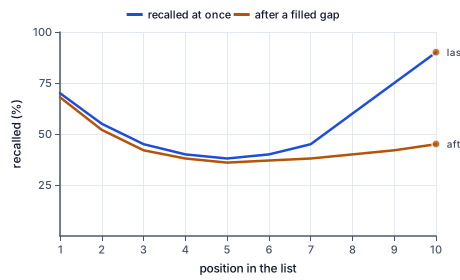
The chart sketches the pattern: recalled at once, the last words are easy; after a filled gap, that easy advantage is gone.
In a classic experiment (Murray Glanzer and Anita Cunitz, 1966), people heard lists of words and wrote them back. With immediate recall, the last few words were remembered best. When people first counted backward for thirty seconds, that advantage for the last words disappeared, while the first words were hardly affected. A short filled gap removed the easy source and left the fetched one.
Jeffrey Karpicke and Henry Roediger (2007) looked at practice rather than testing. Students learning word pairs did better two days later when their first attempt to recall a pair came after some delay instead of straight away. An immediate attempt is easy and teaches little; an attempt that has to fetch the answer does more work. These are findings about groups of students and word lists, not a promise about any one list of yours.
To check the plan, ask one question of the moment you write: how many minutes ago was the list last in mind? If the answer is shorter than the gap you planned, the trial was not the one you meant to run.
The delay in this course's trials is timed on your device, against its own clock. A timing is comparable only with your own, on the same device; nothing here puts it beside anybody else's. A trial interrupted by the doorbell is simply a trial that was interrupted.
Many workplaces give new staff a door code or a locker combination on the first morning. The natural move is to say it over all the way to the door. It works at the door, and the gap that matters, overnight, has not been practiced at all.
Work through a fictional case. Luis is given a six-digit code at 8:05. He says it over for the four-minute walk, which keeps it held, not fetched. Then he tries a better plan. He writes the code on a card, reads it once, puts the card in his pocket and spends ten minutes on his forms without thinking of it. At 8:19 he writes the code from memory on a sticky note and only then checks the card. His clean gap was ten minutes, not fourteen, because the walk had the code in it. That one attempt is what tells him whether the code will still be there tomorrow.
The natural thing to do during a wait is to keep the list fresh: say it over, or peek once to be safe. Both feel responsible, and both put the list back in front of you, so the attempt that follows tells you nothing about fetching.
The opposite mistake is to treat the gap as a ritual about the timer. The minutes matter only because of what is not happening in them; twenty minutes spent reciting the list is a gap of zero.
Note the study time.
Errand list put away at minute 12
The gap is counted from here, so it must be written first.
Add the planned gap.
12 + 15 = 27, so the check goes at minute 27
Each list keeps its own clock.
Write the check time where you will see it.
Sticky note: errands, write back at :27
A planned check is less likely to be replaced by a peek.
Notice the glance and its time.
Ten-minute gap from minute 30; glance at minute 35
The glance has put the list back in front of you.
Restart the gap from the glance.
35 + 10 = 45, so the new check is at minute 45
The gap is measured from the last time the list was seen.
Fill the new gap and write back.
Minutes 35 to 45: dishes, no list. Minute 45: write back, then check.
The attempt is delayed recall again.
Find the last time the list was seen.
Last sight: minute 46
A glance restarts the gap.
Add the full gap to the last sight.
A practice card says: study the list, wait 4 minutes, then write it back. What should fill the 4 minutes?
A list is studied at minute 15 of an hour with a planned gap of 15 minutes. At minute 21 the list is glanced at. Complete the worked plan for when the check can happen.
Find the check time the plan first had.
15 + 15 = a
Without a glance, the check comes one gap after studying.
Restart the gap from the glance.
Last sight: minute 21
The gap is measured from the last time the list was seen.
Add the full gap to the glance minute.
21 + 15 = b
A clean gap needs the whole wait again, not the minutes left.
A delayed trial, for practice. Study the six words; then a 45-second wait begins. Spend it counting backward from 100 by threes, aloud or in your head. When the wait ends, write back what you can. This is practice, not a test of your memory.
Ask someone to read you the list, then cover it and write what you remember:
Three short lists are studied during an hour. Each gets a delayed check. Fill in the minute of the hour each check falls on.
| Studied at minute | Gap in minutes | Check at minute | |
|---|---|---|---|
| Grocery list | 5 | 10 | |
| Names of new coworkers | 20 | 20 | |
| Bus stops | 34 | 10 |
A fictional practice log. Each trial planned a gap of 15 minutes. Trial 1: nothing about the list for 15 minutes. Trial 2: a glance at the list 4 minutes before writing. Trial 3: the list said over under the breath until the moment of writing. Fill in the clean gap each trial really had, and whether it counts as delayed.
| Clean gap in minutes | Delayed or not | |
|---|---|---|
| Trial 1 | ||
| Trial 2 | ||
| Trial 3 |
A fictional first day at a warehouse. Kim is given a six-digit door code at the front desk. She repeats it under her breath for the 6-minute walk to the stockroom, then spends 6 minutes signing forms at the stockroom desk without thinking of it, then tries the door. Fill in how long her clean gap was, how long the whole wait was, and whether the attempt at the door was delayed recall.
| Whole wait in minutes | Clean gap in minutes | Delayed recall? | |
|---|---|---|---|
| Kim's attempt at the door |
Lesson test: one question per skill, one attempt each, no hints. Your answers are checked when you submit.
Run one delayed trial. The card says: study the list, then wait at least 20 minutes before writing it back. Each press of the task button spends five minutes on something unrelated; a glance at the list starts the wait again from zero. Finish with the list written back after a proper gap.
This task has no paper form; do it on a device.
Without looking back: name the three places a list must stay out of during a gap, and say what a glance does to the wait. Next: what a cue does, and how to record a trial that used one. A trial here is practice, not a test of your memory. What is kept is the list you wrote back on this device today, and it is never set beside anyone else's. You can stop at any point: closing the page is the whole of stopping, and the lesson reopens where you left it.
12. Your turn: a list is studied at minute 40 with a gap of 10 minutes, and you glance at it at minute 46. When can the check happen?, step 2
46 + 10 = 56, so the check goes at minute 56
A clean gap needs the whole wait again.