When order is part of what is remembered: telling a sequence from a set, chaining and chunking, and scoring an attempt place by place.
Paper packet. Every task here also exists on screen, where it is checked automatically; answers written on paper are not assessed by Nydus. When you are back at a device, enter your answers there.
1. What you will learn
You will decide when order matters, rebuild a sequence in an ordered trial, chain its steps, and score an attempt place by place so that an order slip is seen for what it is.
2. Where this starts
Every trial so far let the words come back in any order. That was right for those lists. This lesson is about the lists where the order is the point, and it uses the delayed trial and the idea of a miss from earlier lessons: an order slip is a miss of its own kind.
3. Words this lesson uses
Term
What it means
Sequence
A list whose order is part of the task.
Set
A list whose order does not matter.
Serial position curve
A graph of how often each position in a list comes back; usually high at both ends.
Primacy and recency
The advantage of the first items, and of the last.
Chaining
Linking each item to the next, so each one cues the one after.
Chunking
Grouping items, as a phone number is printed 3-3-4.
4. First ask whether order matters
Before practicing a list, ask one question: what would go wrong if two parts swapped places? In directions, you take the wrong turn. In a locker code, the locker stays shut. In a recipe, the eggs go in after the pan is already smoking. Those are sequences, and practice has to rebuild the order.
In a grocery list, nothing goes wrong: the bag ends up the same. Practicing the order there is effort spent on nothing.
When order does matter, an ordered attempt is checked place by place, and an order slip is counted as its own thing rather than as a missing word, because it is a different problem with a different fix. A forgotten step needs the step; a misplaced step needs the link to its neighbor.
Another way: diagram
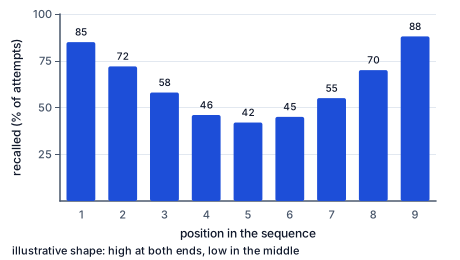
An illustration of the typical shape of recall across a nine-item sequence, in percent of attempts in which each position came back. The first items come back often, the primacy effect, and so do the last, the recency effect; the middle positions, fourth to sixth, come back least. Extra practice pays most in the middle.
The bar chart draws the bright ends and the dim middle as heights: the middle positions come back least.
Picture a line of nine beads. The beads at both ends are bright; the beads in the middle are dim. That is roughly what a record of a practiced sequence shows: the start and the end come back more often than the middle.
Another way: story
Someone gives directions: left at the bakery, right at the church, over the bridge, left at the gas station. The listener reaches the bakery sure of the first turn and the last, and unsure what came in the middle.
5. The middle, and two ways to hold an order
In classic studies of list learning (Bennet Murdock, 1962, among many), the first few items and the last few came back more often than those in the middle. The early advantage is called primacy, the late one recency. So the middle of a sequence is where extra practice pays.
Two plain methods help hold an order:
Chaining: link each item to the next, so that reaching one gives you the one after. It suits steps that set each other up: the flour and eggs are whisked, which lets you pour, which lets you flip.
Chunking: group a string into a few pieces. US phone numbers are printed as 3 digits, 3 digits and 4 digits, so ten digits become three groups to hold.
Whichever you use, practice by rebuilding the order from memory, then checking it place by place.
One more habit follows from the curve. If every practice starts at step one, the first steps get the most rehearsal and the middle gets the least, which is the reverse of what it needs. So now and then start from the middle: what comes after step four? That is still retrieval, and it sends the effort where the slips happen. A delayed attempt, with a clean gap as in the earlier lesson, shows whether the middle links hold once the list has left your mind.
6. Scoring an ordered attempt, step by step, and how to check it
Write the true order with numbered places.
Count every step you wrote, wherever it sits. That is what came back.
Count the steps in their own place. That is what came back in order.
Subtract to find the order slips.
Fix each kind of miss its own way: look up a forgotten step; chain the two neighbors of a slip.
To check the scoring, add the steps in place, the slips and the forgotten steps. The total must equal the length of the sequence.
7. Hands-Only CPR, in order
The American Heart Association's Hands-Only CPR has two steps for a teen or adult who suddenly collapses: call 911, then push hard and fast in the center of the chest, at 100 to 120 pushes a minute, until help arrives. First-aid courses add a step before both: make sure the scene is safe. The order is the point: calling first gets help moving while the pushing starts. The AHA's own course is the place to learn the skill itself; recall practice here is only about keeping the order.
Work through a fictional case. After a workplace class, Lena writes the steps from memory each evening for a week. On Tuesday she writes all four but puts call 911 after the pushing. Scored place by place: 4 recalled, 2 in place, 2 slips. Her fix is a chain for the two neighbors: phone first, then hands. By Friday all four are in place.
8. Treating every list the same way
Practicing the order of a set. A packing list recited in the same order every time spends effort on an order nobody needs.
Scoring an ordered attempt like a free one. Four of four steps recalled sounds complete, but if two are swapped the directions still get you lost. An ordered attempt is scored place by place.
Drilling from the top every time. Starting at the first step each time gives the start the most practice, and it already had the advantage. Begin some practice in the middle.
9. Chaining a set of directions
Write the steps in their true order.
1 left at the bakery, 2 right at the church, 3 over the bridge, 4 left at the gas station
Numbered places are what the practice rebuilds.
Link each step to the next.
Bakery bread → church bells → bells ring over the bridge → bridge leads to the gas pumps
Each link makes one step the cue for the next.
Write the order from memory and score by place.
Written: bakery, bridge, church, gas station → 2 in place, 2 slips
The slip is in the middle, as the serial position curve predicts.
Strengthen the weak link.
New link said aloud: after the bells, the bridge
A slip is fixed by linking the neighbors, not by rereading all four.
10. Chunking a phone number
Write the number as it is printed.
(555) 014-2368
Ten digits in a row are hard to hold in order.
Treat each printed group as one piece.
555 / 014 / 2368
Three groups are fewer things to keep in order than ten digits.
Recall group by group, then check place by place.
Written: 555 014 2386 → last group has a slip (86 for 68)
The check finds the exact place of the slip.
11. Your turn: a seven-step sequence is written back with all seven steps, but steps 3 and 4 have swapped. Score it.
Count the steps written.
7 of 7 recalled
A free count ignores position.
Your turn: work this step out. Its working is at the end of the packet.
Count the steps in their own place.
12. Guided practice
Which of these lists has to be recalled in order?
The steps to reset a home Wi-Fi router
Chores to finish before the weekend
Topics to mention in a birthday card
Snacks to bring to a soccer game
13. Guided practice
An ordered practice attempt at a 7-step sequence. The last step was never written, and two neighboring steps in the middle were swapped. Complete the worked scoring, place by place.
Count the steps written, wherever they were placed.
Steps recalled: a of 7
A free-recall count ignores position; the last step is missing, not misplaced.
Count the steps sitting in their own place.
In the right place: b
The swap moves two steps out of place at once, and the missing step's place is empty.
Find the order slips.
a − b = 2 steps out of place
Recalled but misplaced is a different miss from forgotten: the slip needs a link between two neighbors, the missing step needs the step.
14. Guided practice
An ordered trial, for practice: planting a seed, in six words. Study them in order; after a short wait, write them back in the same order, one per box. This is practice, not a test of your memory.
Ask someone to read you the list, then cover it and write what you remember:
15. Practice
A fictional practice record: a nine-step sequence was practiced on 10 evenings. The first step came back in its place 8 times, the fifth (middle) step 3 times, and the last step 8 times. How many more times did the first step, and the last step, come back than the middle one?
The first step came back x more times than the middle step, and the last step y more times.
16. Practice
Build a chain for the order of steps in resetting a fictional home Wi-Fi router: unplug the router, wait 30 seconds, plug it back in, wait for the lights to settle, reconnect the laptop. For each step, name the step it sets up.
Sets up
Unplug the router
Wait 30 seconds
Plug it back in
Wait for the lights
17. Somewhere new
The American Heart Association's Hands-Only CPR for a teen or adult who suddenly collapses is: call 911, then push hard and fast in the center of the chest until help arrives. First-aid courses add a step before both: make sure the scene is safe. Sam, a fictional learner, writes the steps from memory as: call 911, check the scene is safe, push hard and fast in the center of the chest, keep going until help arrives. How many steps did he write, and how many are in their own place?
Steps written: x. In their own place: y.
18. Lesson test
Lesson test: one question per skill, one attempt each, no hints. Your answers are checked when you submit.
19. Test question
Four lists. For each, say whether the order matters, and choose a way to practice it.
Order matters?
How to practice it
Directions from the bus stop to a job interview
A new 10-digit phone number
Things to pack for a camping trip
Guests coming to a party
20. What you can do now
Without looking back: what one question tells a sequence from a set, and which part of a sequence needs the most practice? Next: bringing an item back after growing gaps. A trial here is practice, not a test of your memory. What is kept is the list you wrote back on this device today, and it is never set beside anyone else's. You can stop at any point: closing the page is the whole of stopping, and the lesson reopens where you left it.
Working for the steps left to you
11. Your turn: a seven-step sequence is written back with all seven steps, but steps 3 and 4 have swapped. Score it., step 2