Back to the on-screen lesson ·
Every quantifier is an interval of counts, and two of them together can pin a number down surprisingly hard.
Paper packet. Every task here also exists on screen, where it is checked automatically; answers written on paper are not assessed by Nydus. When you are back at a device, enter your answers there.
You will turn the words all, none, some, most, at least one, not all and fewer than half into the interval of counts each one permits, check both endpoints separately, and combine two quantified sentences by keeping only the counts they both allow. You will also be able to say, for each of them, what single case or what count would show the claim false.
In the last lesson you turned a sample into an interval of counts the whole group could hold. This lesson does the same thing to a sentence: most of them came back is not vague, it is an interval, and it can be written down.
| Term | What it means |
|---|---|
| Quantifier | An expression specifying how many members of a stated group have a property. |
| Scope | The group and property to which the counting claim applies. |
| Intersection | The counts satisfying both of two constraints. |
| Negation | A claim true exactly when the original claim is false. |
| Counterexample | A verified case or count incompatible with a claim. |
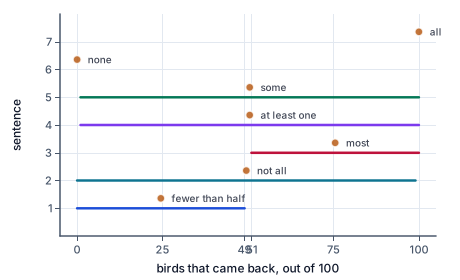
The chart draws the table below as segments on one axis: where two segments overlap, both sentences can be true together.
Out of a hundred birds, here is what each word permits.
| Sentence | Smallest count | Largest count |
|---|---|---|
| All of them came back | 100 | 100 |
| None of them came back | 0 | 0 |
| Some of them came back | 1 | 100 |
| At least one came back | 1 | 100 |
| Most of them came back | 51 | 100 |
| Not all of them came back | 0 | 99 |
| Fewer than half came back | 0 | 49 |
Two rows are worth arguing about.
Some permits all. Some of the birds came back is still true if every bird came back. That feels wrong, because when people say some in conversation they usually mean not all. In this course the word means at least one, and the items say so in the prompt.
Most permits all too. Most of them came back does not stop at 99. It stops at nothing: it only says the count is more than half.
The useful consequence is that these words can be combined, and each one narrows the interval. Most came back but not all leaves 51 to 99 — a sentence built from two words everybody calls vague, which pins the count down to under half the possibilities.
Another way: picture
Draw a line numbered 0 to 100 and shade what each word allows. All is a single dot at the right-hand end, none a single dot at the left. Some shades everything but the left-hand dot; not all shades everything but the right-hand one. Most shades the right-hand half, starting just past the middle.
Another way: steps
For any quantified sentence about a group of $N$:
This lesson fixes the meaning of its counting words before calculating. Here some means at least one, most means strictly more than half, and all includes every member of the stated group. Everyday speakers can use these words differently or convey additional suggestions. A listener may reasonably hear some as suggesting not all. The useful response is to distinguish what follows under our declared convention from what a speaker may have intended. Do not accuse an ordinary speaker of contradicting a technical definition they never adopted.
The group itself must also be fixed. Most of the surveyed riders is a claim about respondents. Most riders in the city is a different claim about a larger population. Even if exactly 70 of 100 respondents support a fare change, that does not make the citywide quantifier true by arithmetic alone. The previous lessons explain what further sampling evidence would matter. Translating a quantifier correctly cannot repair a switch in the group being counted.
For a finite nonempty group of N members, some permits the integers from one through N. Not all permits zero through N minus one. Some but not all is the intersection of those ranges. If N is one, the intersection is empty: its only member cannot both have and lack the property. That is a useful boundary test. A method should work on small groups as well as on the convenient hundred-member examples used in a table.
Most has minimum floor(N divided by two) plus one. The floor instruction means take the greatest whole number not exceeding the division result. For nine members, half is 4.5 and the smallest majority is five. For ten, half is five and the smallest majority is six. Adding one to the unrounded half of an odd group would wrongly produce 5.5 people. Counts require integers, and strictly more than half is the underlying rule.
The upper limit for most is N under the convention here. Most and all are therefore compatible. Most and fewer than half are incompatible when they describe the same property of the same group at the same time. However, most of the morning group and fewer than half of the evening group can both be true. Never intersect ranges before checking that they concern the same count. Shared vocabulary does not make two differently scoped claims contradictory.
Empty groups require care beyond our nonempty counting tasks. In classical logic, all members of an empty group have a property is vacuously true, whereas some members have it is false. Thus all does not generally imply some without an existence assumption. The examples here state positive group sizes, so that assumption is available. Recognizing why it is available prevents the familiar diagram from becoming an unrestricted rule about every possible domain.
Negating a claim means excluding exactly the cases that make it true. For a group of 20, all have the property means a count of 20. Its negation, not all have the property, allows zero through 19. That is not the same as none have the property, which permits only zero. The first leaves many mixed groups available; the second excludes every positive case. A common argumentative mistake turns one exception into a claim of universal failure.
Some have the property permits one through 20. Its negation permits only zero, so not some is equivalent to none under this lesson's convention. Most permits 11 through 20. Its negation permits zero through ten, including an exact tie. Fewer than half permits zero through nine. Therefore not most is not equivalent to fewer than half: the tie belongs to the first range but not the second. Check the boundary rather than relying on a phrase that sounds like an opposite.
Combining two claims with and requires an intersection: keep each count that satisfies both. At least six and at most nine permits six, seven, eight, and nine. Combining claims with an inclusive or takes a union: retain counts satisfying either, including those satisfying both. Some unions have gaps and cannot be represented by one uninterrupted interval. Exactly zero or exactly twenty permits two points. Calling every possible quantified statement a single interval would conceal that distinction; the simple quantifiers taught in this lesson are interval-shaped.
To refute a universal positive claim, one verified negative member is enough. To refute a universal negative claim, one verified positive member is enough. To refute an existential positive claim, the relevant group must contain no positives. That may be hard in an open-ended domain, but it can be straightforward in a fixed tray of six objects that are all inspected. Some is not inherently untestable, and a confirmed existential claim can settle an important dispute about whether anything of a specified kind exists.
Refuting most requires showing that the total positive count is no greater than half. A single negative observation normally leaves the majority question open in a large group. But it can settle it in a group of two: with one verified negative, at most one can be positive, and one of two is not most. The force of a counterexample depends on the quantifier and the known size of the domain, not on a blanket rule that single observations never matter.
Finally distinguish a count incompatible with a claim from a count merely surprising to its author. A count of 100 supports most out of 100 under the stated convention, even if the writer expected 60. A count of 50 refutes it, even if half feels close enough. Close numerical estimates and exact logical truth conditions serve different purposes. When an informal report intends roughly half or a large majority, it should specify an appropriate tolerance or threshold rather than borrowing the exact rule without explanation.
A community workshop has 41 battery packs in a fixed inventory. Its report says that most passed a specified capacity check, but not all passed. Here most means strictly more than half. Let k count packs that passed, and assume each pack either passed or failed that same check. Half of 41 is 20.5, so the lowest possible passing count is 21. Not all excludes 41, leaving an upper limit of 40. The compatible passing counts are therefore the integers from 21 through 40.
The failures are the complementary count 41 minus k. At the greatest passing count, 40, only one failed. At the smallest passing count, 21, twenty failed. Thus the report permits one through twenty failures. This calculation does not show that the workshop has nineteen failures, nor that its most likely count lies halfway between the endpoints. It translates the supplied constraints without adding a probability model.
The manager adds that at least three packs failed. That new statement caps the passing count at 38. Intersecting this cap with the earlier range gives 21 through 38 passes, or three through twenty failures. The extra information narrows the upper passing endpoint while leaving its lower endpoint unchanged.
Before using the result for purchasing, check what passed means. If the first sentence concerns a capacity check and the later sentence concerns damaged cases, the two properties need not be complements. A pack can pass capacity and still have a damaged case. The subtraction is justified only because this scenario explicitly refers to the same binary check for every pack in the same fixed inventory.
*Reading some as not all. Ordinary speech implies it; the word itself does not say it. When a writer means some but not all, the honest thing is to write both words, and that is what the second half of most but not all* is doing.
Thinking half is most. Fifty out of a hundred is exactly half, and most means more than half. One bird decides it.
Treating quantifiers as too vague to check. They are the least vague part of most sentences. Each one has two endpoints, and both can be written down.
*Refuting all with a count instead of a case. Ninety-nine of them came back does refute all of them came back* — but what does the work is the one that did not, and looking for that single case is the habit worth having.
Fix the count being discussed.
Nine entries; k is the number accepted.
The group size determines the majority boundary.
Find half the group.
9 ÷ 2 = 4.5.
Most means strictly exceeding this value.
Use a whole-number count.
The smallest allowed k is 5.
There cannot be half an accepted entry.
Check the upper endpoint.
All nine may be accepted.
Most does not exclude all under the stated convention.
Report the whole permitted range.
5 through 9, inclusive, with integer counts.
Every count in this range exceeds half and no other count does.
State the original claim.
Most of 20 lamps work.
We first identify the positive claim's exact truth conditions.
Translate that claim.
Working count 11 through 20.
Exactly ten is only half.
Remove those counts from the possible domain.
The domain is 0 through 20; remaining counts are 0 through 10.
Negation permits exactly the counts the original excludes.
Compare fewer than half.
Fewer than half permits 0 through 9.
A tie distinguishes this expression from not most.
Test the distinguishing case.
10 working: not most is true; fewer than half is false.
One boundary count demonstrates that the two expressions are not equivalent.
Name the fixed group and binary outcome.
41 packs, each either passing or failing the same check.
Only complementary outcomes justify subtracting one count from the total.
Translate most pass.
At least 21 pass.
Twenty is below half of the odd-sized group.
Translate not all pass.
At most 40 pass.
At least one failure excludes the full passing count.
Intersect and convert to failures.
21–40 pass; 1–20 fail.
Each failure count equals 41 minus a compatible passing count.
Add at least three failures.
At most 38 pass.
Three known failures remove the previously possible counts 39 and 40.
State the updated intersection.
21–38 pass; 3–20 fail, all endpoints included.
The new constraint changes one endpoint without determining a unique count.
Fix the group and threshold.
15 seedlings; half is 7.5.
The inequality concerns this full tray rather than a sample.
Choose the greatest integer below the threshold.
At most 7 sprouted.
Eight would exceed half.
Check the lower endpoint.
A hundred birds were ringed. Someone says: Most of the hundred birds we ringed came back. Taking that sentence exactly as it stands, how many of the hundred came back? Give every number it permits.
This task has no paper form; do it on a device.
Of 17 entries, most qualify but not all qualify. Use most to mean strictly more than half. Complete the inclusive count endpoints.
Find the majority threshold.
Half the group is half.
Strict majority requires a count above this boundary.
Choose the first whole number above half.
Minimum qualifying count minimum.
Counts of entries must be integers.
Exclude the complete group.
Maximum qualifying count maximum.
Not all requires at least one entry to fail to qualify.
A hundred birds were ringed. Match each sentence to the counts it permits.
| Exactly 100 | Exactly 0 | Anything from 1 to 100 | Anything from 51 to 100 | Anything from 0 to 99 | |
|---|---|---|---|---|---|
| All of them came back | |||||
| None of them came back | |||||
| Some of them came back | |||||
| Most of them came back | |||||
| Not all of them came back |
A hundred birds were ringed. The report says: most of them came back, but not all of them did. How many came back? Give every number the two sentences together permit.
This task has no paper form; do it on a device.
Out of a hundred birds ringed, the report claims most of them came back. Which count would show that claim false?
A test rig runs $42$ pumps to destruction. The engineer's note says: at least one of them failed early, and not all of them did. How many failed early? Give every number the note permits.
This task has no paper form; do it on a device.
Lesson test: one question per skill, one attempt each, no hints. Your answers are checked when you submit.
There are 35 crates. Most pass one binary check, but at least four fail it. Most means strictly more than half. Give the smallest possible passing count, largest possible passing count, and largest possible failing count.
Minimum passing minimum; maximum passing maximum; maximum failing failures.
You can write any quantified sentence as an interval of counts and say what would refute it. Tell someone why exactly half is not most, and why some does not rule out all. Next: a table with four boxes in it, which is where evidence about two things at once has to be written down before it can be argued about.
12. Fewer than half of 15 seedlings sprouted, step 3
0 through 7 are permitted, inclusive.
Fewer than half does not assert that any seedling sprouted.