Back to the on-screen lesson ·
A counter-reason is about the claim and pushes against it; a bare no or a remark about the speaker is not one.
Paper packet. Every task here also exists on screen, where it is checked automatically; answers written on paper are not assessed by Nydus. When you are back at a device, enter your answers there.
You will pick out a reason against a claim from a reason for it, a flat no and a remark about the speaker, map reasons for and against with two kinds of arrow, and write a disagreeing reply using ~ for not.
Last week's letter said the summer fair should move from the park to the beach.
The fair should stay in the park.
The beach parking lot holds forty cars, and the park's holds four hundred.
At high tide the sea covers the beach right up to the wall.
Whoever wrote last week's letter obviously knows nothing about fairs.
I have been to every summer fair since I was small.
You know that disagreeing is not accusing, and that a reason must reach its claim. Put those together and you have a counter-reason: a way to disagree that is about the claim.
| Term | What it means |
|---|---|
| This lesson's terms | A counter-reason is a reason against a claim: if it is true, the claim is less likely to be true, or less worth doing. A denial is just saying no with no reason. In symbols, ~ means not: if O is the shop is open, then ~O is the shop is not open. |
| Supported conclusion | The conclusion the stated reasons reach, including the limits on its group, time or conditions. |
Claim: the picnic should be at the beach. Four replies:
Only the first is a counter-reason. It is about the picnic, and if it is true, the beach looks like a worse idea. The second is a reason too, but it points the other way: it supports the claim. The third is about the person, not the picnic. The fourth is a denial: it disagrees and gives nothing to think about.
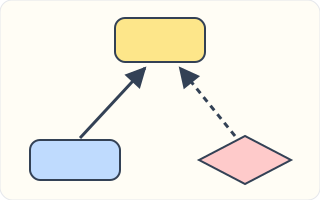
In a map, a counter-reason gets its own arrow into the claim, drawn dashed so you can see at once that it pushes the other way.
A counter-reason does not end the argument. Now there are reasons on both sides, and you weigh them: no shade on a hot day may matter more than swimming — or someone may answer it with we'll bring the big umbrellas.
A reply that disagrees is claiming the opposite. If the claim is O, the reply argues for ~O, not O.
Another way: picture
A see-saw with the claim in the middle. Reasons for sit on one end, counter-reasons on the other. A remark about the person does not sit on the see-saw at all.
Another way: steps
For each reply: is it about the claim? If so, does it push for or against? If it is about the person, or just no, it is not a counter-reason.
A counter-reason counts against a claim or plan. It does more than announce disagreement. If somebody proposes holding a picnic in the field, 'I disagree' tells us their position but not why. 'The field is being sprayed that morning' offers a relevant reason against using it then. The reason gives the first speaker something they can check or answer.
Find the exact target. A counter-reason might challenge a fact, a link, or a cost the proposal leaves out. 'The field is not open on Sunday' challenges whether the plan is available. 'Being larger does not mean it has shade' challenges a link between size and comfort. 'The longer walk excludes a member who cannot manage it' adds a consideration the original argument missed. These replies do different jobs, but all address the proposal.
A reason against a plan does not always settle the decision. A farther venue may be less convenient but still be the only accessible one. Put reasons on both sides before weighing them. Do not erase the first reason simply because a counter-reason appears. Sometimes a change to the plan answers both sides, such as arranging transport to the accessible venue.
Attacking the speaker does not perform this work. 'You always choose badly' gives no information about this venue. Even if somebody made mistakes before, the present claim needs its present support examined. Write the proposal at the top of your page, then write a reply that could change the decision if its factual part were true.
Claim: We should get a puppy this summer. Which reply gives a reason against it?
The supported answer is: We are away for three weeks in August, and nobody could look after it.
A reason against is about the claim and, if true, makes it less likely or less worth doing. We are away for three weeks in August, and nobody could look after it. does that. A puppy would get us all out walking every day. supports the claim instead; the remark about the person is not about the claim; and the flat denial gives no reason at all.
Claim: The match should go ahead on Saturday. Which reply gives a reason against it?
The supported answer is: The pitch is under water, and the groundskeeper says it needs three dry days.
A reason against is about the claim and, if true, makes it less likely or less worth doing. The pitch is under water, and the groundskeeper says it needs three dry days. does that. Both teams are free on Saturday and the referee is booked. supports the claim instead; the remark about the person is not about the claim; and the flat denial gives no reason at all.
Claim: The new water slide is safe for small children. Which reply gives a reason against it?
The supported answer is: The slide's own sign says riders must be at least 120 centimeters tall.
A reason against is about the claim and, if true, makes it less likely or less worth doing. The slide's own sign says riders must be at least 120 centimeters tall. does that. Lifeguards watch the bottom of the slide all day. supports the claim instead; the remark about the person is not about the claim; and the flat denial gives no reason at all.
Claim: The garden lights should stay on all night. Which reply gives a reason against it?
The supported answer is: Lights left on all night keep the neighbors awake and confuse the moths.
A reason against is about the claim and, if true, makes it less likely or less worth doing. Lights left on all night keep the neighbors awake and confuse the moths. does that. The lights make the path safe for anyone coming home late. supports the claim instead; the remark about the person is not about the claim; and the flat denial gives no reason at all.
Claim: The library should get rid of its old encyclopedias. Which reply gives a reason against it?
The supported answer is: Many of the old maps and pictures in them are in no other book the library has.
A reason against is about the claim and, if true, makes it less likely or less worth doing. Many of the old maps and pictures in them are in no other book the library has. does that. They fill two whole shelves that new books could use. supports the claim instead; the remark about the person is not about the claim; and the flat denial gives no reason at all.
Claim: the pool should stay open until nine in summer. Sort each sentence.
People who work late would finally get a swim. / The lifeguards would need an extra shift, and there is no money for it. / Only lazy people swim at night. / The evenings are the warmest time to swim. / You just want to show off your diving. / a reason for the claim / a reason against the claim / about a person, not the claim
People who work late would finally get a swim and the evenings are the warmest time to swim are reasons for. The lifeguards would need an extra shift, and there is no money for it is a reason against. Only lazy people swim at night and you just want to show off your diving are about people, not about the opening hours.
Kit claims: our street party should have a bounce house. Mark every reply that gives a reason against the claim.
The street slopes, and a bounce house has to stand on flat ground. / You would say that — you love bouncing. / Hiring one costs more than the whole food budget. / The little ones would love it. / No way. Not happening.
The street slopes, and a bounce house has to stand on flat ground is a reason against. Hiring one costs more than the whole food budget is a reason against too. The little ones would love it is a reason for; you would say that and no way give no reason.
A news story: the city council plans to turn the old bus station into a covered market. Which of the comments printed under the story is a reason against the plan?
The supported answer is: There are already two markets within five minutes' walk, and both have empty stalls.
A reason against is about the plan and, if true, makes it look less wise. There are already two markets within five minutes' walk, and both have empty stalls does that: a third market may not find stall-holders. Liking the old name is not about whether a market would work; calling the city council names is about people; and more jobs for local people is a reason for the plan.
A club proposes keeping its room open until six instead of five. The supporting reason is that twelve members finish other activities at five and would gain an hour to meet. A counter-reason is that the building's supervised access ends at five-thirty. The second fact bears directly on whether the proposed extra hour can actually be offered.
Do not confuse that counter-reason with 'The person suggesting it is bossy'. The access limit would matter whoever made the proposal. A personal complaint might need attention in a different conversation, but it does not establish when the building can be used.
Map the two sides. More time for twelve members supports the later opening. The supervision limit counts against opening until six under the present arrangements. The club now has a useful question: can supervision be extended, or could the meeting run from five to five-thirty? Half an hour is not the whole requested hour, but it may answer part of the need.
If an adult confirms that supervision can extend to six, the counter-reason is answered for that day. If it cannot, the proposal needs revision. Neither result proves that wanting more meeting time was silly. A counter-reason helps test and improve a plan. In your written response, include the fact and its connection: 'Closing supervision at five-thirty leaves the last thirty minutes unsupported, so the six-o'clock plan needs a different arrangement.' That is clearer than a bare no and more useful than a judgment about the speaker.
*Thinking a strong no is a counter-reason. However loudly it is said, no* gives no reason.
Taking any reply that mentions the topic as being against. Everyone could swim mentions the beach and supports going.
Thinking one counter-reason wins. It adds weight to the other side; then you weigh.
Claim: the bake sale should be on Saturday. Reply: half the bakers are away at the soccer tournament on Saturday.
Claim: the bake sale should be on Saturday. Reply: half the bakers are away at the soccer tournament on Saturday.
Is it about the claim?
State the result of this reading move.
Is it about the claim?
This records the link just identified: Claim: the bake sale should be on Saturday. Reply: half the bakers are away at the soccer tournament on Saturday.
Yes: it is about holding the sale on Saturday. If it is true, Saturday looks like a worse choice.
Yes: it is about holding the sale on Saturday. If it is true, Saturday looks like a worse choice.
It pushes against: a counter-reason.
State the result of this reading move.
It pushes against: a counter-reason.
This records the link just identified: Yes: it is about holding the sale on Saturday. If it is true, Saturday looks like a worse choice.
It does not settle it. Someone might answer: the bakers who are free could bake double. Now that reply is weighed too.
It does not settle it. Someone might answer: the bakers who are free could bake double. Now that reply is weighed too.
Counter-reasons start the weighing.
Kai: the match goes ahead — call it M. Mo: the pitch is flooded, so the match does not go ahead.
Kai: the match goes ahead — call it M. Mo: the pitch is flooded, so the match does not go ahead.
What is Mo arguing for?
State the result of this reading move.
What is Mo arguing for?
This records the link just identified: Kai: the match goes ahead — call it M. Mo: the pitch is flooded, so the match does not go ahead.
Mo argues for the opposite of M: not M, written ~M.
Mo argues for the opposite of M: not M, written ~M.
A disagreeing reply argues for the denial of the claim.
State the result of this reading move.
A disagreeing reply argues for the denial of the claim.
This records the link just identified: Mo argues for the opposite of M: not M, written ~M.
Mo's reason, the pitch is flooded, is his counter-reason.
Mo's reason, the pitch is flooded, is his counter-reason.
Claim M; counter-reason; reply ~M.
Identify the task before answering its parts.
Counter-reason: {{b0}}
Seat shortage: {{b1}}
Reason in favor: {{b2}}
The three labeled spaces ask for different parts of this analysis, so keep their order visible.
Locate the evidence for the first part.
A counts against the proposal by showing that the vehicle cannot carry the whole group.
This is the supplied information that bears on work out counter-reason.
Work out counter-reason.
A
A counts against the proposal by showing that the vehicle cannot carry the whole group.
Work out seat shortage.
2
The group has 10 people and the bus has 8 seats, leaving two without seats.
Work out reason in favor.
B
B supports comfort, while C attacks a person without bearing on capacity or comfort.
Write the completed analysis in its original order.
A / 2 / B
Read these entries with their labels: Work out counter-reason. / Work out seat shortage. / Work out reason in favor.
Claim: the choir should sing outdoors at the fair. Reply A: the brass band will be playing right beside the stage. Is A about the claim?
Claim: the choir should sing outdoors at the fair. Reply A: the brass band will be playing right beside the stage. Is A about the claim?
Yes, and it pushes against.
Reply B: you just want everyone to see you. Is B about the claim?
Which reply is the counter-reason, and does it settle the question?
Claim: *the class should keep a pet rabbit.* Map the four sentences. Use *supports* for a reason for the claim and *counts against* for a reason against it. Draw nothing for a sentence that is neither.
This task has no paper form; do it on a device.
Proposal: use a 11-seat bus for 13 people. D: two people would have no seat. A: the bus has comfortable seats. B: the proposer wears odd shoes. Write the letter giving a counter-reason, the seat shortage, and the letter giving a reason in favor.
Work out counter-reason.
b0
Find the fact that makes the proposal less workable.
Work out seat shortage.
b1
Compare passengers with seats.
Work out reason in favor.
b2
Find a benefit rather than a personal attack.
Proposal: use a 15-seat bus for 17 people. D: two people would have no seat. A: the bus has comfortable seats. B: the proposer wears odd shoes. Write the letter giving a counter-reason, the seat shortage, and the letter giving a reason in favor.
Counter-reason: b0
Seat shortage: b1
Reason in favor: b2
Proposal: use a 9-seat bus for 11 people. B: two people would have no seat. C: the bus has comfortable seats. D: the proposer wears odd shoes. Write the letter giving a counter-reason, the seat shortage, and the letter giving a reason in favor.
Counter-reason: b0
Seat shortage: b1
Reason in favor: b2
Proposal: use a 10-seat bus for 12 people. C: two people would have no seat. D: the bus has comfortable seats. A: the proposer wears odd shoes. Write the letter giving a counter-reason, the seat shortage, and the letter giving a reason in favor.
Counter-reason: b0
Seat shortage: b1
Reason in favor: b2
Proposal: use a 13-seat ferry for 15 people. B: two people would have no seat. C: the ferry has comfortable seats. D: the proposer wears odd shoes. Write the letter giving a counter-reason, the seat shortage, and the letter giving a reason in favor.
Counter-reason: b0
Seat shortage: b1
Reason in favor: b2
Lesson test: one question per skill, one attempt each, no hints. Your answers are checked when you submit.
Proposal: use a 12-seat bus for 14 people. A: two people would have no seat. B: the bus has comfortable seats. C: the proposer wears odd shoes. Write the letter giving a counter-reason, the seat shortage, and the letter giving a reason in favor.
Counter-reason: b0
Seat shortage: b1
Reason in favor: b2
You can tell a counter-reason from a denial and from an attack on the person, and you know it adds weight rather than ending the argument. Say why no, that's just wrong is not a counter-reason. Next: drawing a small argument as a map.
16. Your turn: the choir, step 2
Reply B: you just want everyone to see you. Is B about the claim?
A flat no and a remark about the person are not counter-reasons.
16. Your turn: the choir, step 3
Which reply is the counter-reason, and does it settle the question?
A flat no and a remark about the person are not counter-reasons.