Back to the on-screen lesson ·
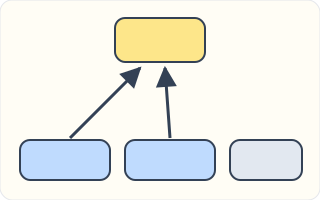
An argument map puts the claim on top and draws an arrow from each reason up into it, and none from background.
Paper packet. Every task here also exists on screen, where it is checked automatically; answers written on paper are not assessed by Nydus. When you are back at a device, enter your answers there.
You will draw a map of a short argument — claim at the top, reasons underneath, an arrow from each reason up into the claim, no arrow for background — and write one arrow as an if-then with the reason first.
Hedgehogs travel about a mile every night looking for food.
The fences between our gardens have no gaps at the bottom.
Every garden on the street should cut a small hole at the foot of its fence.
A hole the size of a CD case is too small for most cats and dogs.
The garden club meets on the first Monday of the month.
You have seen small maps already: a claim box with arrows running into it. Now you draw them yourself, for any short argument, step by step.
| Term | What it means |
|---|---|
| This lesson's terms | An argument map is a picture of an argument. The claim goes in a box at the top. Each reason goes in a box below. A support arrow runs from a reason up into the claim, and means this is offered as a reason for that. In symbols, -> means if … then. |
| Supported conclusion | The conclusion the stated reasons reach, including the limits on its group, time or conditions. |
Here is a note: (1) The bin should be moved. (2) It sits under the kitchen window. (3) On hot days it smells. (4) It is a green bin.
To map it:
Direction is everything. An arrow says this is offered as a reason for that. The smell is a reason for moving the bin; moving the bin is not a reason for the smell. So an arrow never starts at the claim.
The arrow can also be written in symbols. If R is the reason and C the claim, the arrow says if R is true, then C is true: R -> C. Turn it round, C -> R, and you have said something quite different.
Another way: picture
Think of balloons. The claim is a basket, and each reason is a balloon tied to it, pulling it up. A balloon tied to nothing floats off: that is background.
Another way: steps
Number → find the claim → put it at the top → reasons underneath → arrows up → no arrow for background.
An argument map is a picture of a reading. Its boxes hold claims and reasons, and its arrows show which statement is meant to support which. The arrow points from the support toward the statement being supported. It does not mean that the first event happened before the second. A schedule and an argument map may contain the same facts but connect them for different purposes.
Write one complete idea in each box. 'Rain' may be too short: does it mean that rain is forecast, rain has stopped or rain is needed? 'Heavy rain is forecast for Saturday' is clear enough to serve as a reason. Numbering the boxes can help you record arrows without squeezing long sentences beside every line. Keep a key so a reader can recover each statement.
Before drawing an arrow, say the proposed link aloud with because. 'Move the stall indoors because heavy rain is forecast' states the intended support. Reversing the arrow would suggest that moving the stall indoors supports the weather forecast, which is not the argument. If an arrow fails this reading, check its direction and endpoints.
Leaving background outside a map is a decision about its job, not a claim that it is false. A fairground's opening year may be useful history while doing nothing to support a proposal for a larger water table. Keep a separate background note if you need it. A small accurate map is more useful than a crowded drawing with every sentence connected to every other.
Put the five steps of drawing an argument map in order.
Number the sentences. / Find the claim and put it at the top. / Find each reason and put it underneath. / Draw an arrow from each reason up to the claim. / Check that no background sentence has an arrow.
Number the sentences first, so you can talk about each one. Find the claim and put it at the top; then find each reason and put it underneath. Draw an arrow from each reason up to the claim, and last, check that no background sentence has an arrow.
Nika maps the swings need new chains, because the old ones are rusty. She puts the claim at the top and draws an arrow from the claim down to the old chains are rusty. What is wrong?
The supported answer is: The arrow is backwards: it should run from the reason up to the claim.
An arrow means this is offered as a reason for that. The rusty chains are offered as a reason for new chains, not the other way round. So the arrow should run from the reason up to the claim. Nika's is backwards.
Here is a second map to build on paper. Keep the original notice beside your drawing for checking. A notice says: 'The bridge is closed. The footpath goes over that bridge. We should take the road route today. The bridge is made of wood.' Number the sentences 1 to 4. Sentence 3 is the proposal, and sentences 1 and 2 explain why the usual footpath will not work. Sentence 4 gives a description that does not explain the change of route. Put the proposal in a box with enough space below it for its reasons.
Write the reason sentences in their own boxes. Draw their support toward sentence 3. Now put your finger at each arrow's start and read toward its point. You should hear a reason followed by the claim it supports. If you hear 'Take the road route, therefore the bridge is closed', you have drawn the link backwards. The closure is not established by deciding which route to take; it is information used to make that decision.
Next read backwards as a question. Begin at the proposal and ask why it was made. Follow the incoming arrows back to the reasons. This is a different way to inspect the same map, not a different arrow direction. The arrows remain where they were. You are checking that every reason you find really answers why this proposal, on this day, for this route.
A map can also reveal a missing reason. Suppose the notice said only 'The bridge is made of wood, so take the road route.' The drawing would have one arrow, but the passage has not explained why a wooden bridge cannot be used. Drawing an arrow does not make the support good. You would write a question beside it: 'What about the wood makes the bridge unsuitable?' Perhaps the writer meant that a damaged wooden board needs repair. That extra fact must be supplied rather than silently invented.
Try removing a sentence before you redraw. If you remove the color or material of a bridge, the stated closure can still explain avoiding it. If you remove the fact that the path crosses the bridge, the connection to this particular route becomes unclear. This shows how a map helps you notice information that matters. It is not simply a picture of which words appear close together.
Use the same care when somebody gives you a completed map. Count the boxes and identify the main claim. Look for an arrow whose source is actually background. Look for an arrow pointing away from the claim when it should point toward it. Read every box as a full sentence, because a single word can hide a change of meaning. Then compare the drawing with the original passage. A neat diagram can still misread the words.
Finally, keep the map small enough to read. You can use numbered labels after writing a clear key. You can place background underneath with no support arrow. You do not need to color every line or make the drawing beautiful. The test is whether another reader can recover the same claim and the same reasons. If your friend reads a different argument from the picture, ask which box or arrow caused the difference and correct that part. This is a practical way to improve a map without starting again each time.
A school eco-club writes: 'We need two recycling bins by the hall. One bin fills before lunch. The afternoon group also uses the hall. Our poster is green.' Give these statements labels A, B, C and D in that order. A is the proposal. B and C explain the demand across the day. D describes the poster.
Start with the clear link B to A. A full bin before lunch gives a reason for increasing capacity. Then ask what C adds: people continue using the space after the first bin fills. Together the observations explain why a second bin may be useful. In a simple map, show these relevant reasons pointing toward A and leave D outside the support structure. Do not add an arrow from A to B: buying a second bin does not show that the first already fills early.
Read the picture back into a sentence. 'The club asks for two bins because one fills before lunch and another group uses the hall afterwards.' The green poster is omitted from this short argument summary. If you instead write that the club wants a green bin, you have changed the claim: the passage describes the poster's color, not the requested bins' color.
Finally, distinguish drawing the argument from accepting it. Emptying the first bin at lunch might be another solution. A map shows the support the club offered so that this alternative can be discussed clearly. It does not hide the argument's limits or promise that its conclusion is the only sensible answer.
Drawing arrows from the claim down. It feels like the claim leads to the reasons because you read it first. It does not: the reasons hold it up.
Giving every sentence an arrow. A map with an arrow from it is a green bin says the color is a reason. It is not.
Putting the first sentence on top. The claim goes on top, wherever it was in the passage.
(1) The printer is out of ink. (2) The shop is shut until Monday. (3) So the posters will have to wait until Monday.
(1) The printer is out of ink. (2) The shop is shut until Monday. (3) So the posters will have to wait until Monday.
Number the sentences, then find the claim.
State the result of this reading move.
Number the sentences, then find the claim.
This records the link just identified: (1) The printer is out of ink. (2) The shop is shut until Monday. (3) So the posters will have to wait until Monday.
So and the why-test point to sentence 3. It goes at the top.
So and the why-test point to sentence 3. It goes at the top.
Claim first, whatever its number.
State the result of this reading move.
Claim first, whatever its number.
This records the link just identified: So and the why-test point to sentence 3. It goes at the top.
Sentences 1 and 2 each answer why wait?, so each gets an arrow up into sentence 3. Nothing is left over.
Sentences 1 and 2 each answer why wait?, so each gets an arrow up into sentence 3. Nothing is left over.
Two arrows, both ending at 3.
(1) The class hamster needs a bigger cage. (2) It can't turn round in its wheel. (3) Its name is Biscuit.
(1) The class hamster needs a bigger cage. (2) It can't turn round in its wheel. (3) Its name is Biscuit.
Find the claim.
State the result of this reading move.
Find the claim.
This records the link just identified: (1) The class hamster needs a bigger cage. (2) It can't turn round in its wheel. (3) Its name is Biscuit.
Sentence 1 is the claim. Sentence 2 answers why a bigger cage?
Sentence 1 is the claim. Sentence 2 answers why a bigger cage?
One arrow: 2 up into 1.
State the result of this reading move.
One arrow: 2 up into 1.
This records the link just identified: Sentence 1 is the claim. Sentence 2 answers why a bigger cage?
Sentence 3 is true and answers nothing, so it gets no arrow. In symbols, the one arrow is R -> C: if it can't turn round, it needs a bigger cage.
Sentence 3 is true and answers nothing, so it gets no arrow. In symbols, the one arrow is R -> C: if it can't turn round, it needs a bigger cage.
Background gets no arrow.
Identify the task before answering its parts.
Arrow source: {{b0}}
Arrow target: {{b1}}
Arrow count: {{b2}}
The three labeled spaces ask for different parts of this analysis, so keep their order visible.
Locate the evidence for the first part.
A records the shortage that supplies support.
This is the supplied information that bears on work out arrow source.
Work out arrow source.
A
A records the shortage that supplies support.
Work out arrow target.
B
B is the request the shortage supports; the arrow points toward B.
Work out arrow count.
1
One relevant link is supplied, A to B. C is background and adds no support arrow.
Write the completed analysis in its original order.
A / B / 1
Read these entries with their labels: Work out arrow source. / Work out arrow target. / Work out arrow count.
(1) Swimming lessons should move to Thursday. (2) On Tuesdays the pool is full of the diving club. (3) On Thursdays it is nearly empty. (4) The pool is heated. Which sentence goes at the top?
(1) Swimming lessons should move to Thursday. (2) On Tuesdays the pool is full of the diving club. (3) On Thursdays it is nearly empty. (4) The pool is heated. Which sentence goes at the top?
Sentence 1.
Which sentences get arrows?
Does sentence 4 get an arrow?
A note says: *The bin by the gate should be moved. It sits right under the kitchen window. On hot days it smells. It is a green bin.* Draw the map: a *supports* arrow from each reason to the claim, and nothing else.
This task has no paper form; do it on a device.
Map these statements about 11 visitors: D: 'The room has only 10 seats.' A: 'Bring one extra chair.' B: 'The room is green.' Use the direction reason to claim. Write the source letter and target letter of the support arrow, then the number of relevant arrows.
Work out arrow source.
b0
Begin the arrow at the evidence.
Work out arrow target.
b1
End the arrow at the request the evidence supports.
Work out arrow count.
b2
Count supporting links while leaving background outside them.
Map these statements about 15 visitors: D: 'The room has only 14 seats.' A: 'Bring one extra chair.' B: 'The room is green.' Use the direction reason to claim. Write the source letter and target letter of the support arrow, then the number of relevant arrows.
Arrow source: b0
Arrow target: b1
Arrow count: b2
Map these statements about 9 visitors: B: 'The room has only 8 seats.' C: 'Bring one extra chair.' D: 'The room is green.' Use the direction reason to claim. Write the source letter and target letter of the support arrow, then the number of relevant arrows.
Arrow source: b0
Arrow target: b1
Arrow count: b2
Map these statements about 10 visitors: C: 'The room has only 9 seats.' D: 'Bring one extra chair.' A: 'The room is green.' Use the direction reason to claim. Write the source letter and target letter of the support arrow, then the number of relevant arrows.
Arrow source: b0
Arrow target: b1
Arrow count: b2
Map these statements about 13 visitors: B: 'The shelter has only 12 seats.' C: 'Bring one extra chair.' D: 'The shelter is green.' Use the direction reason to claim. Write the source letter and target letter of the support arrow, then the number of relevant arrows.
Arrow source: b0
Arrow target: b1
Arrow count: b2
Lesson test: one question per skill, one attempt each, no hints. Your answers are checked when you submit.
Map these statements about 12 visitors: A: 'The room has only 11 seats.' B: 'Bring one extra chair.' C: 'The room is green.' Use the direction reason to claim. Write the source letter and target letter of the support arrow, then the number of relevant arrows.
Arrow source: b0
Arrow target: b1
Arrow count: b2
You can map a short argument and keep every arrow pointing from a reason into the claim. Say why an arrow from the claim down to a reason is backwards. Next: two reasons for one claim, and reasons that form a chain.
15. Your turn: the swimming lesson, step 2
Which sentences get arrows?
Arrows start at reasons and end at the claim.
15. Your turn: the swimming lesson, step 3
Does sentence 4 get an arrow?
Arrows start at reasons and end at the claim.