Back to the on-screen lesson ·
A reason has to bear on this claim; a true sentence about the same topic can still give no support.
Paper packet. Every task here also exists on screen, where it is checked automatically; answers written on paper are not assessed by Nydus. When you are back at a device, enter your answers there.
You will decide whether a reason actually reaches its claim by supposing it is true and finishing the bridge sentence, and you will keep two questions apart: whether a reason is true, and whether it helps this claim.
The library should buy more graphic novels.
They are borrowed more than any other books: every copy is out on loan right now.
Eleven people are on the waiting list for the newest one.
The library was built in the same year as the town hall.
A graphic novel is a long story told in comic pictures.
You can find a claim and the sentences offered as its reasons. Now the harder question: does a reason actually help the claim, or is it only nearby?
| Term | What it means |
|---|---|
| This lesson's terms | A reason is relevant to a claim, or reaches it, when, if the reason is true, it gives some reason to accept the claim. A reason that is about the same subject and gives no help only shares the topic. The bridge sentence is the test: this helps the claim because … |
| Supported conclusion | The conclusion the stated reasons reach, including the limits on its group, time or conditions. |
We should put a canopy over the sandpit, because canopies come in lots of colors. Canopies do come in lots of colors; that is true. But color is not what makes a canopy worth putting up. The reason is about canopies and misses the claim.
The bridge test. Suppose the reason is true. Then try to finish: this helps the claim because …. The sand is too hot to touch by noon finishes easily: a canopy would shade it. Canopies come in lots of colors cannot finish without changing the subject.
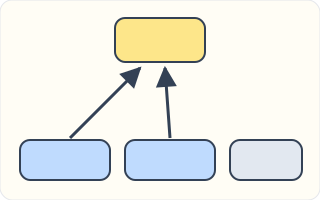
In a map of the argument, a reason that reaches gets an arrow up into the claim. A sentence that only shares the topic gets no arrow at all.
True and relevant are two different questions.
| Reaches the claim | Does not reach | |
|---|---|---|
| True | a good reason | true, and no help |
| False | would help, but check it | no help at all |
A true reason can miss the claim. A relevant reason can turn out false, which is why relevant reasons are worth checking.
Another way: picture
A bridge has to land on the other bank. A reason that shares the topic is a bridge that stops halfway: it starts in the right place and never gets across to the claim.
Another way: steps
A relevant reason bears on the exact claim. Sharing a topic is not enough. 'The garden needs watering' and 'The garden gate is blue' both mention the garden. But the gate's color does not make the soil any drier. 'The soil is dry below the surface' does bear on the watering claim. The link concerns what plants need, not a repeated word.
Try changing the reason while holding the claim steady. Suppose the gate were red. Would that affect whether the garden needs water? Usually it would not. Suppose the soil were already soaked. That would affect the claim. This change test can help you notice a link, but it still needs careful reading. A surprising fact may be relevant through a connection you have not yet understood. Ask the speaker to explain the connection before dismissing it.
Relevance and strength are different. One dry patch may be relevant to watering the whole garden but too small a check to settle the matter. A relevant reason can be weak. A true and interesting fact can be irrelevant. Use separate notes for these questions: does it reach the claim, and how much support does it give?
The same fact can reach one claim and miss another. A long line is relevant to opening another ticket desk. It may not be relevant to painting the desk green. The fact has not changed; the question has. Always copy the claim before sorting reasons. Otherwise you may silently judge them against a different question and produce a tidy answer to the wrong problem.
Claim: The club should buy a bike rack. Reason: Every Saturday a dozen bicycles lie on the grass by the door. Suppose the reason is true. Does it reach the claim?
The supported answer is: Yes: if it is true, it gives some reason to accept the claim.
The distinction in this case is that a pile of bikes with nowhere to go is exactly what a rack is for.
Claim: The hill road will be closed tomorrow morning. Reason: The hill road is the oldest road in the valley. Suppose the reason is true. Does it reach the claim?
The supported answer is: No: it is about the same topic, but it gives no reason to accept the claim.
The distinction in this case is that how old the road is has nothing to do with whether it closes tomorrow.
Claim: Tomas should sing the solo at the concert. Reason: Tomas has lived on Concert Street all his life. Suppose the reason is true. Does it reach the claim?
The supported answer is: No: it is about the same topic, but it gives no reason to accept the claim.
The distinction in this case is that it shares the word concert and nothing else: where he lives says nothing about how he sings.
Claim: The hill road will be closed tomorrow morning. Reason: Heavy snow is forecast overnight, and the road is closed whenever it snows. Suppose the reason is true. Does it reach the claim?
The supported answer is: Yes: if it is true, it gives some reason to accept the claim.
The distinction in this case is that if both parts are true, the closure follows.
Claim: We should plant shade trees by the benches. Reason: The benches are too hot to sit on at lunchtime. Suppose the reason is true. Does it reach the claim?
The supported answer is: Yes: if it is true, it gives some reason to accept the claim.
The distinction in this case is that trees would fix the very problem the reason describes.
Claim: We should plant shade trees by the benches. Reason: Some trees live for more than a thousand years. Suppose the reason is true. Does it reach the claim?
The supported answer is: No: it is about the same topic, but it gives no reason to accept the claim.
The distinction in this case is that it is about trees, but how long trees can live says nothing about whether the benches need shade.
Claim: The club should buy a bike rack. Reason: The first bicycles had no pedals at all. Suppose the reason is true. Does it reach the claim?
The supported answer is: No: it is about the same topic, but it gives no reason to accept the claim.
The distinction in this case is that it shares the topic of bikes, and what the first bicycles looked like gives no reason to buy a rack now.
Claim: Tomas should sing the solo at the concert. Reason: At the tryouts he was the only one who hit every note. Suppose the reason is true. Does it reach the claim?
The supported answer is: Yes: if it is true, it gives some reason to accept the claim.
The distinction in this case is that hitting every note is what a solo needs.
Claim: the class should plant trees along the playground fence. Sort each sentence: does it reach the claim, or only share its topic?
The playground has no shade and gets very hot at lunch. / Trees along a fence cut down noise from the road. / Some trees are the oldest living things on Earth. / The fence was painted blue last summer. / The word tree has only four letters. / reaches the claim / only shares the topic
No shade and a hot playground: trees would give shade, so it reaches the claim. Trees cutting the noise from the road: that is a good thing trees along a fence would do, so it reaches the claim. How old trees can get, when the fence was painted, and how many letters tree has are about trees or the fence, and none gives a reason to plant.
Sam says: We should have my birthday party at the pool, because the pool first opened a hundred years ago. Suppose what he says about the pool is true. What is wrong with his reason?
The supported answer is: It may be true, but it gives no reason to have the party there.
The claim is that the party should be at the pool. Try the bridge sentence: a hundred-year-old opening helps the claim because … There is no way to finish it. So the reason is true and does not reach the claim. A reason like the pool has a party room with slides would.
At a town meeting, Councillor Barros says the town should build a skate park in Fenwick Field. People call out five things. Mark every one that reaches her claim.
Skaters use the shop parking lot at night, where cars come and go. / Fenwick Field was named after a farmer. / The field has stood empty all year. / Skateboards were first made from wooden boxes. / The field is right next to the bus stop.
Skaters using the shop parking lot, and the field lying empty all year, both give reasons for a skate park there: there is a need and there is room. The field being next to the bus stop gives a reason too: people can get there. How Fenwick Field got its name, and who invented the skateboard, are about the field and about skating, and neither helps the claim.
A reading group wants to put thirty heavy books on one shelf. Its claim is, 'Use the lower shelf for these books.' Four facts are supplied: the lower shelf can hold forty books of this weight; the upper shelf can hold twenty; the lower shelf is painted yellow; the room has two windows.
The capacity facts reach the claim. Thirty fits within forty, but thirty is more than twenty. That difference supports using the lower shelf for the whole group of books. Yellow paint does not tell us what weight the shelf can hold. Two windows tells us about the room, not the shelf's capacity. Both facts could matter for another decision, such as matching colors or finding daylight, but they do not do the work required here.
Now change the claim to 'Use a shelf where the labels are easiest to read in daylight.' The windows may become relevant, provided we also know where the shelves stand and how the light reaches them. We cannot simply carry over the earlier sorting. Relevance follows the particular decision being made.
Make a small two-column note: fact and connection to the goal. Beside forty-book capacity, write 'enough space for thirty at this weight'. Beside yellow, write 'no stated link to capacity'. This last wording leaves room for a missing connection rather than claiming colors could never matter. Before acting, check that the capacity figures really apply to books of this weight and to the fitted shelf. We have analyzed the supplied argument; actual shelves still need their real instructions and condition checked by the responsible adult.
Matching words. Mia lives on Market Street shares a word with Mia should run the market stall and gives no reason at all.
Thinking a true reason must be a good one. Canopies really do come in many colors, and that says nothing about our sandpit.
Thinking an irrelevant reason makes the claim false. It only fails to help. The claim may still be right, for other reasons.
Claim: the class should get a second computer. Reason A: every lunchtime six people wait in line for the one we have.
Claim: the class should get a second computer. Reason A: every lunchtime six people wait in line for the one we have.
Suppose it is true and try the bridge sentence.
State the result of this reading move.
Suppose it is true and try the bridge sentence.
This records the link just identified: Claim: the class should get a second computer. Reason A: every lunchtime six people wait in line for the one we have.
This helps the claim because a second computer would halve that line.
This helps the claim because a second computer would halve that line.
It finishes: A reaches the claim.
State the result of this reading move.
It finishes: A reaches the claim.
This records the link just identified: This helps the claim because a second computer would halve that line.
Reason B: the first computers filled whole rooms. This helps the claim because … — nothing honest can follow.
Reason B: the first computers filled whole rooms. This helps the claim because … — nothing honest can follow.
B only shares the topic of computers.
Claim: the ferry will not sail tomorrow. Reason: the ferry is the oldest boat in the harbor.
Claim: the ferry will not sail tomorrow. Reason: the ferry is the oldest boat in the harbor.
Both mention the ferry.
State the result of this reading move.
Both mention the ferry.
This records the link just identified: Claim: the ferry will not sail tomorrow. Reason: the ferry is the oldest boat in the harbor.
Try the bridge: the boat's age does not make tomorrow's sailing any less likely.
Try the bridge: the boat's age does not make tomorrow's sailing any less likely.
No bridge.
State the result of this reading move.
No bridge.
This records the link just identified: Try the bridge: the boat's age does not make tomorrow's sailing any less likely.
Compare a gale is forecast, and the ferry never sails in a gale. That one lands on the claim.
Compare a gale is forecast, and the ferry never sails in a gale. That one lands on the claim.
Relevance is about the link, not the words.
Identify the task before answering its parts.
Balls outside: {{b0}}
Relevant fact 1: {{b1}}
Relevant fact 2: {{b2}}
The three labeled spaces ask for different parts of this analysis, so keep their order visible.
Locate the evidence for the first part.
Subtracting capacity 5 from 8 leaves three balls.
This is the supplied information that bears on work out balls outside.
Work out balls outside.
3
Subtracting capacity 5 from 8 leaves three balls.
Work out relevant fact 1.
A
A reaches the claim because insufficient capacity gives a reason for a larger container.
Work out relevant fact 2.
C
C records the same shortage directly; label color does not affect capacity in this case.
Write the completed analysis in its original order.
3 / A / C
Read these entries with their labels: Work out balls outside. / Work out relevant fact 1. / Work out relevant fact 2.
Claim: Mia should run the market stall. Reason: she added up every sale at the last fair without a mistake. Try the bridge sentence.
Claim: Mia should run the market stall. Reason: she added up every sale at the last fair without a mistake. Try the bridge sentence.
It helps because a stall needs someone who counts money well.
Now try: Mia lives on Market Street.
Which reason reaches the claim, and which only shares a word?
Claim: *the library should stay open until eight on Thursdays.* Draw a *supports* arrow from every sentence that reaches the claim, and no others.
This task has no paper form; do it on a device.
Claim: 'Use a bigger container for all 11 balls.' Facts: D: the current one holds 8 balls; A: its label is purple; B: three balls are left outside it. Record how many balls do not fit, then the letters of the two relevant facts in alphabetical order in separate boxes.
Work out balls outside.
b0
Compare required space with available space.
Work out relevant fact 1.
b1
List the relevant facts by their current labels.
Work out relevant fact 2.
b2
Keep the second relevant fact in alphabetical order.
Claim: 'Use a bigger container for all 15 balls.' Facts: D: the current one holds 12 balls; A: its label is purple; B: three balls are left outside it. Record how many balls do not fit, then the letters of the two relevant facts in alphabetical order in separate boxes.
Balls outside: b0
Relevant fact 1: b1
Relevant fact 2: b2
Claim: 'Use a bigger container for all 9 balls.' Facts: B: the current one holds 6 balls; C: its label is purple; D: three balls are left outside it. Record how many balls do not fit, then the letters of the two relevant facts in alphabetical order in separate boxes.
Balls outside: b0
Relevant fact 1: b1
Relevant fact 2: b2
Claim: 'Use a bigger container for all 10 balls.' Facts: C: the current one holds 7 balls; D: its label is purple; A: three balls are left outside it. Record how many balls do not fit, then the letters of the two relevant facts in alphabetical order in separate boxes.
Balls outside: b0
Relevant fact 1: b1
Relevant fact 2: b2
Claim: 'Use a bigger container for all 13 balls.' Facts: B: the current one holds 10 balls; C: its label is purple; D: three balls are left outside it. Record how many balls do not fit, then the letters of the two relevant facts in alphabetical order in separate boxes.
Balls outside: b0
Relevant fact 1: b1
Relevant fact 2: b2
Lesson test: one question per skill, one attempt each, no hints. Your answers are checked when you submit.
Claim: 'Use a bigger container for all 12 balls.' Facts: A: the current one holds 9 balls; B: its label is purple; C: three balls are left outside it. Record how many balls do not fit, then the letters of the two relevant facts in alphabetical order in separate boxes.
Balls outside: b0
Relevant fact 1: b1
Relevant fact 2: b2
You can tell a reason that reaches its claim from one that only shares its topic or a word. Say why canopies come in lots of colors does not help put a canopy over the sandpit. Next: among reasons that do reach, which ones give the most support.
16. Your turn: the market stall, step 2
Now try: Mia lives on Market Street.
Sharing a word or a topic is not the same as reaching the claim.
16. Your turn: the market stall, step 3
Which reason reaches the claim, and which only shares a word?
Sharing a word or a topic is not the same as reaching the claim.