Back to the on-screen lesson ·
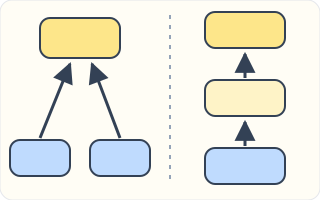
Two reasons can support one claim separately or only together, and a chain supports a claim through an in-between claim.
Paper packet. Every task here also exists on screen, where it is checked automatically; answers written on paper are not assessed by Nydus. When you are back at a device, enter your answers there.
You will use the cover-one test to say whether two reasons support a claim separately or only together, write a joint reason with &, and map a chain of reasons through its in-between claim.
Heavy rain is forecast all weekend.
Whenever it rains for two days, the river path floods.
So the river path will be under water by Sunday.
So Sunday's sponsored walk should follow the road instead.
The walk raises money for the lifeboat every year.
You can map an argument with an arrow from each reason into the claim. But two reasons can hold a claim up in different ways, and some arguments go step by step. This lesson shows three shapes.
| Term | What it means |
|---|---|
| This lesson's terms | Reasons work separately when each gives some support on its own. They work together when neither helps without the other. A chain is an argument in steps, where an in-between claim is supported by one reason and then supports the final claim. In symbols, & means and. |
| Supported conclusion | The conclusion the stated reasons reach, including the limits on its group, time or conditions. |
Separately. The club should buy new soccer balls: the old ones are flat, and ten new players joined this year. Cover the flat balls: the new players still help. Cover the new players: the flat balls still help. Each reason gets its own arrow.
Together. We can fly the kite now: the wind is up, and the string is untangled. Cover the wind is up: a tidy string on a still day is no help. Cover the string is untangled: wind with a knotted string is no help. Neither works alone, so they hold the claim up as a pair. In symbols, with W for the wind and U for the string, the joint reason is W & U: both must be true.
The cover-one test tells these apart: hide one reason and ask whether the other still gives any support.
A chain. The oven is broken, so the cake can't be baked here, so we'll bake it at Gran's. The middle sentence does two jobs: it is supported by the broken oven, and it supports going to Gran's.
In a map, a chain is a column of boxes with arrows running up from one to the next. The in-between claim has an arrow in and an arrow out.
Another way: picture
Separate reasons are two table legs: take one away and the table leans but stands. Joint reasons are the two halves of a folding leg: take either half and there is no leg. A chain is a ladder: each rung holds up the next.
Another way: steps
Two reasons may support a claim separately. A bus may be preferable because it is cheaper and because it stops closer to the destination. Cover either reason and the other still gives some support. The map can show two independent arrows into the claim. Losing one arrow weakens the support without necessarily removing the other.
Joined reasons need each other for their particular job. 'Everyone with a blue ticket may enter' and 'Mina has a blue ticket' together support Mina's entry. The rule alone does not tell us Mina qualifies; the ticket fact alone does not tell us what entry rule applies. Use the cover-one test: when you hide one statement, ask whether the remaining statement still gives the same support for that conclusion.
A chain adds a middle claim. 'The pipe froze, so water cannot pass through it, so the tap will not supply water.' Water cannot pass is supported by an earlier reason and itself supports the final claim. One sentence can therefore have two jobs in the same argument. It is a conclusion at one link and a reason at the next.
Do not decide the shape by counting sentences. Two sentences may contain three claims, and a long sentence may hide a missing connection. Name the statements before connecting them. When a chain breaks, identify the broken link rather than saying the whole passage is nonsense. Perhaps the pipe froze but another pipe still supplies the tap. The useful objection concerns the step from this blocked pipe to no supply.
We can buy bread at the corner shop right now. The corner shop sells bread, and it is open until eight. Do the two reasons support the claim separately, or only together?
The supported answer is: Only together: neither gives any support without the other.
The distinction in this case is that a shop that sells bread but is shut is no help, and an open shop with no bread is no help either.
Grandad can get into the shed. The shed key is on the hook, and Grandad knows where the hook is. Do the two reasons support the claim separately, or only together?
The supported answer is: Only together: neither gives any support without the other.
The distinction in this case is that a key on a hook he cannot find does not help, and knowing a hook with no key on it does not help either.
The garden needs watering tonight. It has not rained for a week, and today was the hottest day of the year. Do the two reasons support the claim separately, or only together?
The supported answer is: Separately: each reason gives some support on its own.
The distinction in this case is that a dry week is a reason on its own, and a hot day is a reason on its own.
Mom will be home by six. Her train gets in at half past five, and the walk from the station takes twenty minutes. Do the two reasons support the claim separately, or only together?
The supported answer is: Only together: neither gives any support without the other.
The distinction in this case is that the train time alone says nothing about getting home, and the walk alone says nothing about when she starts it; only together do they give six o'clock.
The café should sell soup this winter. It is cold outside, and customers keep asking for something hot. Do the two reasons support the claim separately, or only together?
The supported answer is: Separately: each reason gives some support on its own.
The distinction in this case is that the cold on its own is a reason for soup, and customers asking is a reason on its own too.
Ola would make a good goalkeeper. She is the tallest in the team, and she never panics. Do the two reasons support the claim separately, or only together?
The supported answer is: Separately: each reason gives some support on its own.
The distinction in this case is that height helps on its own and calm helps on its own; each gives some support without the other.
Match each argument to its shape.
We should picnic in the park: it is sunny, and the park has benches. / The torch will work: it has new batteries, and the bulb is fine. / The lake froze, so the ice rink is open, so we can skate today. / two reasons that work separately / two reasons that work only together / a chain through an in-between claim
We should picnic in the park: it is sunny, and the park has benches — cover either reason and the other still helps: separately. The torch will work: it has new batteries, and the bulb is fine — neither is enough alone: together. The lake froze, so the ice rink is open, so we can skate today — the middle sentence is supported and then supports: a chain.
Our class raised the most money for the charity. So we won the prize trip. So we are going to the zoo on Friday. Mark the in-between claim.
Our class raised the most money for the charity. / So we won the prize trip. / So we are going to the zoo on Friday.
The first sentence is only a reason; nothing in the passage supports it. So we won the prize trip is supported by the first sentence, and it supports the last one. The last sentence is the final claim. So the in-between claim is the prize trip sentence.
A leaflet for a new bike bridge says: The bridge will cut the ride to the town center to ten minutes. More people will cycle to work. The town will have less traffic. Read as a chain, which sentence is the in-between claim?
The supported answer is: More people will cycle to work.
The final claim is the one everything leads to: less traffic. The ten-minute ride is the first reason. It supports more people will cycle to work. More people will cycle then supports less traffic. It is supported and supporting, so it is the in-between claim.
A workshop notice says that each person who is registered and has paid can enter. Sal is registered. Sal has paid. The conclusion is that Sal can enter. These two facts work with the entry rule; registration by itself is not enough under the stated rule, and payment by itself is not enough either.
Write the rule and Sal's two facts before drawing the final arrow. If you hide the payment fact, you cannot complete the required check. If you hide the registration fact, the same gap remains. The reasons are joined for this entry decision. This is different from two separate reasons why Sal might enjoy the workshop, such as liking drawing and wanting to meet friends. Either enjoyment reason could give some support on its own.
Now add a chain. The organizer checks Sal's registration and payment, so Sal receives an entry band. Everyone with a valid entry band may enter the room. Therefore Sal may enter the room. Receiving the band is the middle claim: it is supported by the first checks and supports the last step under the band rule.
Suppose somebody accidentally gives a band to an unregistered visitor. That raises a question about the checking step, not about whether the visitor likes drawing. A useful map makes this location clear. Mark where the band came from and what rule permits entry. Keeping the links separate lets the organizer correct the process without mixing up reasons for eligibility with reasons for wanting to attend.
Thinking a claim can only have one reason. A claim can have as many as people give.
Calling every pair of reasons separate. The wind and the string need each other.
Skipping the middle of a chain. An arrow straight from the oven is broken to bake at Gran's leaves out the step that makes the argument work: the cake can't be baked here.
Bo would make a good captain: she is always on time, and everyone listens to her.
Bo would make a good captain: she is always on time, and everyone listens to her.
Two reasons. Cover one at a time.
State the result of this reading move.
Two reasons. Cover one at a time.
This records the link just identified: Bo would make a good captain: she is always on time, and everyone listens to her.
Cover always on time: everyone listens still helps. Cover everyone listens: always on time still helps.
Cover always on time: everyone listens still helps. Cover everyone listens: always on time still helps.
Each works alone.
State the result of this reading move.
Each works alone.
This records the link just identified: Cover always on time: everyone listens still helps. Cover everyone listens: always on time still helps.
So they work separately, and each gets its own arrow into the claim.
So they work separately, and each gets its own arrow into the claim.
Two arrows, one claim.
The bridge is shut. So the bus will go the long way round. So we'll be late for the film.
The bridge is shut. So the bus will go the long way round. So we'll be late for the film.
Find the final claim: we'll be late for the film.
State the result of this reading move.
Find the final claim: we'll be late for the film.
This records the link just identified: The bridge is shut. So the bus will go the long way round. So we'll be late for the film.
The bus will go the long way round is supported by the shut bridge, and it supports the final claim.
The bus will go the long way round is supported by the shut bridge, and it supports the final claim.
It is the in-between claim.
State the result of this reading move.
It is the in-between claim.
This records the link just identified: The bus will go the long way round is supported by the shut bridge, and it supports the final claim.
The map is a column: shut bridge → long way round → late for the film.
The map is a column: shut bridge → long way round → late for the film.
Two arrows, one after the other.
Identify the task before answering its parts.
Joined premise 1: {{b0}}
Joined premise 2: {{b1}}
Middle claim: {{b2}}
The three labeled spaces ask for different parts of this analysis, so keep their order visible.
Locate the evidence for the first part.
A provides the entry rule but does not alone identify Jo as eligible.
This is the supplied information that bears on work out joined premise 1.
Work out joined premise 1.
A
A provides the entry rule but does not alone identify Jo as eligible.
Work out joined premise 2.
B
B supplies Jo's qualifying fact, so A and B work together to establish C.
Work out middle claim.
C
C is supported by A and B and then supports D under the stated game condition; it has both jobs in the chain.
Write the completed analysis in its original order.
A / B / C
Read these entries with their labels: Work out joined premise 1. / Work out joined premise 2. / Work out middle claim.
The lamp will light: it is plugged in, and it has a new bulb. Cover plugged in. Does a new bulb still help?
The lamp will light: it is plugged in, and it has a new bulb. Cover plugged in. Does a new bulb still help?
No: a new bulb with no power gives no light.
Now cover a new bulb. Does being plugged in still help?
So do the reasons work separately or together?
*The river is rising fast. So the river path will flood tonight. So we should walk home by the road. The jumble sale is on Saturday.* Map the chain with *supports* arrows.
This task has no paper form; do it on a device.
In case 11: D: all blue-ticket holders may enter. A: Jo has a blue ticket. B: Jo may enter. C: Jo can therefore take part in the indoor game (entry is the only stated condition). Write the two joined premise letters in alphabetical order in separate boxes, then the middle claim letter that also supports C.
Work out joined premise 1.
b0
Identify the joined premises, then order their labels alphabetically.
Work out joined premise 2.
b1
Keep both the entry rule and the qualifying fact.
Work out middle claim.
b2
Find the statement that receives support and passes it onwards.
In case 15: D: all blue-ticket holders may enter. A: Jo has a blue ticket. B: Jo may enter. C: Jo can therefore take part in the indoor game (entry is the only stated condition). Write the two joined premise letters in alphabetical order in separate boxes, then the middle claim letter that also supports C.
Joined premise 1: b0
Joined premise 2: b1
Middle claim: b2
In case 9: B: all blue-ticket holders may enter. C: Jo has a blue ticket. D: Jo may enter. A: Jo can therefore take part in the indoor game (entry is the only stated condition). Write the two joined premise letters in alphabetical order in separate boxes, then the middle claim letter that also supports A.
Joined premise 1: b0
Joined premise 2: b1
Middle claim: b2
In case 10: C: all blue-ticket holders may enter. D: Jo has a blue ticket. A: Jo may enter. B: Jo can therefore take part in the indoor game (entry is the only stated condition). Write the two joined premise letters in alphabetical order in separate boxes, then the middle claim letter that also supports B.
Joined premise 1: b0
Joined premise 2: b1
Middle claim: b2
In case 13: B: all blue-ticket holders may enter. C: Jo has a blue ticket. D: Jo may enter. A: Jo can therefore take part in the indoor game (entry is the only stated condition). Write the two joined premise letters in alphabetical order in separate boxes, then the middle claim letter that also supports A.
Joined premise 1: b0
Joined premise 2: b1
Middle claim: b2
Lesson test: one question per skill, one attempt each, no hints. Your answers are checked when you submit.
In case 12: A: all blue-ticket holders may enter. B: Jo has a blue ticket. C: Jo may enter. D: Jo can therefore take part in the indoor game (entry is the only stated condition). Write the two joined premise letters in alphabetical order in separate boxes, then the middle claim letter that also supports D.
Joined premise 1: b0
Joined premise 2: b1
Middle claim: b2
You can tell separate reasons from joint ones and find the middle of a chain. Say why the wind is up and the string is untangled only work together. Next: summarizing someone else's argument fairly.
16. Your turn: the lamp, step 2
Now cover a new bulb. Does being plugged in still help?
In a chain, the in-between claim has an arrow in and an arrow out.
16. Your turn: the lamp, step 3
So do the reasons work separately or together?
In a chain, the in-between claim has an arrow in and an arrow out.