Back to the on-screen lesson ·
The curl test $\nabla \times \vec{F} = 0$, potential energy $\vec{F} = -\nabla U$, energy conservation, turning points and equilibria, and the time of a motion from an integral.
Paper packet. Every task here also exists on screen, where it is checked automatically; answers written on paper are not assessed by Nydus. When you are back at a device, enter your answers there.
By the end of this lesson you will be able to decide whether a force is conservative, find its potential energy, and use energy conservation and potential curves to find speeds, turning points, equilibria and times.
From Physics C you know the work–energy theorem, potential energy for gravity and springs, and conservation of mechanical energy. From multivariable calculus you know the gradient, the curl and Stokes's theorem, and line integrals. This lesson asks exactly which forces have a potential energy, and shows how much a potential curve tells you about a motion before you solve anything.
| Term | What it means |
|---|---|
| Work–energy theorem | $\Delta T = W$: the change in kinetic energy equals the work of the net force. |
| Conservative force | A force that depends only on position and whose work between two points is path independent. |
| Potential energy | $U(\vec{r}) = -W(\vec{r}_0 \to \vec{r})$, defined for a conservative force up to a constant. |
| Curl test | In a simply connected region, $\nabla \times \vec{F} = 0$ exactly when $\vec{F}$ is conservative. |
| Turning point | A place where $E = U$, so the particle momentarily stops and reverses. |
| Stable equilibrium | A minimum of $U$, where a small displacement produces a restoring force. |
| Bound motion | Motion confined between two turning points, in a potential well. |
The work–energy theorem, $\Delta T = \int\vec{F} \cdot d\vec{r}$, holds for any force. Energy conservation needs more. A force is conservative when
Then the work defines a function of position, the potential energy, $U(\vec{r}) = -\int_{\vec{r}_0}^{\vec{r}}\vec{F} \cdot d\vec{r}'$, with $\vec{F} = -\nabla U$, and the total energy $E = T + U$ is constant.
Checking every path is impossible, but Stokes's theorem turns condition 2 into a derivative: the work around any closed loop is the flux of the curl through it, so path independence holds exactly when
$$\nabla \times \vec{F} = 0.$$
In one dimension there is only one path between two points, so every force $F(x)$ is conservative, with $U(x) = -\int F\,dx$. Then energy conservation, $\tfrac{1}{2}m\dot{x}^2 + U(x) = E$, is a first-order equation that can always be solved by one integral.
Another way: picture
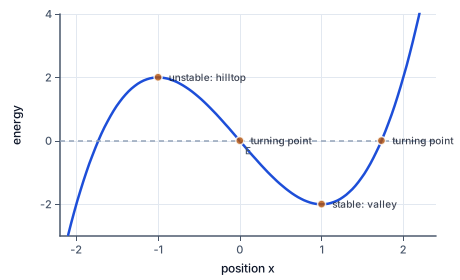
Draw $U(x)$ and a horizontal line at the energy $E$. The particle can be only where the curve lies below the line, because the kinetic energy $E - U$ cannot be negative. It moves fastest where the gap is widest, stops where the line meets the curve, and rolls back. Valleys are stable resting places, and hilltops are balancing points it will fall off.
Another way: steps
Take two paths from $\vec{r}_1$ to $\vec{r}_2$. The difference of the work along them is the work around the closed loop made by going out along one and back along the other. Stokes's theorem says $\oint\vec{F} \cdot d\vec{r} = \int(\nabla \times \vec{F}) \cdot d\vec{a}$ over any surface bounded by the loop. If the curl vanishes everywhere, every loop gives zero and every path gives the same work.
The region must have no holes for this argument: a loop around a hole may not bound a surface inside the region. The classic example is $\vec{F} = \hat{\phi}/r$, which has zero curl everywhere except the axis but does work $2\pi$ around any circle about it. For forces defined everywhere, as nearly all mechanical forces are, the curl test is the whole story.
Once the curl vanishes, $U$ is found by integrating one component and fixing the leftover function with the others. For $\vec{F} = (2xy, x^2)$, integrating $F_x = -\partial U/\partial x$ gives $U = -x^2y + g(y)$; then $-\partial U/\partial y = x^2 - g'(y)$ must equal $F_y = x^2$, so $g$ is a constant.
Two families cover most of mechanics. Central forces that depend only on distance, $\vec{F} = f(r)\hat{r}$, are always conservative, with $U = -\int f(r)\,dr$; gravity and the Coulomb force are examples. Uniform forces are conservative with $U = -\vec{F} \cdot \vec{r}$, as for gravity near the ground. Friction, drag and the magnetic force are not conservative: friction and drag depend on velocity and always remove energy, and the magnetic force does no work at all.
In the figure, a particle with energy E is confined to the valley between the two turning points, where the line crosses the curve. At the valley floor it could sit at rest; on the hilltop the slightest push sends it away.
In one dimension the curve $U(x)$ organizes the motion. At a given energy $E$, the allowed region is where $U(x) \le E$. Its edges, where $E = U$, are turning points. A particle between two turning points oscillates in a bound motion; one with only a single turning point comes in, turns and escapes.
Equilibria are where $U'(x) = 0$, since the force $-U'$ vanishes there. At a minimum, $U'' > 0$, a small displacement produces a force back toward it: stable. At a maximum, $U'' < 0$, the force pushes further away: unstable. For the potential $U = x^3 - 3x$, the minimum at $x = 1$ is a valley of depth $-2$ and the maximum at $x = -1$ a barrier of height $2$. A particle with energy below $2$ starting near $x = 1$ is trapped; one with more energy escapes over the barrier toward $x \to -\infty$.
Energy conservation in one dimension gives the speed at every position, $\dot{x} = \pm\sqrt{2(E - U(x))/m}$. Separating, the time to go from $x_1$ to $x_2$ is
$$t = \int_{x_1}^{x_2}\frac{dx}{\sqrt{2(E - U(x))/m}}.$$
This solves every one-dimensional conservative problem, at least as an integral. For a spring, $U = \tfrac{1}{2}kx^2$, it gives a quarter period of $\tfrac{\pi}{2}\sqrt{m/k}$ whatever the amplitude. For a pendulum at large amplitude it gives an elliptic integral, which is why the period of a real pendulum grows with its swing. The integrand blows up at the turning points, where the speed is zero, but the integral converges: the particle spends a long time near a turning point, not an infinite one.
For two particles interacting through a force that depends on their separation, $U(\vec{r}_1 - \vec{r}_2)$, the third law holds automatically: the force on one is $-\nabla_1 U$ and on the other $-\nabla_2 U = +\nabla_1 U$. The total energy $T_1 + T_2 + U$ is conserved, and only one potential energy appears for the pair, not one for each particle.
For many particles the internal potential energy is a sum over pairs, and external fields add their own terms. A rigid body is the special case where the internal forces do no work, because the distances between particles never change, so only external potentials enter its energy. That is the reason a ball rolling without slipping conserves energy even though friction acts on it: static friction at the contact point does no work, since that point is momentarily at rest.
Checking an answer. Differentiate $U$ and confirm $-\nabla U$ returns the force, including its sign. The kinetic energy $E - U$ must be non-negative wherever the particle goes. A stable equilibrium must be a local minimum of the curve you drew. And the work between two points must equal $U_{\text{start}} - U_{\text{end}}$ however you computed it.
The deepest use of energy is that it answers questions about a motion without solving it. How high will a ball go, how fast will a satellite be at its closest point, can this particle escape: each follows from $E = T + U$ in one line, while solving the equation of motion might take pages or be impossible in closed form.
The price is that energy gives only one equation. In one dimension that is enough, but in two or three dimensions a second conserved quantity is usually needed, most often angular momentum. The central-force unit uses exactly that pair, energy and angular momentum, to reduce orbital motion to a one-dimensional problem in an effective potential, and reads the orbits off its curve just as this lesson reads motion off $U(x)$.
The Apollo lunar modules left the Moon from the surface, with no atmosphere to fight, so energy alone decides what a launch can reach. The Moon's $GM$ is $4.905 \times 10^{12}$ m³/s² and its radius $1737$ km, so the potential per unit mass at the surface is $-2.82$ MJ/kg. A probe launched straight up at $554$ m/s climbs $100$ km; with uniform gravity, $\sqrt{2gh}$ would suggest $570$ m/s, because it ignores the weakening of gravity with height.
Setting the final potential to zero at infinity gives the escape speed, $\sqrt{2GM/R} = 2.38$ km/s, less than a quarter of the Earth's $11.2$ km/s. That is why the ascent stage of the Apollo lander, with a single engine and about $2.2$ tonnes of propellant, could reach lunar orbit at $1.7$ km/s, while leaving the Earth took a Saturn V. NASA's Artemis plans lean on the same arithmetic: a base on the Moon makes it a cheap place to launch from.
The potential energy of two atoms in a molecule, as a function of their separation, is a well: steeply repulsive at short range, attractive at long range, with a minimum at the bond length. The Lennard-Jones form $U = 4\varepsilon[(\sigma/r)^{12} - (\sigma/r)^6]$ describes noble gas atoms well; its minimum is at $r = 2^{1/6}\sigma$ with depth $\varepsilon$.
Reading the curve gives the chemistry. The depth is the energy needed to break the bond; the curvature at the bottom sets the vibration frequency, which infrared spectrometers measure; and the asymmetry of the well, steeper inside than outside, makes the average separation grow as the vibration grows, which is why most solids expand when heated. Engineers at national laboratories such as Sandia use potentials of this kind in simulations of millions of atoms, and the whole method rests on the idea of this lesson: a conservative force is fully described by one function of position.
In one dimension any force $F(x)$ has a potential energy. It is tempting to carry that over, but in two or three dimensions a force can depend only on position and still fail to be conservative. The force $(-y, x)$ does positive work around every counterclockwise circle, so no potential energy can describe it, and its curl, $2$, says so at once.
A second error concerns signs. The force is minus the gradient: it points downhill on $U$. A potential built by integrating $+\vec{F}$ gives equilibria in the right places but calls the stable ones unstable.
Test $\vec{F} = (2xy, x^2)$ in the plane. Compute the curl's component.
$\dfrac{\partial F_y}{\partial x} - \dfrac{\partial F_x}{\partial y} = 2x - 2x = 0$
Zero everywhere, and the plane has no holes.
Integrate the $x$ component.
$U = -\int 2xy\,dx = -x^2y + g(y)$
$F_x = -\partial U/\partial x$.
Differentiate with respect to $y$.
$-\dfrac{\partial U}{\partial y} = x^2 - g'(y)$
This must equal $F_y$.
Match with the $y$ component.
$x^2 - g'(y) = x^2 \Rightarrow g'(y) = 0$
So $g$ is a constant, set to zero.
State and check the potential.
$U = -x^2y, \quad -\nabla U = (2xy, x^2)$
The gradient returns the force.
A particle moves in $U = x^3 - 3x$ (joules, meters). Find where the force vanishes.
$U' = 3x^2 - 3 = 0 \Rightarrow x = \pm 1$
Equilibrium points.
Classify them with the second derivative.
$U'' = 6x: \quad U''(1) = 6 > 0, \quad U''(-1) = -6 < 0$
Stable at $x = 1$, unstable at $x = -1$.
Evaluate the well depth and barrier height.
$U(1) = -2\ \text{J}, \quad U(-1) = 2\ \text{J}$
The heights on the curve.
A particle has $E = 0$ near $x = 1$. Find its turning points.
$x^3 - 3x = 0 \Rightarrow x = 0,\ \pm\sqrt{3}$
Where $E = U$.
Pick the turning points around the well.
$0 \le x \le \sqrt{3} = 1.73\ \text{m}$
The segment containing $x = 1$ with $U \le 0$.
A mass $m$ on a spring $k$ is released from rest at $x = A$. Write its energy.
$E = \tfrac{1}{2}kA^2$
All potential at release.
Write the speed at position $x$.
$|\dot{x}| = \sqrt{\dfrac{2(E - \tfrac{1}{2}kx^2)}{m}} = \sqrt{\dfrac{k}{m}}\sqrt{A^2 - x^2}$
From $T = E - U$.
Write the time to reach the center as an integral.
$t = \sqrt{\dfrac{m}{k}}\displaystyle\int_0^A\frac{dx}{\sqrt{A^2 - x^2}}$
Separate $dt = dx/|\dot{x}|$.
Evaluate the integral.
$\displaystyle\int_0^A\frac{dx}{\sqrt{A^2 - x^2}} = \arcsin 1 = \frac{\pi}{2}$
A standard integral; it converges despite the infinite integrand at $x = A$.
State the time.
$t = \dfrac{\pi}{2}\sqrt{\dfrac{m}{k}}$
A quarter of the period $2\pi\sqrt{m/k}$.
Evaluate for $m = 0.50$ kg and $k = 200$ N/m.
$t = 1.571 \times \sqrt{0.0025} = 1.571 \times 0.050 = 0.079\ \text{s}$
Independent of the amplitude $A$.
Write the potential as an integral.
$U(x) = -\displaystyle\int_0^x(-4x'^3)\,dx'$
Minus the work from the origin.
Integrate the power.
$U(x) = 4 \cdot \dfrac{x^4}{4}$
The power rule.
Simplify the potential.
Is the force $\vec{F} = (6y,\ 6x)$ conservative, and if so what is a potential energy for it?
Complete the worked solution: a particle moves in the potential $U = 4x^2 + 4y^2$ (joules, meters) from $(4, 0)$ to $(0, 3)$. Find the potential energy at the start and at the end, and the work done on it by the force, in joules.
Evaluate the potential at the starting point.
$U_{\text{start}} =$ s
Only the $x$ term contributes on the $x$ axis.
Evaluate the potential at the end point.
$U_{\text{end}} =$ e
Only the $y$ term contributes on the $y$ axis.
Subtract the final potential from the initial one.
$W = U_{\text{start}} - U_{\text{end}} =$ w
The work of a conservative force is the drop in potential energy, whatever the path.
Check the sign against the motion on the potential.
$\text{moving downhill in } U \Rightarrow W > 0$
The force points down the slope of $U$.
Match each idea to its mathematical statement.
| $\nabla \times \vec{F} = 0$ | $\vec{F} = -\nabla U$ | $E = U(x)$ | $U' = 0,\ U'' > 0$ | |
|---|---|---|---|---|
| conservative force | ||||
| force from potential | ||||
| turning point | ||||
| stable equilibrium |
A particle moves in the potential $U(x) = x^3 - 12x$ (joules, with $x$ in meters). Fill in the position of the stable equilibrium, the position of the unstable equilibrium, and the potential energy at each.
| value | |
|---|---|
| stable equilibrium position (m) | |
| unstable equilibrium position (m) | |
| potential at the stable point (J) | |
| potential at the unstable point (J) |
A particle on the $x$ axis feels the force $F(x) = -6x + 9x^2$ (newtons, $x$ in meters). Find its potential energy $U(x)$, in joules, choosing $U(0) = 0$.
Answer:
A particle is released from rest at $x = 2$ m in the potential $U(x) = 2x^4 - x^2$ (joules, $x$ in meters). What is its kinetic energy when it passes $x = 1$ m, in joules?
Answer: J of kinetic energy
A NASA lander test launches a small probe straight up from the lunar surface, where there is no air. What launch speed, in m/s, lets it just reach $1737$ km above the surface? Use $GM = 4.905 \times 10^{12}$ m³/s² and $R = 1737$ km for the Moon.
Answer: m/s at lunar launch
Lesson test: one question per skill, one attempt each, no hints. Your answers are checked when you submit.
A particle on the $x$ axis feels the force $F(x) = -2x + 3x^2$ (newtons, $x$ in meters). Find its potential energy $U(x)$, in joules, choosing $U(0) = 0$.
Answer:
You can use conservative forces and potential energy. Explain to someone why the force $(-y, x)$ has no potential energy even though it depends only on position.
18. Your turn: find the potential energy for $F(x) = -4x^3$ newtons with $U(0) = 0$., step 3
$U(x) = x^4\ \text{J}$
A well steeper than a spring's.