Back to the on-screen lesson ·
Mass and stiffness matrices, the eigenvalue problem $\det(\mathbf{K} - \omega^2\mathbf{M}) = 0$, normal modes and normal coordinates, starting conditions, beats, and many masses.
Paper packet. Every task here also exists on screen, where it is checked automatically; answers written on paper are not assessed by Nydus. When you are back at a device, enter your answers there.
By the end of this lesson you will be able to find the normal frequencies and mode shapes of coupled oscillators, write a general motion as a sum of modes, and predict beats and energy exchange.
You can find the frequency of small oscillations about equilibrium from the curvature of a potential, write Lagrangians for several coordinates, and solve eigenvalue problems for matrices. You know that a harmonic oscillator's general motion is a sum of sines and cosines. This lesson couples oscillators together, which is how molecules vibrate, bridges sway and crystals carry sound.
| Term | What it means |
|---|---|
| Coupled oscillators | Oscillators whose equations of motion each contain the others' displacements. |
| Mass matrix | $\mathbf{M}$, with $T = \tfrac{1}{2}\dot{\mathbf{x}}^T\mathbf{M}\dot{\mathbf{x}}$. |
| Stiffness matrix | $\mathbf{K}$, with $U = \tfrac{1}{2}\mathbf{x}^T\mathbf{K}\mathbf{x}$ near equilibrium. |
| Normal mode | A motion in which every coordinate oscillates at one frequency with fixed ratios. |
| Normal frequency | A root $\omega$ of $\det(\mathbf{K} - \omega^2\mathbf{M}) = 0$. |
| Normal coordinates | Combinations of the coordinates, one per mode, that oscillate independently. |
| Beats | A slow rise and fall of amplitude from two nearby frequencies added together. |
Near a stable equilibrium, a system of $n$ coordinates has $T = \tfrac{1}{2}\dot{\mathbf{x}}^T\mathbf{M}\dot{\mathbf{x}}$ and $U = \tfrac{1}{2}\mathbf{x}^T\mathbf{K}\mathbf{x}$, and Lagrange's equations give
$$\mathbf{M}\ddot{\mathbf{x}} = -\mathbf{K}\mathbf{x}.$$
Look for a motion in which every coordinate oscillates at one frequency: $\mathbf{x} = \mathbf{a}\cos(\omega t - \delta)$. Substituting gives $(\mathbf{K} - \omega^2\mathbf{M})\mathbf{a} = 0$, which has a solution with $\mathbf{a} \ne 0$ only if
$$\det(\mathbf{K} - \omega^2\mathbf{M}) = 0.$$
This equation of degree $n$ in $\omega^2$ gives $n$ normal frequencies, and each has an eigenvector $\mathbf{a}$, the shape of its normal mode. For two equal masses joined wall–mass–mass–wall by springs $k$, $\kappa$, $k$, the modes are $(1, 1)$ at $\omega_1 = \sqrt{k/m}$ and $(1, -1)$ at $\omega_2 = \sqrt{(k + 2\kappa)/m}$. The general motion is any combination of the modes, each with its own amplitude and phase, fixed by the starting positions and velocities.
Another way: picture
Hold two pendulums side by side, joined by a loose spring. Pull both to the same side and let go: they swing together forever, the spring idle. Pull them apart and let go: they swing toward and away from each other, a little faster, the spring working. Those are the two normal modes. Any other start is a mixture, and the mixture makes the swinging pass back and forth between them.
Another way: steps
Let $x_1$ and $x_2$ be the displacements. The left mass feels $-kx_1$ from its wall spring and $\kappa(x_2 - x_1)$ from the coupling spring, so $m\ddot{x}_1 = -(k + \kappa)x_1 + \kappa x_2$, and symmetrically for the right. In matrix form, $\mathbf{K} = \begin{pmatrix} k + \kappa & -\kappa \\ -\kappa & k + \kappa \end{pmatrix}$ and $\mathbf{M} = m\mathbf{1}$.
The characteristic equation $(k + \kappa - m\omega^2)^2 = \kappa^2$ gives $m\omega^2 = k$ or $m\omega^2 = k + 2\kappa$. For the first, the eigenvector is $(1, 1)$: both masses move together and the coupling spring does nothing. For the second, $(1, -1)$: they move oppositely, and the coupling spring is stretched by $2x$, which is why it counts twice. With three equal springs, $\omega_2 = \sqrt{3}\,\omega_1$.
Define $\xi_1 = (x_1 + x_2)/2$ and $\xi_2 = (x_1 - x_2)/2$. Adding and subtracting the two equations of motion gives $\ddot{\xi}_1 = -\omega_1^2\xi_1$ and $\ddot{\xi}_2 = -\omega_2^2\xi_2$: two independent simple harmonic oscillators. These normal coordinates diagonalize both $\mathbf{M}$ and $\mathbf{K}$ at once, and in them the energy splits into two separate oscillator energies.
This is the general result. For any number of coordinates, a change of variables to normal coordinates turns $n$ coupled oscillators into $n$ independent ones. A crystal of $N$ atoms has $3N$ normal modes; quantized, they are phonons, and they carry heat and sound through solids. A molecule's normal modes are the vibrations infrared spectroscopy detects.
Release mass 1 from $x_1 = A$ with mass 2 at rest at zero. Then $\xi_1(0) = \xi_2(0) = A/2$, and $x_1 = \tfrac{A}{2}(\cos\omega_1t + \cos\omega_2t)$, $x_2 = \tfrac{A}{2}(\cos\omega_1t - \cos\omega_2t)$. With the sum-to-product formulas, $x_1 = A\cos(\Delta t/2)\cos(\bar{\omega}t)$ and $x_2 = A\sin(\Delta t/2)\sin(\bar{\omega}t)$, with $\Delta = \omega_2 - \omega_1$ and $\bar{\omega}$ the average.
When the coupling is weak, $\Delta$ is small, and each mass oscillates at nearly $\bar{\omega}$ inside a slowly varying envelope. The envelopes are out of step: when mass 1's has fallen to zero, mass 2's is at its peak. The energy passes completely from one to the other in a time $\pi/\Delta$, and back again. The weaker the coupling, the slower the exchange, but it always becomes complete.
Three equal masses joined by four equal springs have three modes: all moving together with the middle one farthest, the outer two opposite with the middle one still, and alternating. As the number of masses grows, the modes look more and more like standing waves on a string, with $1, 2, 3, \ldots$ half-wavelengths across.
In the limit of a continuous string, the normal modes are exactly the harmonics of a vibrating string, with frequencies $n$ times the fundamental. A guitar string's sound is a sum of these modes, and which ones are present depends on where it is plucked. The calculation of this lesson, taken to many masses, is how physicists pass from the mechanics of particles to the physics of waves.
A linear carbon dioxide molecule, O=C=O, has two stretching modes along its axis. In the symmetric stretch the oxygen atoms move out and in together while the carbon stays still; in the asymmetric stretch the oxygens move one way while the carbon moves the other. Modeled as three masses and two springs, the ratio of their frequencies is $\sqrt{1 + 2m_O/m_C} \approx 1.9$; measured, it is about $1.7$, since real bonds are not perfect springs.
The asymmetric stretch changes the molecule's electric dipole and absorbs infrared light near $4.3$ μm; the symmetric stretch does not. Together with the bending modes, these absorptions are what make carbon dioxide a greenhouse gas. Satellites such as NASA's Orbiting Carbon Observatory measure atmospheric CO₂ by the depth of these absorption bands.
Checking an answer. Each $\omega^2$ must be positive for a stable equilibrium. Modes must be orthogonal with respect to $\mathbf{M}$. Setting the coupling to zero must give the uncoupled frequencies. And the sum of the modes at $t = 0$ must reproduce the starting positions exactly.
Without coupling, the two oscillators share one frequency, and any combination of their motions is equally good: the modes are degenerate. Coupling breaks the tie. The symmetric combination does not stretch the coupling spring and keeps the original frequency; the antisymmetric one does and is pushed up. The two frequencies split by an amount that grows with the coupling.
The same splitting appears throughout physics. Two identical atoms brought together share an electron in symmetric and antisymmetric states of different energy, which is the origin of the chemical bond. Two identical LC circuits coupled by a shared inductor split their resonance, which is how wireless chargers and radio filters shape their response. Recognizing a coupled-oscillator problem in a new setting is often the fastest way to understand it.
When the masses differ, the mass matrix is no longer a multiple of the identity, and the modes are not simply symmetric and antisymmetric. The equation $(\mathbf{K} - \omega^2\mathbf{M})\mathbf{a} = 0$ is a generalized eigenvalue problem, and its eigenvectors are orthogonal in a weighted sense: $\mathbf{a}_1^T\mathbf{M}\mathbf{a}_2 = 0$. A heavy mass joined to a light one by a spring has one mode in which the heavy mass barely moves and the light one oscillates fast, and another in which both move together slowly.
This weighting is why a diatomic molecule's vibration depends on the reduced mass, and why the carbon atom in carbon dioxide moves less than the oxygen atoms in the asymmetric stretch. Engineers use the same generalized problem for structures with heavy floors and light columns, solving it numerically for thousands of coordinates; the principle is the one worked out here with two.
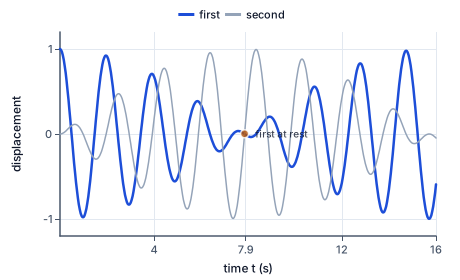
The chart follows two coupled pendulums whose normal modes have $\omega_1 = 3.0$ and $\omega_2 = 3.4$ rad/s, after the first is pulled aside and the second is left at rest. The first curve starts at full amplitude and its swings shrink steadily; the second starts flat and its swings grow. At $t = \pi/0.4 \approx 7.9$ s the first pendulum is momentarily still and the second swings fully, and then the process reverses. Both pendulums oscillate at the average frequency, $3.2$ rad/s, inside envelopes that rise and fall at the difference frequency, which is what the sum-to-product formula says.
Science museums, including several in Georgia and across the Southeast, often show two pendulums joined by a spring or hung from a shared flexible bar. Set one swinging, and over a minute or so it slows to a stop as the other swings up to full amplitude; then the exchange reverses. The visitors are watching beats between two normal modes.
For pendulums a meter long, $\omega_1 = \sqrt{g/L} = 3.13$ rad/s. A weak spring with $\kappa/m = 0.2$ s⁻² raises the out-of-phase mode to $3.19$ rad/s, and the energy passes across in $\pi/0.064 \approx 50$ s. Stiffen the spring and the exchange speeds up; loosen it and it slows, but it is always complete. The same physics of beats is how piano tuners compare two strings by ear, listening for the slow throb that vanishes when the frequencies match.
A tuned mass damper is a coupled oscillator by design. A heavy block on springs and dampers near the top of a skyscraper is tuned to the same frequency as the building's main sway mode. The coupled system then has two modes, split above and below the original frequency, and wind that would have driven the building at resonance instead finds the damper moving against the building's sway and draining its energy.
Several American towers, including buildings in New York and Boston, use tuned mass dampers of hundreds of tonnes. Engineers design them by writing the mass and stiffness matrices of the building and damper, finding the normal modes as in this lesson, and choosing the damper's mass and damping so that neither mode has a sharp resonance near the frequencies the wind and earthquakes supply.
Set one of two weakly coupled pendulums swinging, and it seems it should keep swinging while the other perhaps joins in a little. Instead, the first slowly comes to rest as the second builds up to the full swing, and then the process reverses. The start is a mixture of two modes with slightly different frequencies, and their slow drift in and out of step moves the energy back and forth.
A second error is to think every coupled motion is periodic. A mixture of modes whose frequencies have an irrational ratio never repeats exactly, although each mode on its own is perfectly periodic.
Two $1.0$ kg masses are joined wall–mass–mass–wall by springs of $4.0$, $2.0$ and $4.0$ N/m. Write the equation for mass 1.
$\ddot{x}_1 = -(4.0 + 2.0)x_1 + 2.0x_2 = -6.0x_1 + 2.0x_2$
Its wall spring and the coupling spring.
Write the characteristic equation.
$(6.0 - \omega^2)^2 - 2.0^2 = 0$
$\det(\mathbf{K} - \omega^2\mathbf{M}) = 0$.
Solve for the normal frequencies squared.
$6.0 - \omega^2 = \pm 2.0 \Rightarrow \omega^2 = 4.0 \text{ or } 8.0\ \text{s}^{-2}$
Take the square root of both sides.
Find the mode for $\omega^2 = 4.0$.
$(6.0 - 4.0)a_1 - 2.0a_2 = 0 \Rightarrow (1, 1)$
In phase, at $\omega_1 = 2.0$ rad/s.
Find the mode for $\omega^2 = 8.0$.
$(6.0 - 8.0)a_1 - 2.0a_2 = 0 \Rightarrow (1, -1)$
Out of phase, at $\omega_2 = 2.83$ rad/s.
With the same masses, mass 1 starts at $x_1 = 4.0$ cm and mass 2 at zero, both at rest. Write the motion as a sum of modes.
$\mathbf{x} = C_1(1, 1)\cos 2.0t + C_2(1, -1)\cos 2.83t$
Released from rest: cosines only.
Apply the starting positions.
$C_1 + C_2 = 4.0, \quad C_1 - C_2 = 0$
At $t = 0$.
Solve for the amplitudes.
$C_1 = C_2 = 2.0\ \text{cm}$
Equal shares.
Write each mass's motion.
$x_1 = 2.0(\cos 2.0t + \cos 2.83t), \quad x_2 = 2.0(\cos 2.0t - \cos 2.83t)$
Components of the sum.
Find when mass 1 first stops completely.
$t = \dfrac{\pi}{\omega_2 - \omega_1} = \dfrac{3.14}{0.83} = 3.8\ \text{s}$
The envelope $\cos(\Delta t/2)$ reaches zero.
Write the two equations for identical masses and coupling.
$m\ddot{x}_1 = -(k + \kappa)x_1 + \kappa x_2, \quad m\ddot{x}_2 = -(k + \kappa)x_2 + \kappa x_1$
Symmetric under exchanging the masses.
Add the two equations.
$m(\ddot{x}_1 + \ddot{x}_2) = -k(x_1 + x_2)$
The coupling terms cancel.
Subtract the second equation from the first.
$m(\ddot{x}_1 - \ddot{x}_2) = -(k + 2\kappa)(x_1 - x_2)$
The coupling terms add.
Name the normal coordinates.
$\xi_1 = \dfrac{x_1 + x_2}{2}, \quad \xi_2 = \dfrac{x_1 - x_2}{2}$
The center and half the separation.
Write their equations.
$\ddot{\xi}_1 = -\dfrac{k}{m}\xi_1, \quad \ddot{\xi}_2 = -\dfrac{k + 2\kappa}{m}\xi_2$
Two independent oscillators.
Interpret the result.
$\text{each normal coordinate is a mode}$
The coupling has disappeared from the equations.
Find the in-phase frequency.
$\omega_1 = \sqrt{\dfrac{18}{2}} = 3.0\ \text{rad/s}$
The coupling spring is idle.
Write the out-of-phase frequency.
$\omega_2 = \sqrt{\dfrac{18 + 2 \times 7}{2}} = \sqrt{16}$
The coupling counts twice.
Evaluate the second frequency.
Two equal masses $m$ sit between two walls, joined wall–mass–mass–wall by three springs, each of stiffness $3$ N/m. In the normal mode where both masses move together, what is the angular frequency?
Complete the worked solution: two $4$ kg masses are joined wall–mass–mass–wall by three springs, each of stiffness $100$ N/m. Find $\omega_1^2$ and $\omega_2^2$ for the two normal modes, and their difference, in s⁻².
Divide one spring's stiffness by the mass.
$\omega_1^2 = \dfrac{k}{m} =$ a
The in-phase mode: the middle spring is idle.
Triple that for the out-of-phase mode.
$\omega_2^2 = \dfrac{3k}{m} =$ b
Each mass feels its outer spring plus the middle spring stretched twice.
Subtract the first from the second.
$\omega_2^2 - \omega_1^2 =$ c
Twice the middle spring's contribution.
Check the ratio of frequencies.
$\dfrac{\omega_2}{\omega_1} = \sqrt{3}$
Independent of the mass and stiffness.
Two masses $m$, each held by an outer spring $k$ and joined by a coupling spring $\kappa$. Match each feature to its expression.
| $\sqrt{k/m}$ | $\sqrt{(k + 2\kappa)/m}$ | $\det(\mathbf{K} - \omega^2\mathbf{M}) = 0$ | $\omega_2 - \omega_1$ | |
|---|---|---|---|---|
| in-phase frequency | ||||
| out-of-phase frequency | ||||
| frequency equation | ||||
| beat frequency |
Two masses of $2$ kg are each held by an outer spring of $16$ N/m and joined by a coupling spring of $4$ N/m. Fill in $\omega_1^2$ and $\omega_2^2$ for the two normal modes in s⁻², and their difference.
| value | |
|---|---|
| $\omega_1^2$ (s⁻²) | |
| $\omega_2^2$ (s⁻²) | |
| difference (s⁻²) |
Two coupled masses have normal-mode frequencies $\omega_1 = 2$ rad/s (in phase) and $\omega_2 = 4$ rad/s (out of phase). Mass 1 is pulled to $x_1 = 2$ cm with mass 2 at $x_2 = 0$, and both are released from rest. Write $x_1$, in cm, as a formula in $t$.
Answer:
Two identical masses on outer springs oscillate in phase at $\omega_1 = 6$ rad/s. A coupling spring between them has $2\kappa/m = 28$ s⁻². What is the frequency of the out-of-phase mode, in rad/s?
Answer: rad/s out-of-phase mode
At a science museum in Atlanta, two identical pendulums $2.0$ m long hang side by side, joined by a light spring with $\kappa/m = 0.2$ s⁻². One is set swinging while the other hangs still. How long, in seconds, until the first is still and the second swings fully? Use $g = 9.8$ m/s².
Answer: s for the energy to pass across
Lesson test: one question per skill, one attempt each, no hints. Your answers are checked when you submit.
Two coupled masses have normal-mode frequencies $\omega_1 = 6$ rad/s (in phase) and $\omega_2 = 7$ rad/s (out of phase). Mass 1 is pulled to $x_1 = 4$ cm with mass 2 at $x_2 = 0$, and both are released from rest. Write $x_1$, in cm, as a formula in $t$.
Answer:
You can analyze coupled oscillators with normal modes. Explain to someone why a pendulum coupled to a twin slowly stops swinging and then starts again.
20. Your turn: two $2$ kg masses are each on an outer spring of $18$ N/m, joined by a $7$ N/m spring. Find both normal frequencies., step 3
$\omega_2 = 4.0\ \text{rad/s}$
Higher than the in-phase mode.